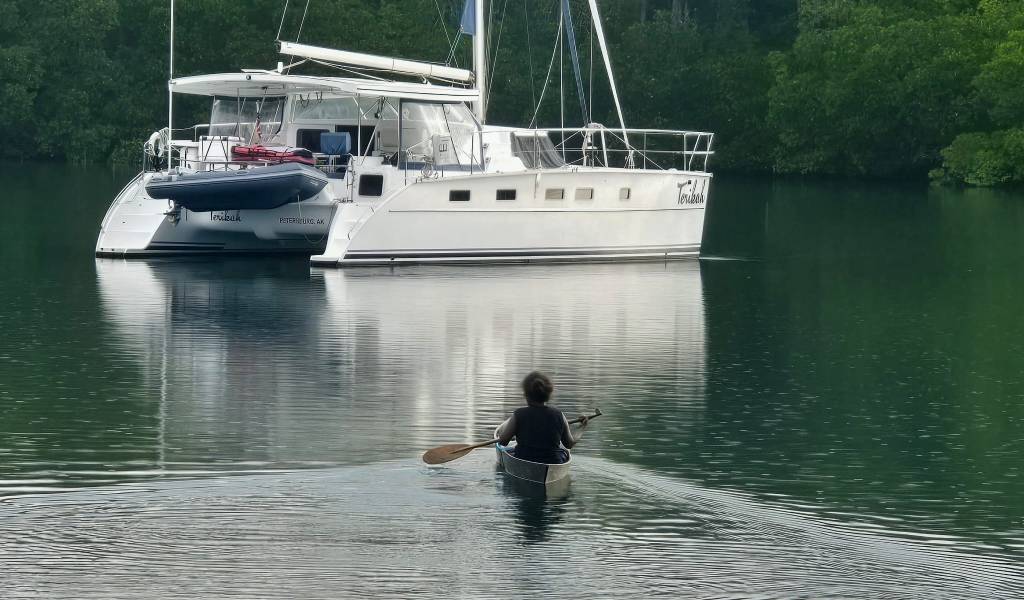
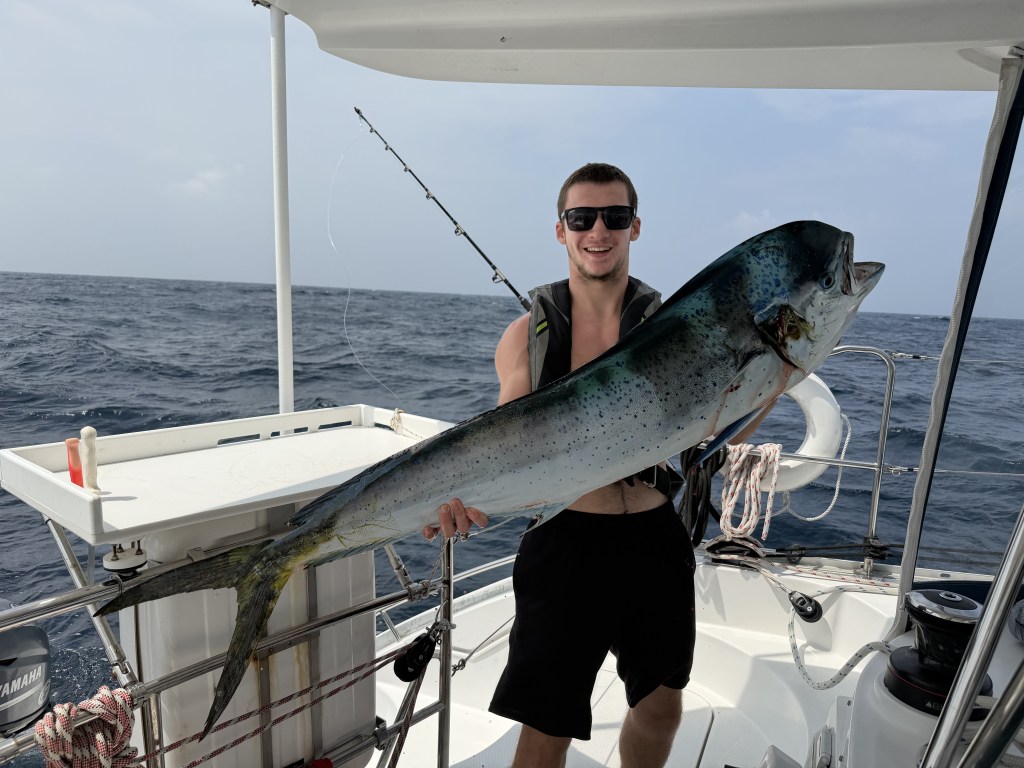
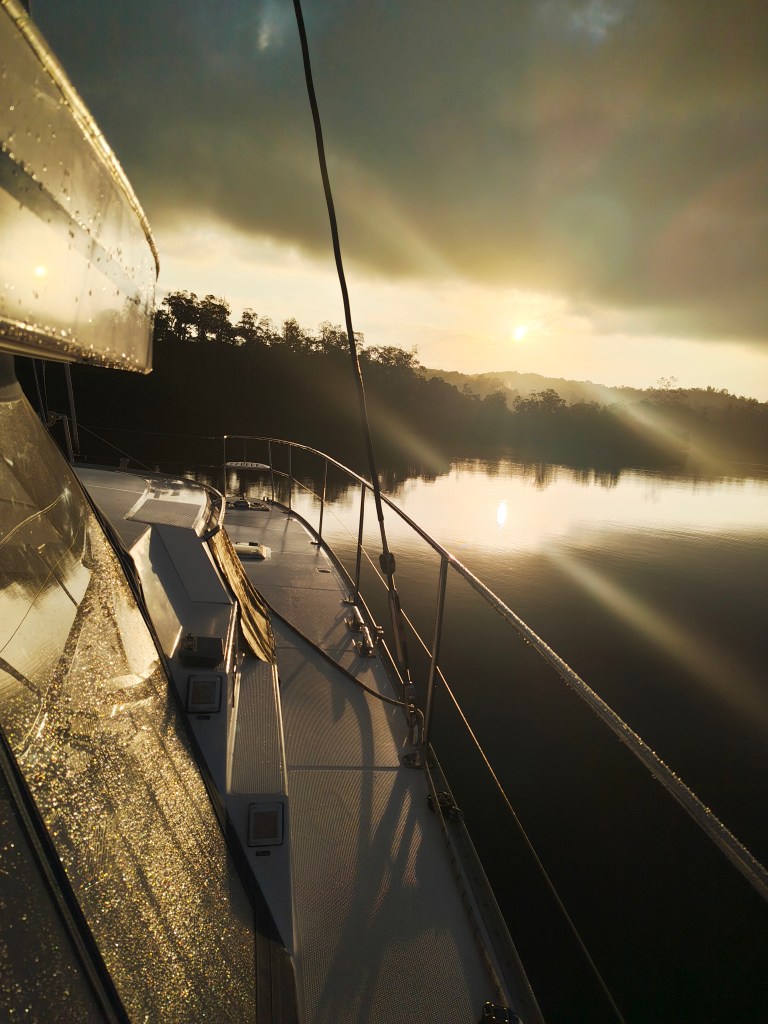
Overnight we had an excellent 130 miles passage, landing a large mahi just before we arrived to Mbili anchorage in Marovo Lagoon.
Marovo Lagoon, covering about 700 km² and stretching roughly 150 km, is the world’s largest and best-defined double-barrier reef lagoon, famous for its extraordinary marine biodiversity (including saltwater crocs) and the intricate wood carvings of its people.
Our goal was to buy a carving—and, well, we bought many. Soon after we anchored, a local man named Paul John came out to talk with us about land rights in the area and, more importantly for our purposes, organized a small local carving show that evening and a larger regional carving show the following morning. The idea was a good one: rather than having individual carvers paddle out in their canoes all day, from boat to boat, the carvers could gather in one place and cruisers could come to them—a much more organized and manageable arrangement for everyone.
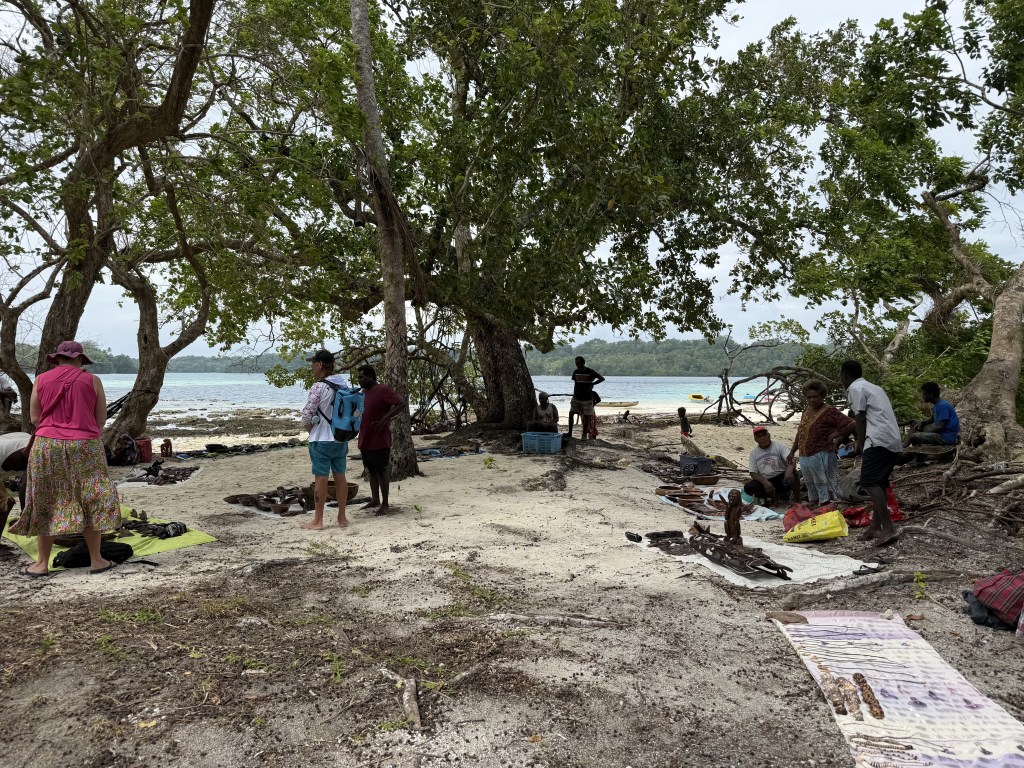
The carvers’ process was simple: they spread their carvings out along the beach, and if you were interested in one, you’d briefly discuss a starting price. Then the real negotiation could begin once the carver came out to your boat, often involving a combination of cash and barter. A carving might be priced at $100 USD (yes, USD—and these are genuinely stunning, high-quality works of art), but the price might drop to $70 if you could add a few things from your boat. And they were specific about what they needed: old phones, snorkel masks, flippers, and all sorts of other items that are difficult or expensive to obtain locally. They actually preferred this arrangement, which allowed them to earn some cash while also acquiring things they simply couldn’t easily buy. Once we got to shore, we were immediately overwhelmed—not just by the quantity of carvings, but by their quality. How on earth were we supposed to choose? For many of these carvers, this is their only source of income; several had gone away to school, only to return to their home villages when they couldn’t find other work, and now make their living carving.
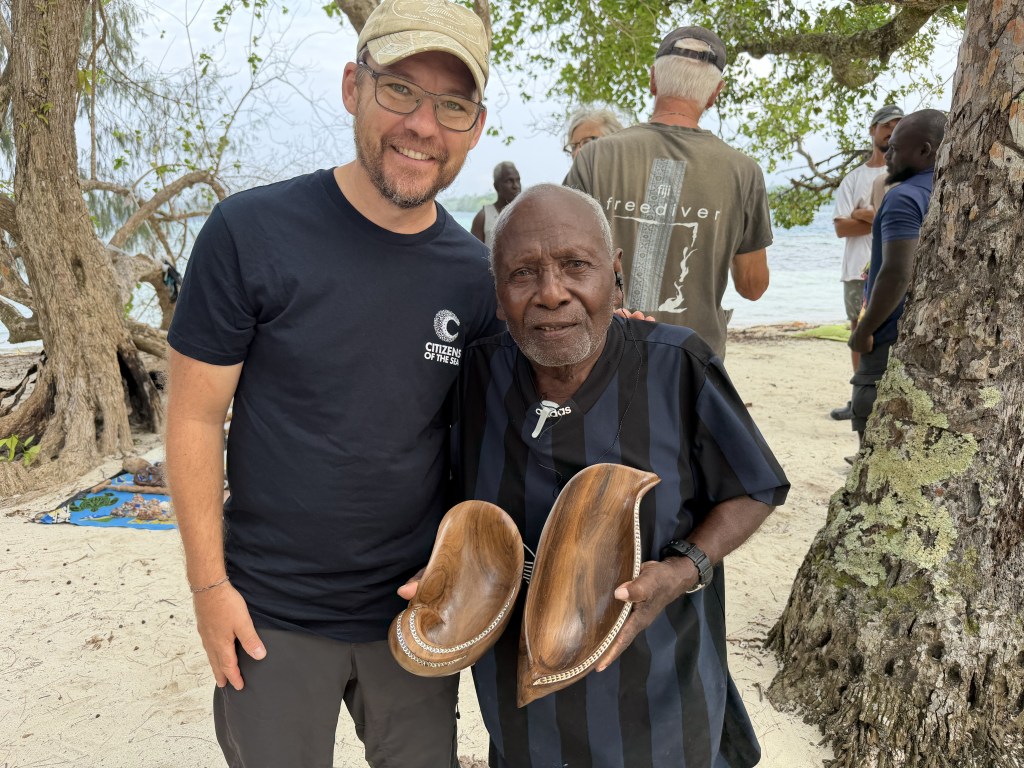
Chris especially enjoyed talking with Chief Luten, and we eventually chose three beautiful shell-shaped bowls with delicate nautilus-shell inlay to bring home to friends.
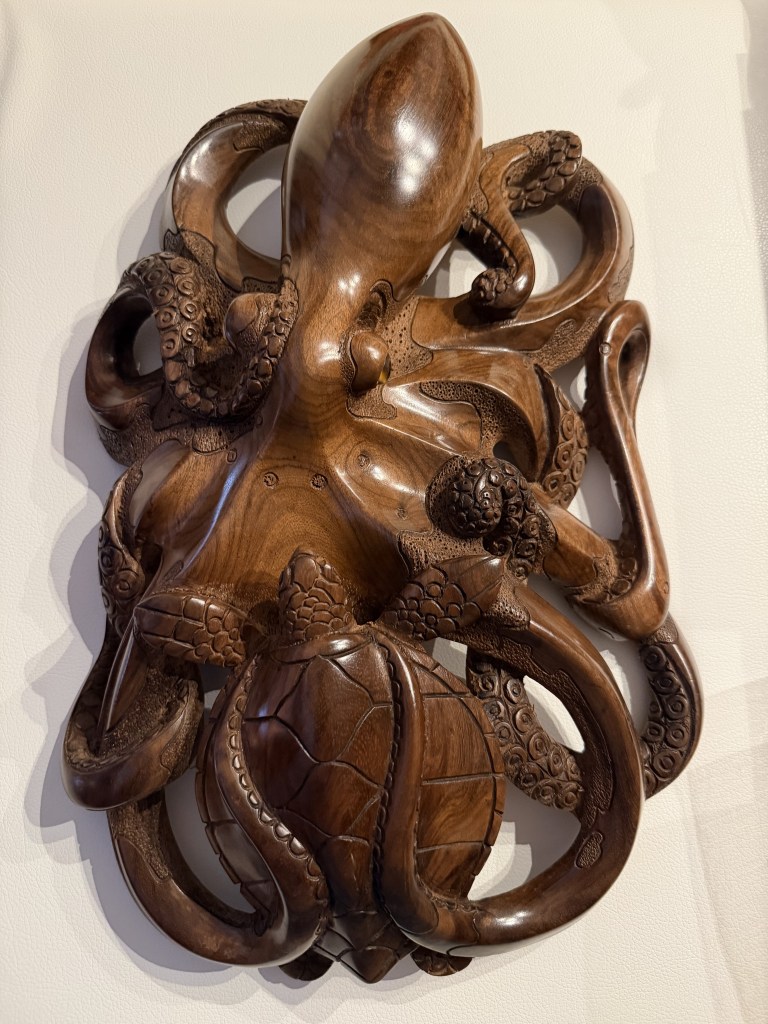
We bought a hermit crab for Cora (the carver generously threw in a tiny sailfish as well) and a beautiful tuna with nautilus inlay for Calder. But the piece that stole our hearts—and will eventually grace a wall in Alaska—is an intricate octopus and turtle, carved with an astonishing amount of detail.
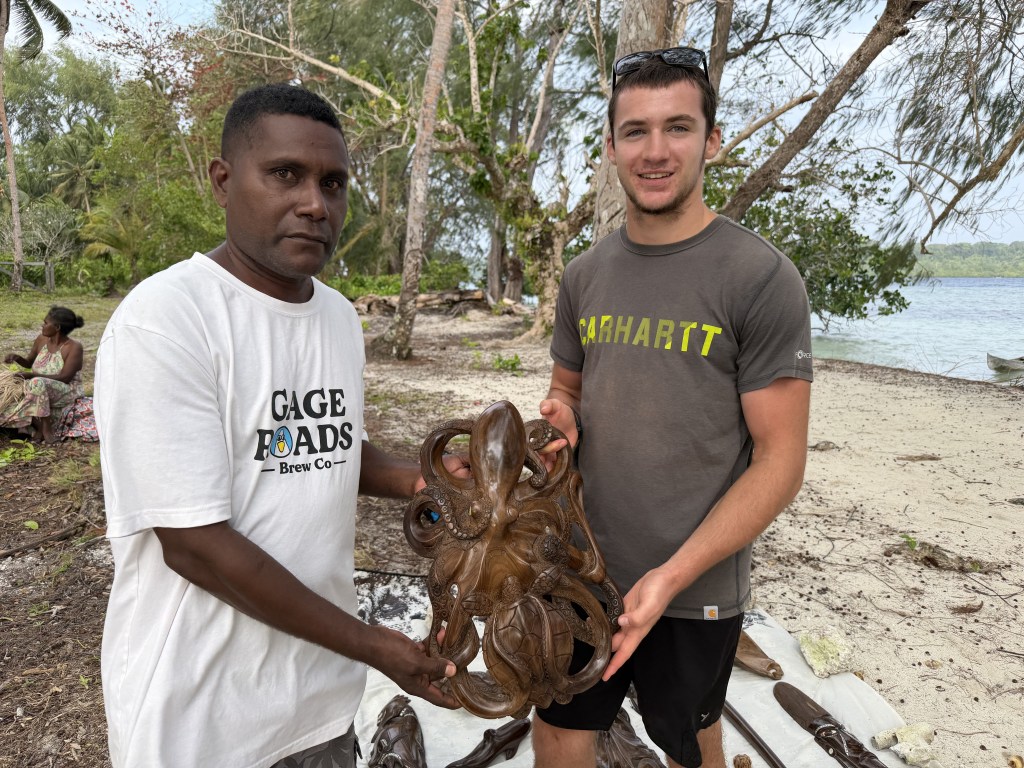
The buying process itself could be surprisingly exhausting. You would first sit down together and try to agree on a fair price, then negotiate that price down by adding things from our boat. Over the course of our various transactions, we traded everything from flashlights, batteries and sunglasses to flippers, clothes, children’s books and school supplies; sweet biscuits, sandpaper, files, chisels, towels, reading glasses, fishing hooks and line, lures and filet knives all found new homes as well. Our catamaran platform turned out to be particularly well suited to this kind of exchange—we could invite the carvers aboard, sit down, talk, look at their work, and get to know one another rather than conducting the entire transaction from opposite sides of a boat. One carver who came aboard seemed quite stern and serious throughout our visit, but as he shook our hands to leave, he looked at us and said, “You are nice, letting me on your boat. Many boats do not do this.” It was a simple comment, but it stayed with us.
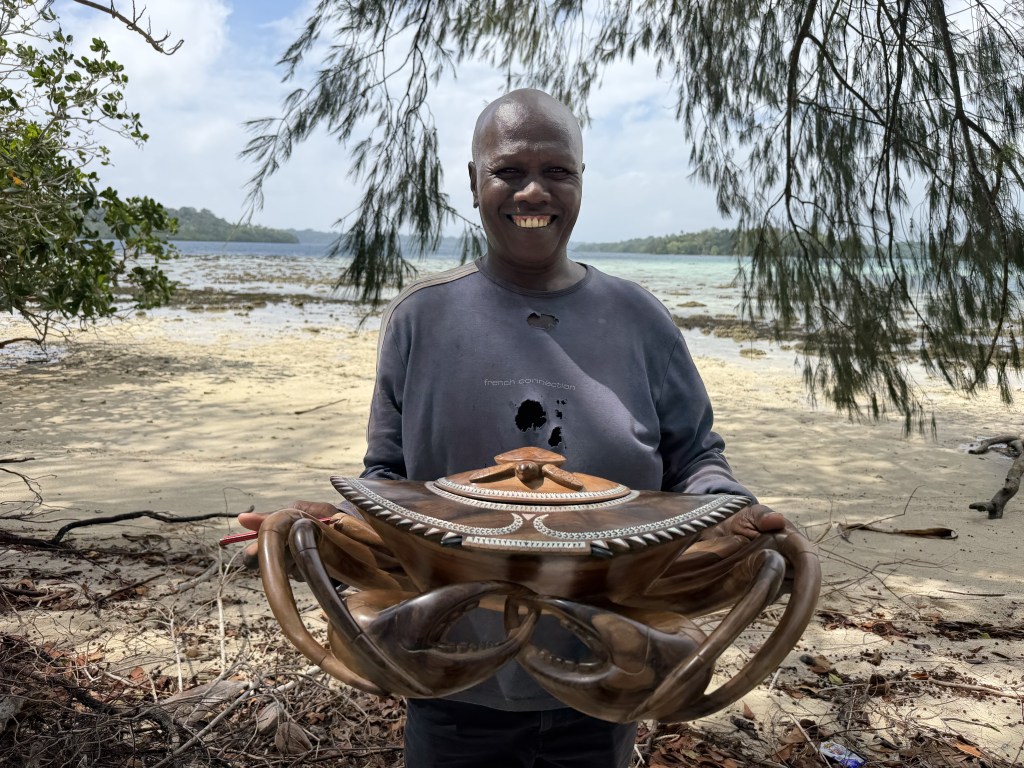
The next morning, there were even more carvings on display—and they were stunning. Many of the carvers arrived in clean shirts and carried themselves with a quiet, professional edge, and we noticed something else: their teeth were remarkably nice, a contrast to what we had seen elsewhere in the Solomons. We learned that the strong Seventh-day Adventist presence in the area discourages betel nut chewing, which may help explain the difference.
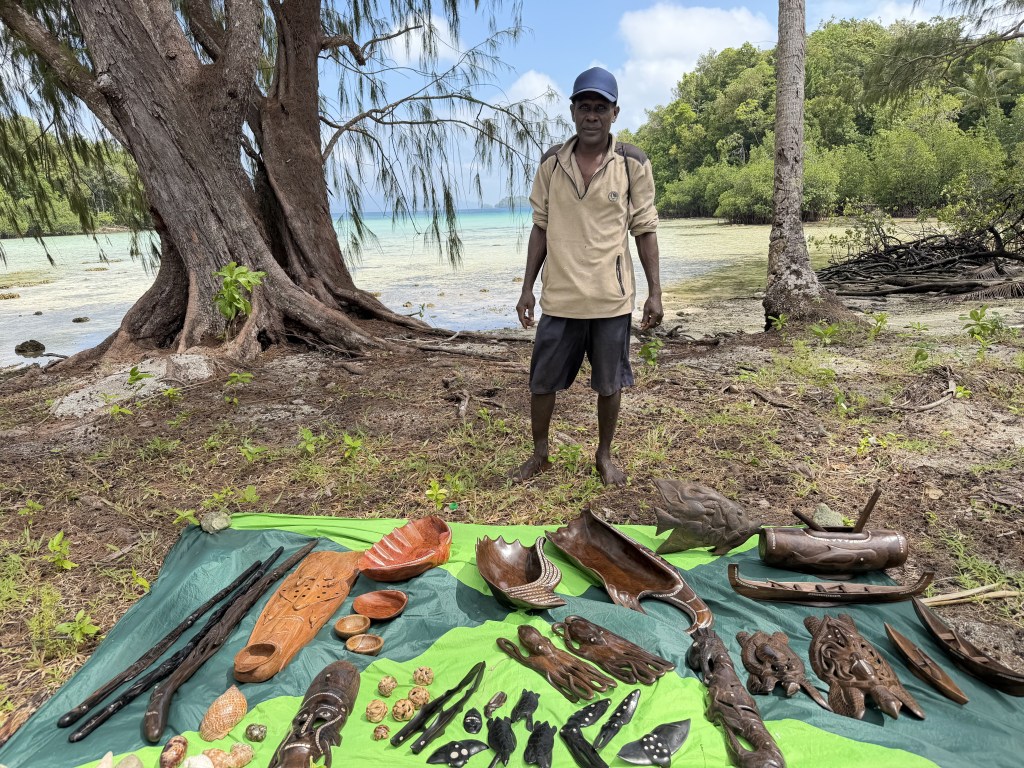
It was hard not to marvel at the contrast: holding a carving that could easily have belonged in an art gallery, knowing that it had been created by hand in a humble home somewhere in the jungle of the Solomon Islands.
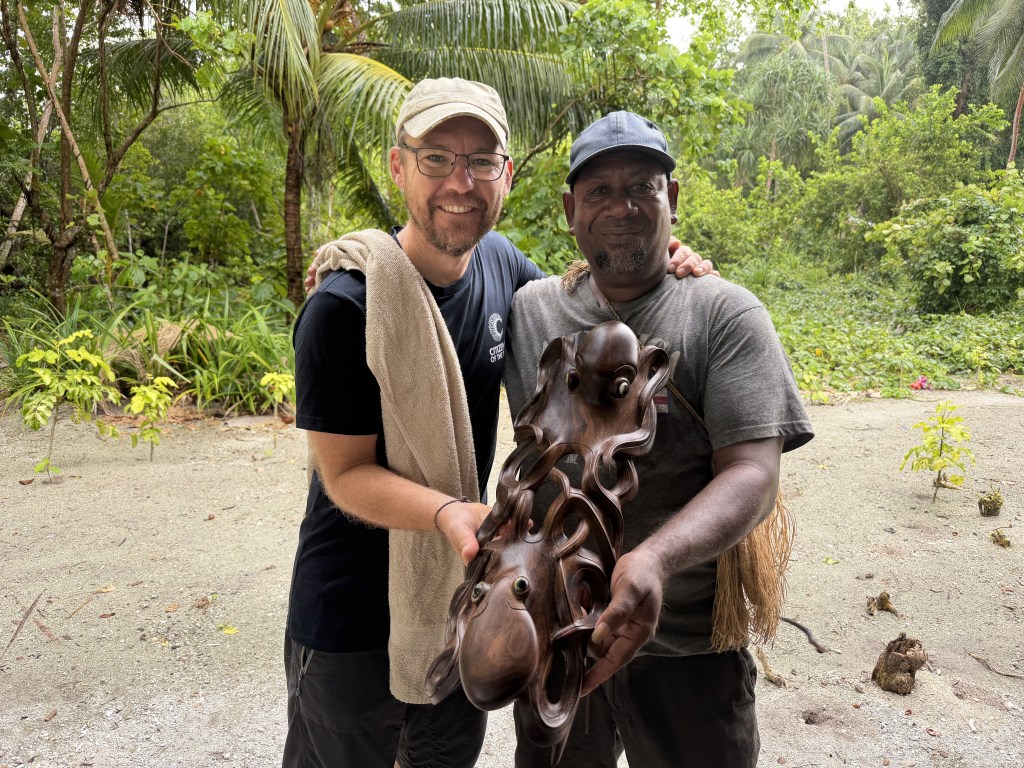
But even with all of this, it never quite felt like we could give enough. “What else do you have to trade? Just bring it out here,” they would say, and when we piled up a collection of things and asked which they needed, the answer was often, “Well, I need it all,” as the price of the carving continued to drop. There was a visible disappointment when we couldn’t offer more, and it was hard not to feel the weight of knowing that for many of them, this was their only real source of income. There were no spontaneous gifts of fruit, no one calling us “brother,” no extra invitations simply because we were visitors. They were respectful and kind, but the warmth felt different. In the Florida Islands, we had felt as though people were opening their arms and inviting us into their culture simply because they wanted to share it; here, we sometimes felt more like the yachties had arrived and the question was, What can the yachties give us? It wasn’t unfriendly—just a different kind of welcome, shaped, perhaps, by the very real economics of trying to make a living from the boats that pass through.
Our final purchase required one last dash back to the boat. Calder and I laughed all the way there in the dinghy as a rain squall soaked and pelted us, then we grabbed his small flippers and headed back to the beach. The flippers were exchanged for a beautiful dugong carving, and the carver’s son tucked one more little treasure into our bag—a tiny carving made from a carved nut. These intricate little figures are known as ivory-nut carvings, although there is no animal ivory involved; the “ivory” is actually the incredibly hard, white seed of the ivory-nut palm.
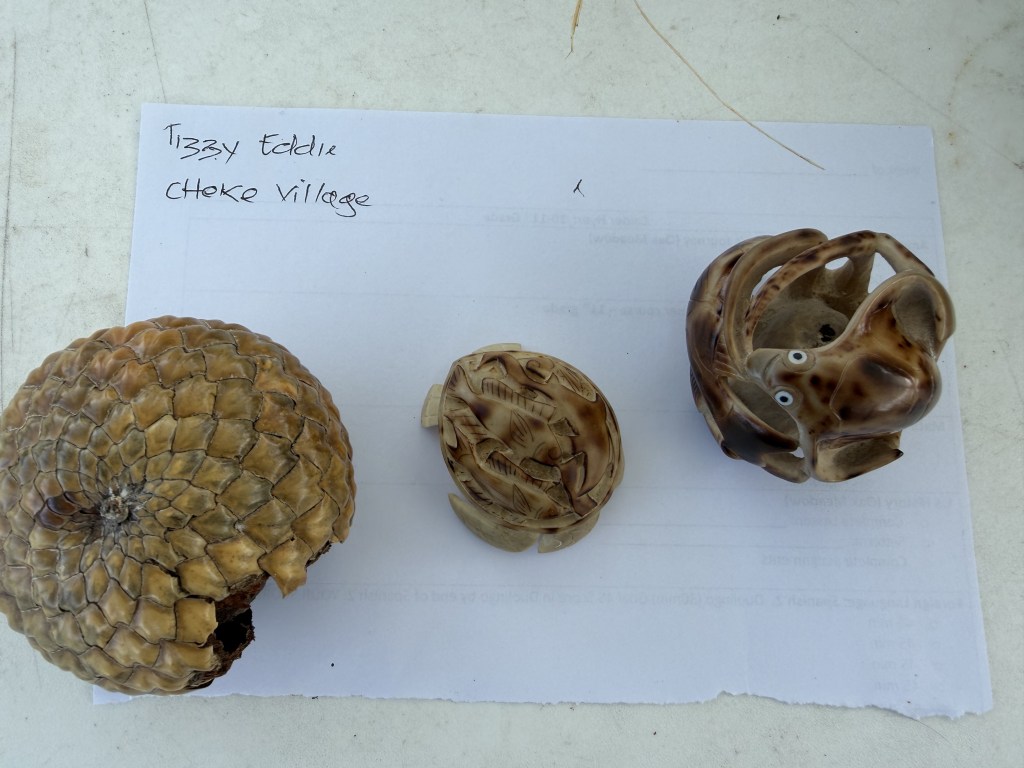
And then, quite literally, we were out of everything: all the cash was gone, the table aboard Terikah was completely covered in carvings, and the crew was utterly exhausted. We had come ashore intending to buy a carving or two. Somehow, we had acquired a small art gallery.
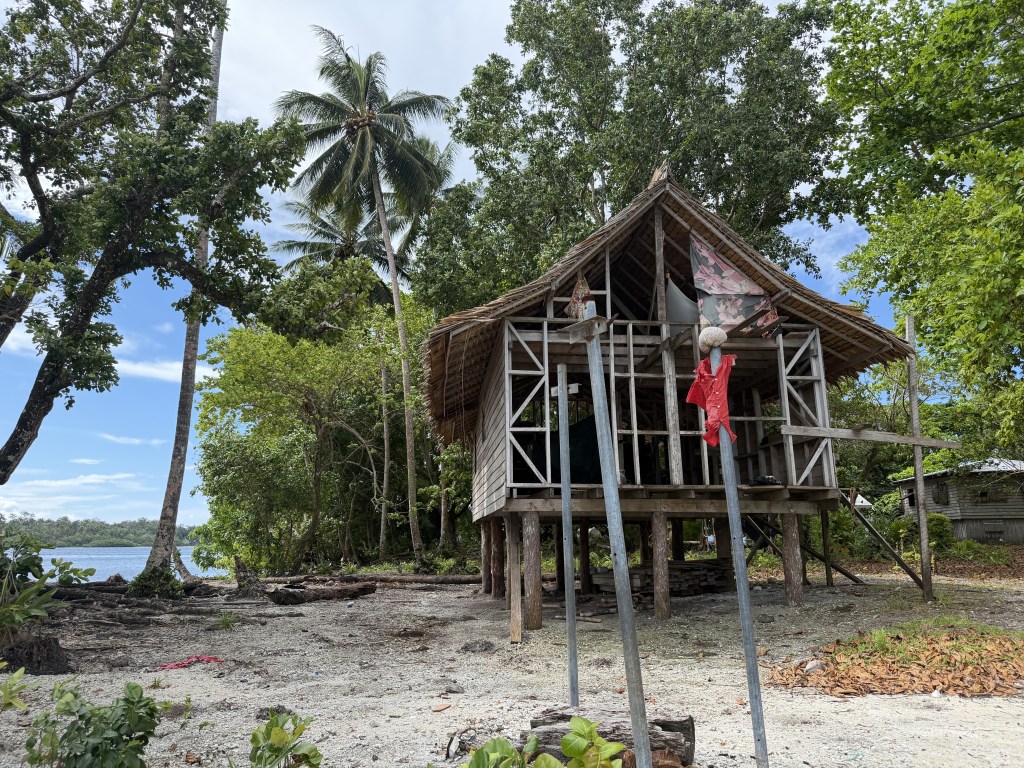
Over to Chief Luton’s island, where he greeted us warmly. We met his son, the “real Crocodile Dundee,” as he showed us the scars on his arm and scalp from a saltwater crocodile attack. He saved himself by sticking his finger deep under the croc’s jaw.
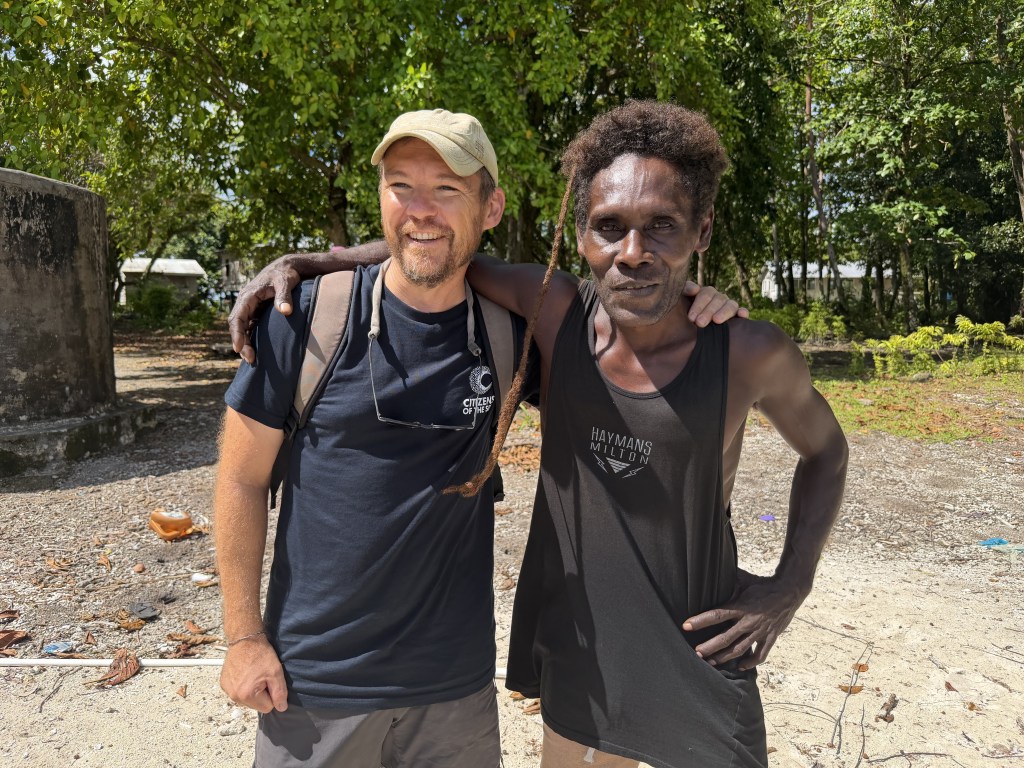
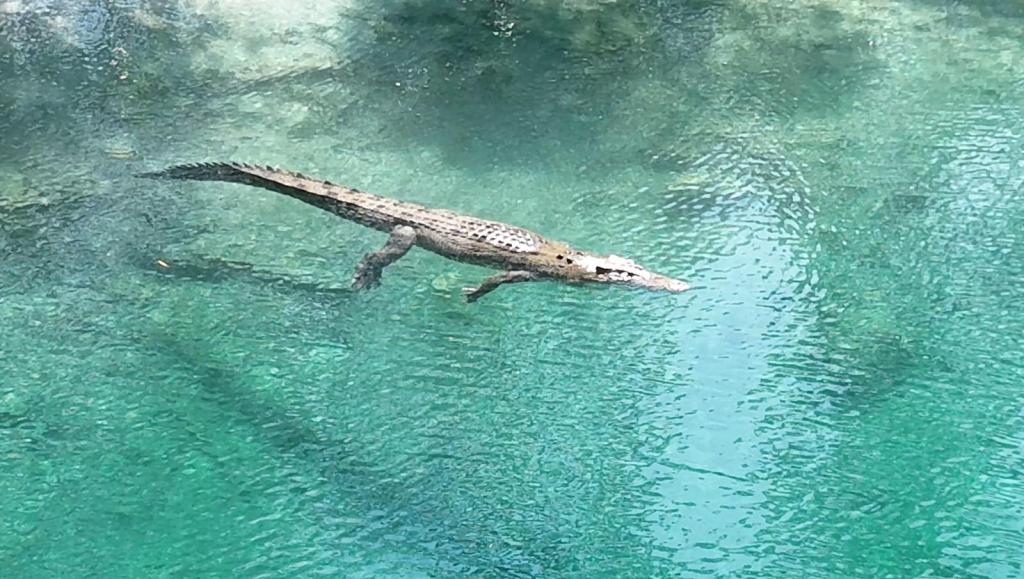
This is the first place in the Solomons that they admitted they had saltwater crocs, advising us to swim in groups or have someone keep watch; no thank you! Our crew is very hesitant to get in the water where saltwater crocs live.
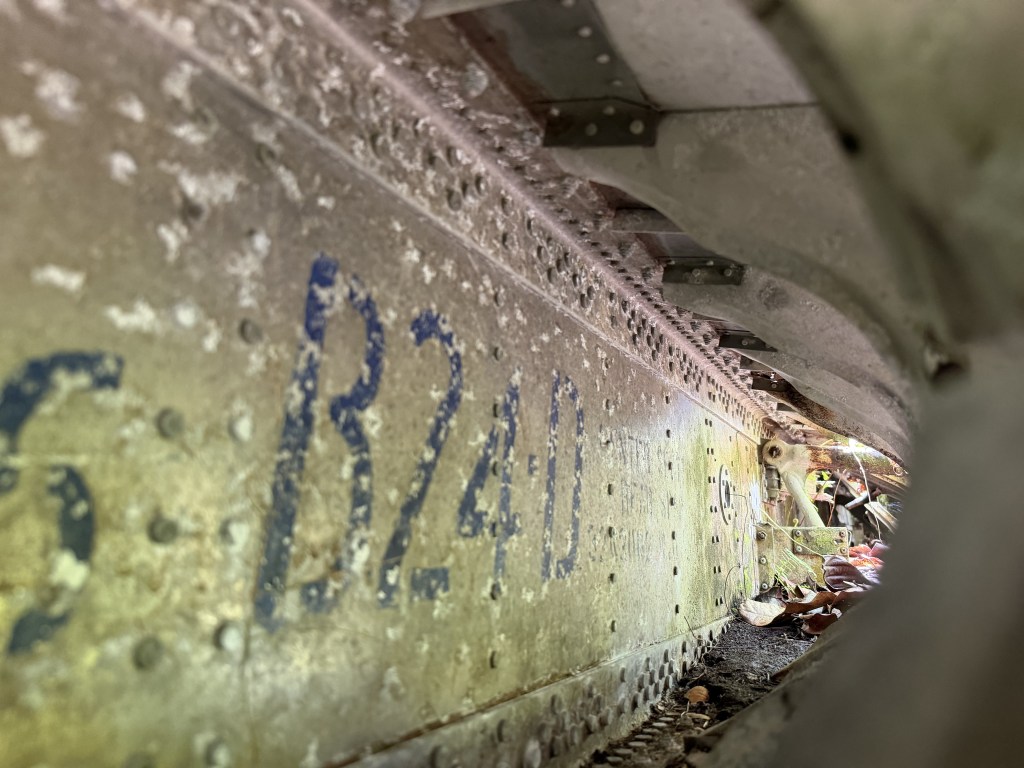
Chief Luton climbed aboard our dinghy to take us to a WW2 plane in the jungle. The wreck is “Bundles for Japan,” a US Army Air Force B-24D Liberator lost in 1943. Returning from a nighttime bombing mission against Japanese airfields further north in the Solomons, the crew became lost in bad weather and eventually ran critically short of fuel over New Georgia.
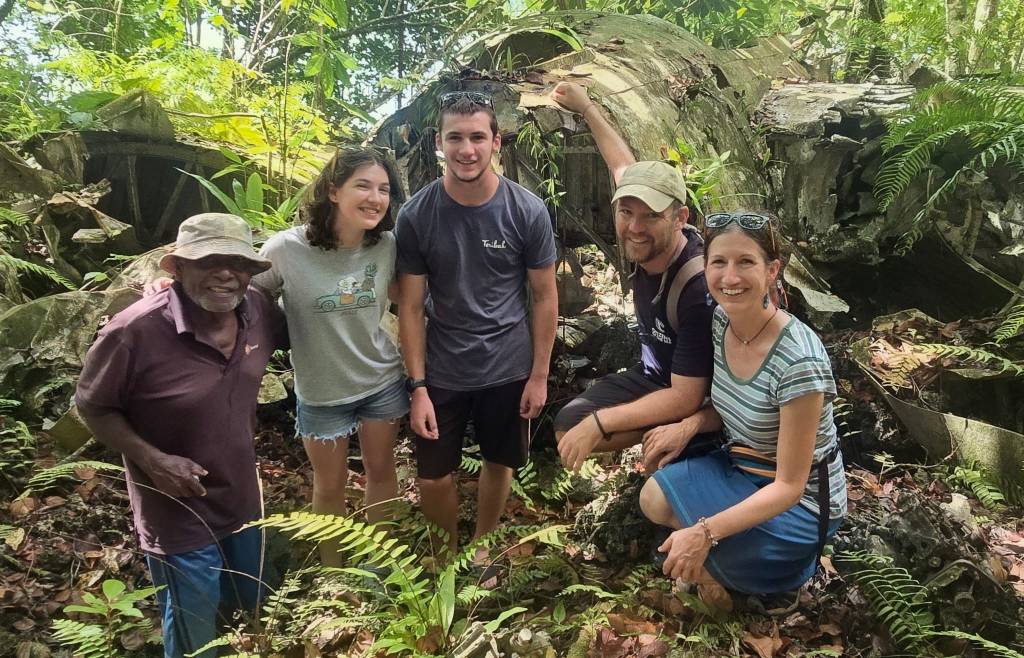
They set the bomber on autopilot and bailed out, with 8 of the 9 men surviving. The empty B-24 continued circling until its engines ran dry and it crashed here on the shore of Nggatokae Island at the edge of Marovo Lagoon. More than 80 years later, much of the aircraft still lies where it came to rest, the jungle slowly taking it back. Chief Luton tells of the massive explosive sound his parents heard and how they took in some of the survivors in their village until they were rescued. This WW2 history is all around us, from villagers showing us WW2 dogtags that they have found to hearing about unsafe anchorages due to undetonated artillery.
We had a cruiser gathering on our boat that evening, all of us understanding the importance of sticking together—or at least making sure no boat is sitting alone and isolated in an anchorage. Of the 15 cruising boats here, three have been boarded at night, which is not a ratio that inspires much confidence. At night, we close up the boat with only the side windows cracked open, leaving us hot and sticky with almost no airflow. The fan above our heads stays off so the boat is quiet enough to hear if a canoe bumps against the hull or someone comes aboard, and we keep VHF 16 on overnight along with the other boats in the anchorage. I am not a fan of this heightened level of awareness—listening for sounds that, under normal circumstances, I would sleep straight through—and I’m very glad this vigilance is something we only need to do for two months, here and in PNG.
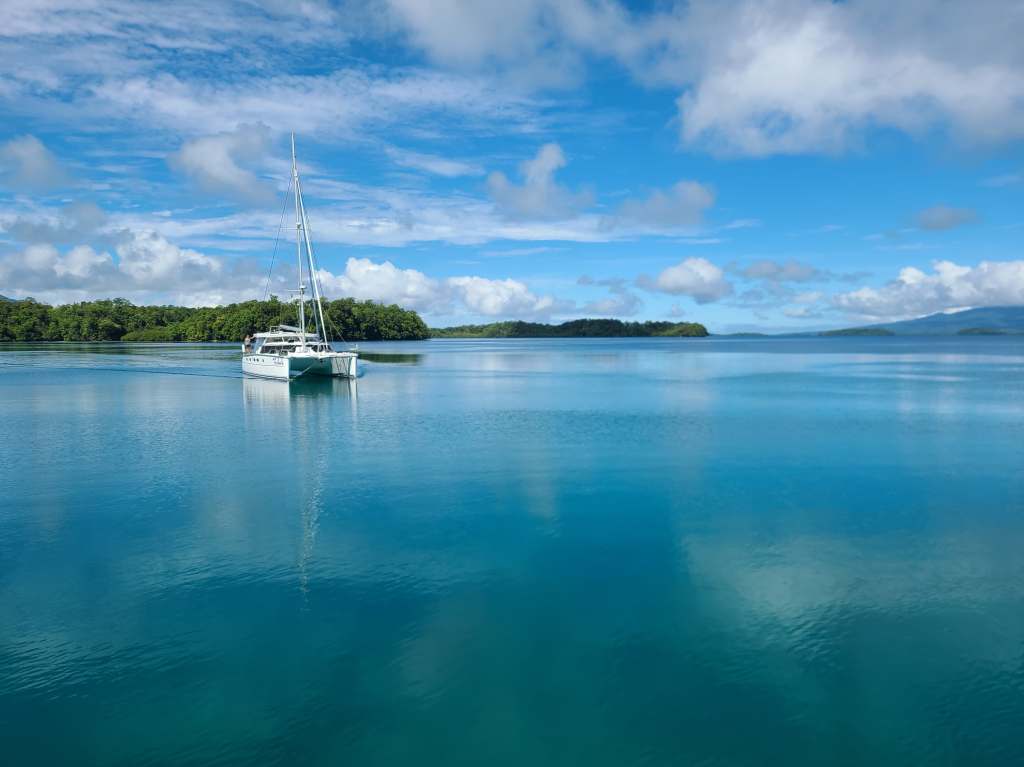
We moved to different anchorage in Marovo Lagoon, Lumalihe, where we anchored in turquoise waters.
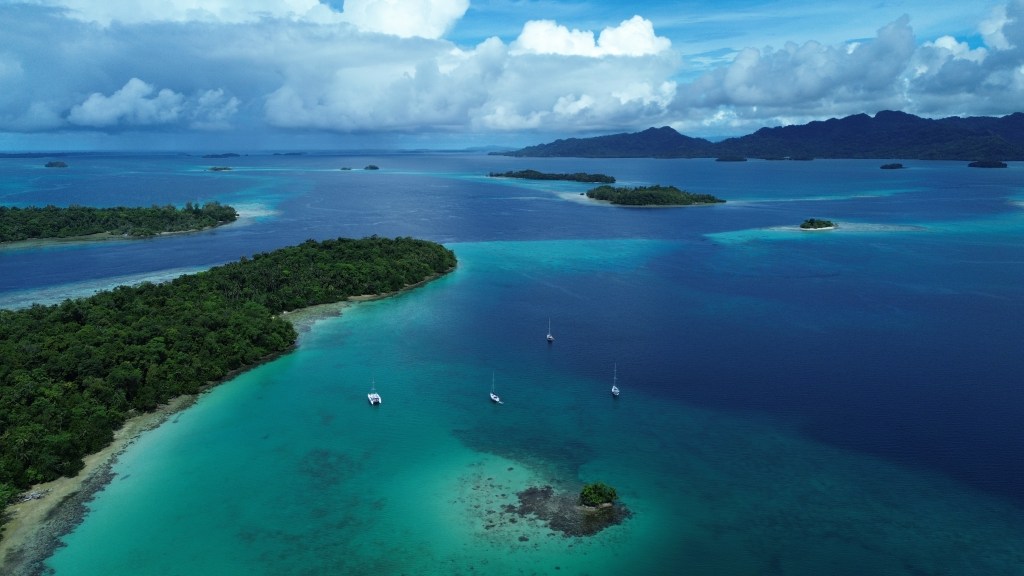
There was no village here, and after the intensity of the previous few days, we were craving a little space. At night it was beautifully quiet, with only the distant glow of underwater fishing lights from local fishermen punctuating the darkness. By morning, however, a steady stream of canoes began arriving from the surrounding villages. We warned everyone that we had zero cash left, but we were happy to photograph their work and post it on No Foreign Land, the sailing app that cruisers build together along the way with reviews, information, and recommendations. And so the day began: we took pictures, we traded, and we gifted.
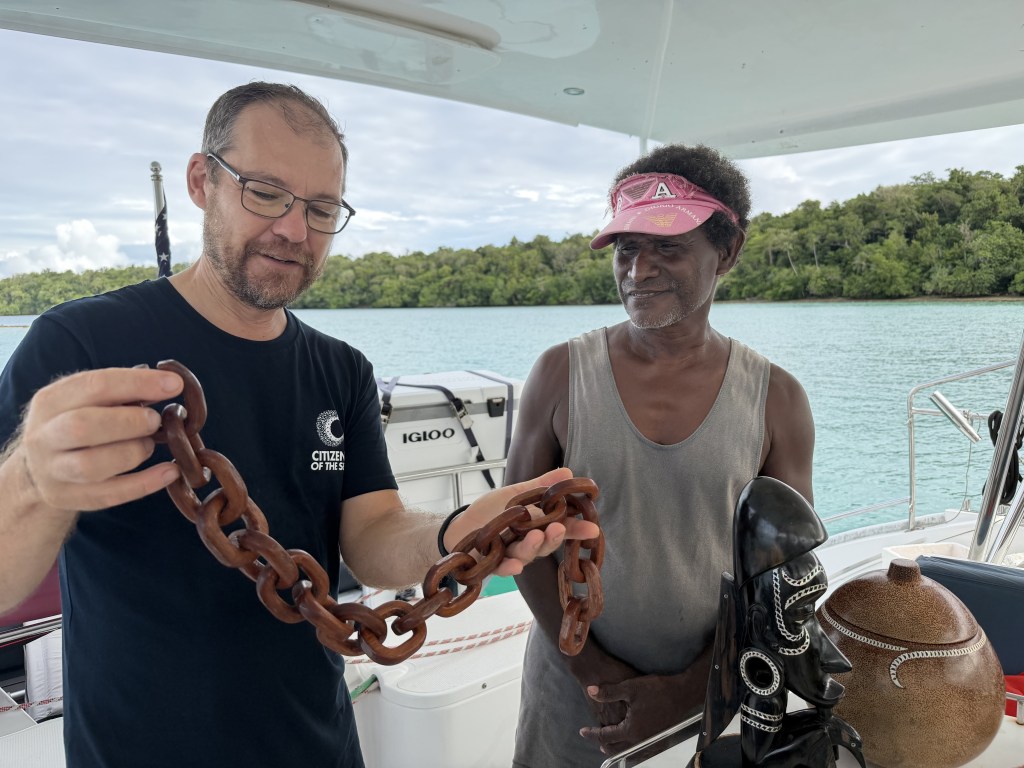
At one point, an older man in a canoe became so desperate, showing us his fairly mediocre carvings and asking if we had a towel. I just lost it. The sheer amount of need, compressed into that little canoe in front of me, was suddenly too much; I had myself a good cry, took a breath, and then jumped back into the fray. There was also a lovely full-circle moment when we were able to give hose fittings to a man whose hose had actually been given to him by cruisers we know a year earlier. And Chris was given a somewhat crudely made necklace with a chunk of shell—a small, imperfect memento from the many hours he had patiently spent sitting on our back swimstep, visiting and talking, and getting sunburned.
The next morning we made our way 46 miles to Mbaeni Harbour, a quiet still anchorage tucked deep into the mangroves.
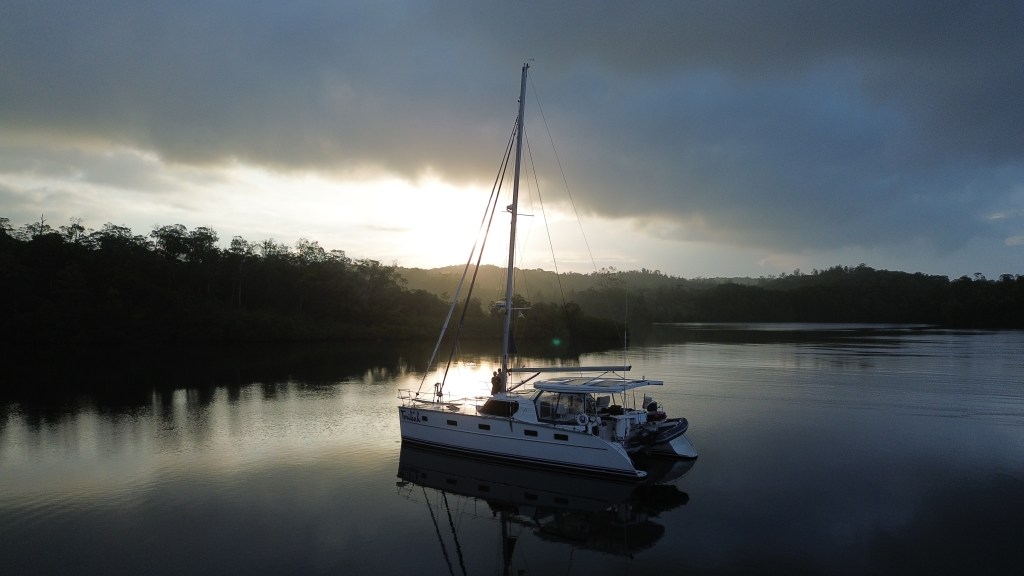
As we entered the bay, the people of the small village of Kolumbaghea (only about 40 people) started running along and climbing trees to get coconuts. Then the stream of canoes came; we barely anchored and Kevin pulled up with children, very kind and we traded for crayfish that he would bring in the early morning before we left. We had two more canoes of rowdy fun guys who declared, “Merry Christmas! Happy New Year!” as we shared cookies.
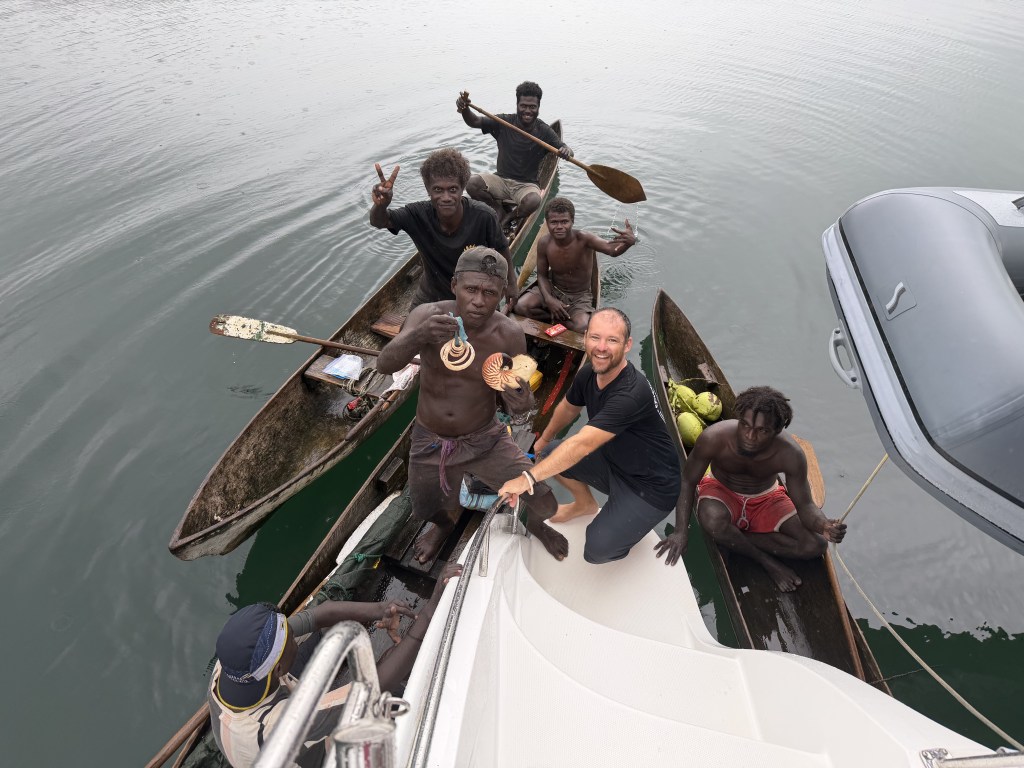
Yes, there admitted there are crocs here, but we’re fine to swim, as they are the kind that don’t eat people. Hmmmm. Women and their children came out, more subdued in their requests for trade, asking for rice or clothing for their kids. One elderly female traded fruit and shells with us, excited to get batteries for her light and new reading glasses, hoping to read that evening. Our table was covered in fruits and shells.
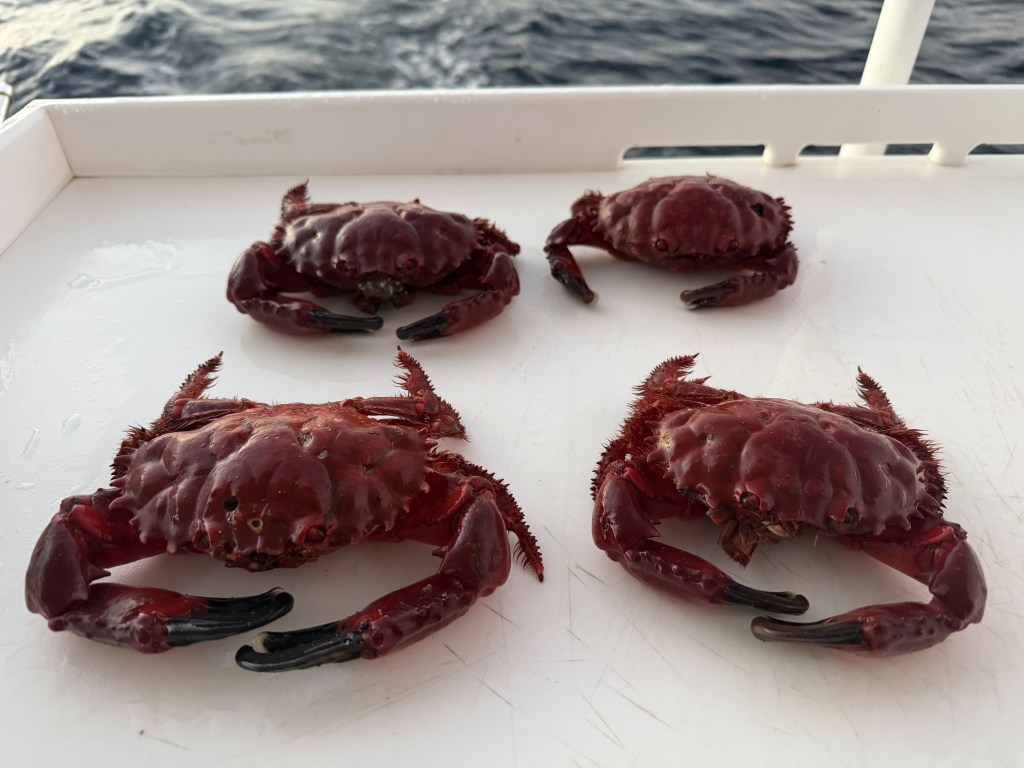
The people themselves of the Solomon Islands have remarkable diversity in skin and hair color: the dark skin reflects the deep ancestry of the first people who reached the region more than 40,000 years ago, while later migrations brought additional genetic diversity; remarkably, the distinctive blond hair seen in some Solomon Islanders arose from a unique local genetic mutation rather than European ancestry. We had our anchor up at 5:30 a.m., and there, paddling up alongside us in a canoe, was Kevin. He hadn’t been able to find any crayfish, but he had found us some reef crab instead—which we promptly cleaned, cooked, and tucked away for dinner that evening.
On our way to Noro to check-out of the country and re-supply as best we could.
This is the center of the Chinese fishing fleet in the Solomons, with SolTuna’s cannery in Noro. It is the Solomon Islands’ only tuna-processing facility, turning locally caught tuna into canned and frozen products and employing more than 1,800 people, making it one of the country’s most important employers and a major part of Noro’s economy. The sustainably harvested tuna is generally caught from free-swimming schools rather than around fish-aggregating devices (FADs), using methods and management practices designed to reduce bycatch and protect tuna stocks, whereas conventional commercial tuna is caught with large purse-seine nets around FADs, which has greater bycatch. When we turned the corner toward Noro, we were greeted by the largest purse-seine vessel we had ever seen, dwarfing even the fishing boats we know from Petersburg. Calder stared at it and said, “That boat is such a cool boat… in such a sick way.”
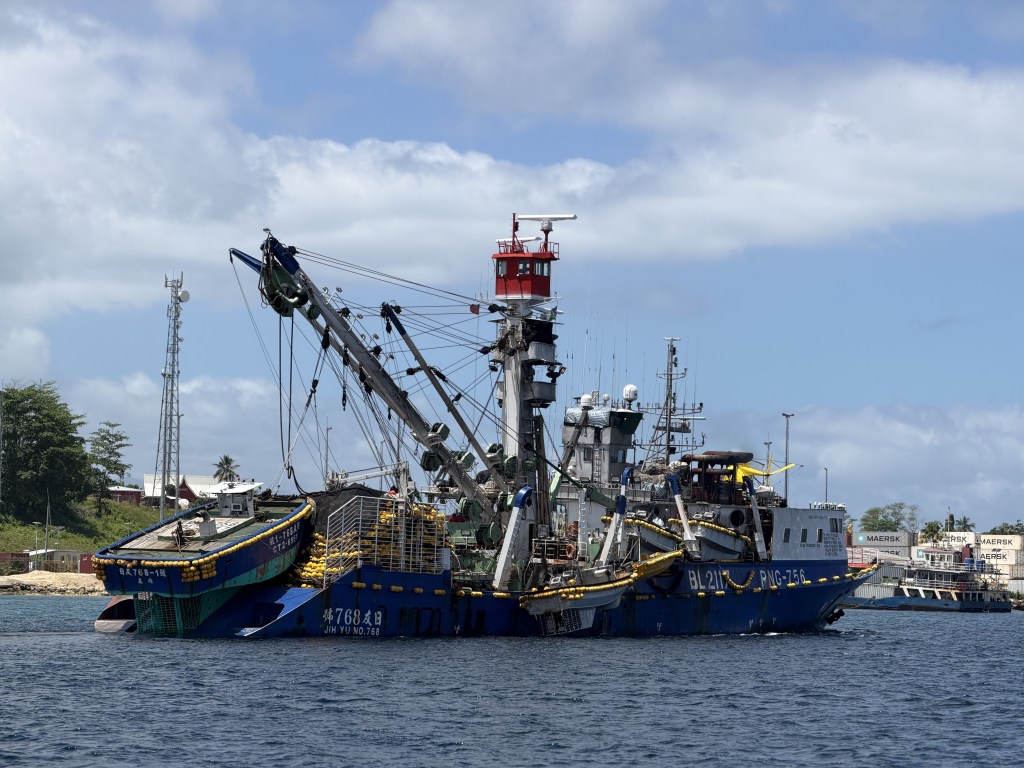
It was an impressive piece of machinery, but there was something deeply nauseating about seeing that scale of industrial fishing here—the sheer power of it set against the small villages and communities whose lives depend on these waters. It was hard not to think about the complicated economics of the Pacific, where an ocean can be extraordinarily rich while many of the people living along its shores remain extraordinarily poor. We had signed up for a mooring at Fred’s “marina,” but he met us in his panga and instead showed us where to anchor. It took two tries to find a decent hold in the mix of sand, mud, and broken dead coral, and in the end, we’re held mostly in place by the sheer weight of our anchor and chain.
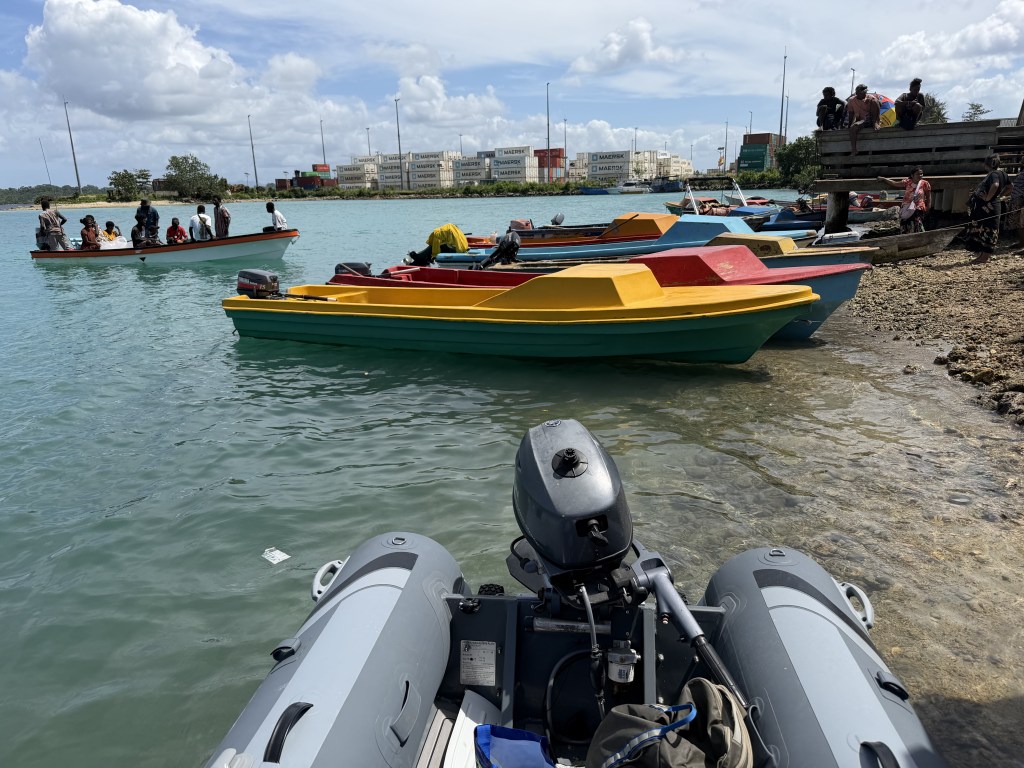
Then it was off by dinghy to the wharf at Noro, where we tied up among the brightly colored pangas.
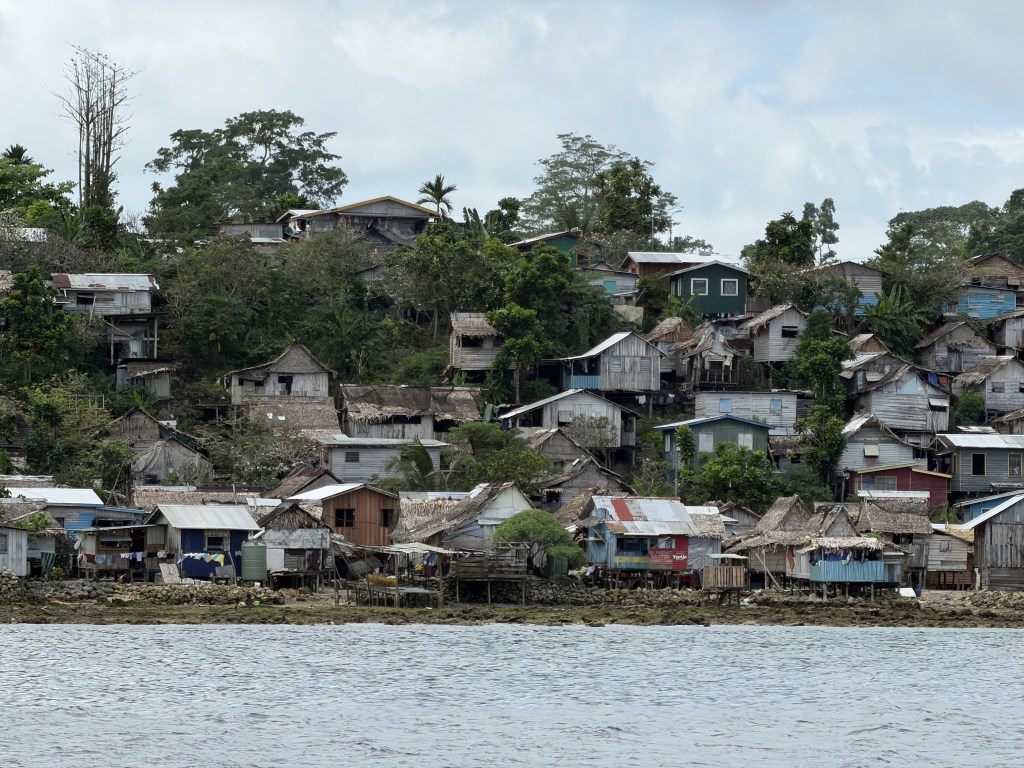
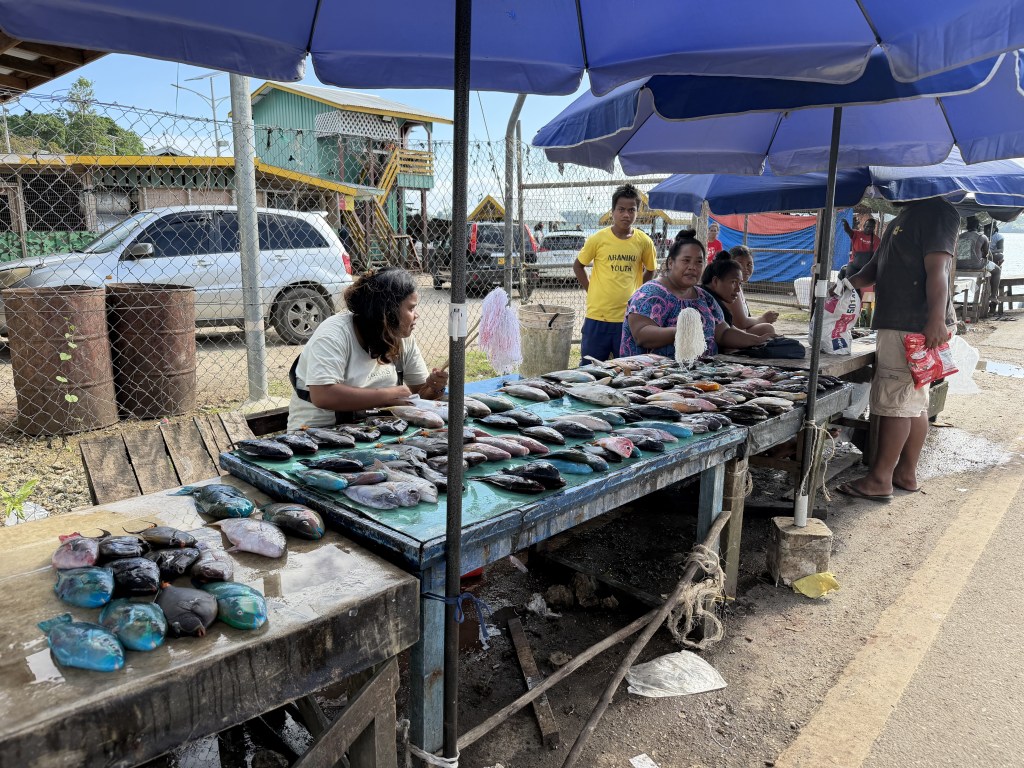
The streets were splashed with red betel-nut spit and litter, and women sat waving fans to keep the flies off piles of brilliantly colored dead reef fish they were selling.
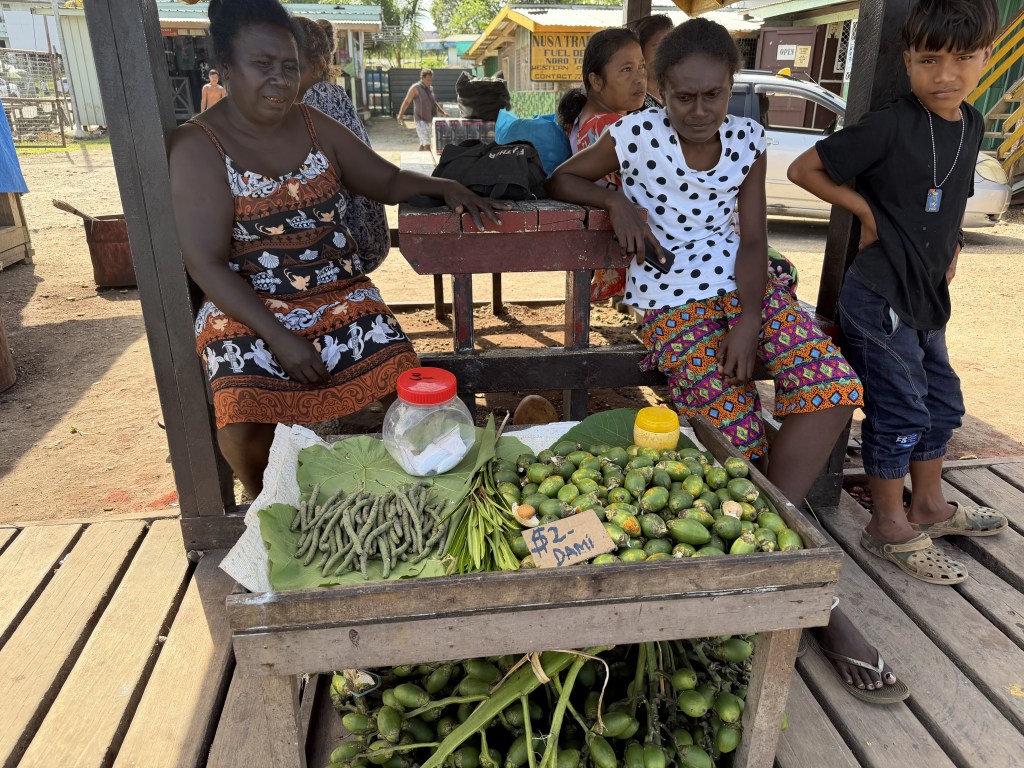
Betel-nut and lime vendors seemed to be everywhere, with people milling around and stopping to chew, spit, and chat.
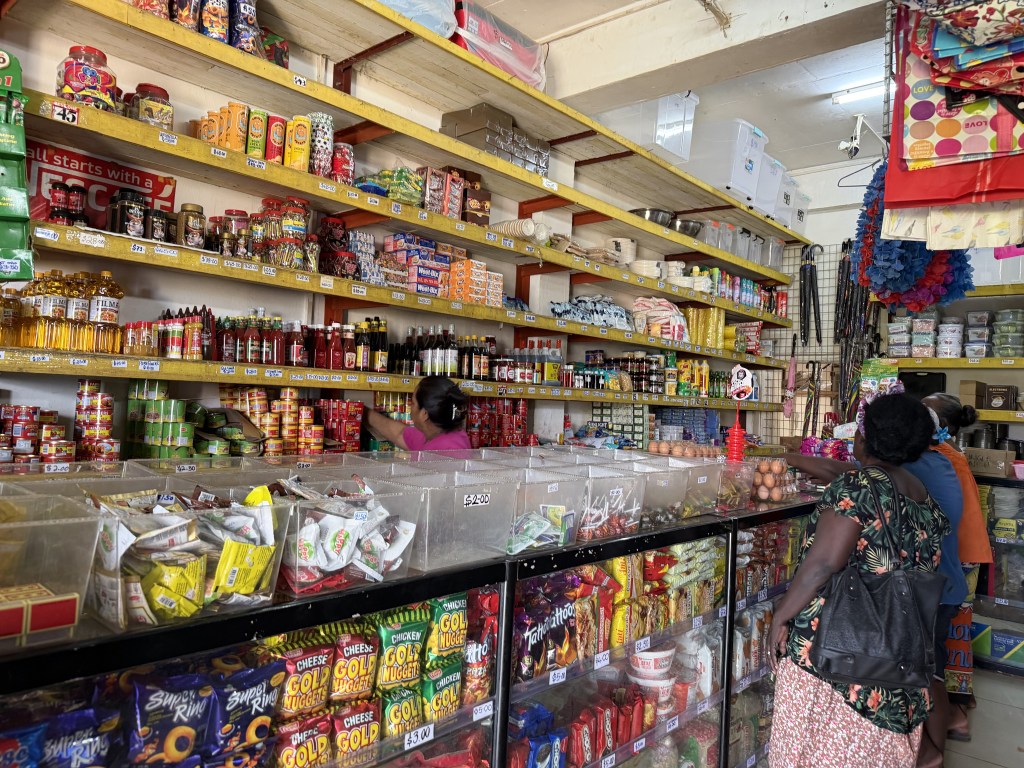
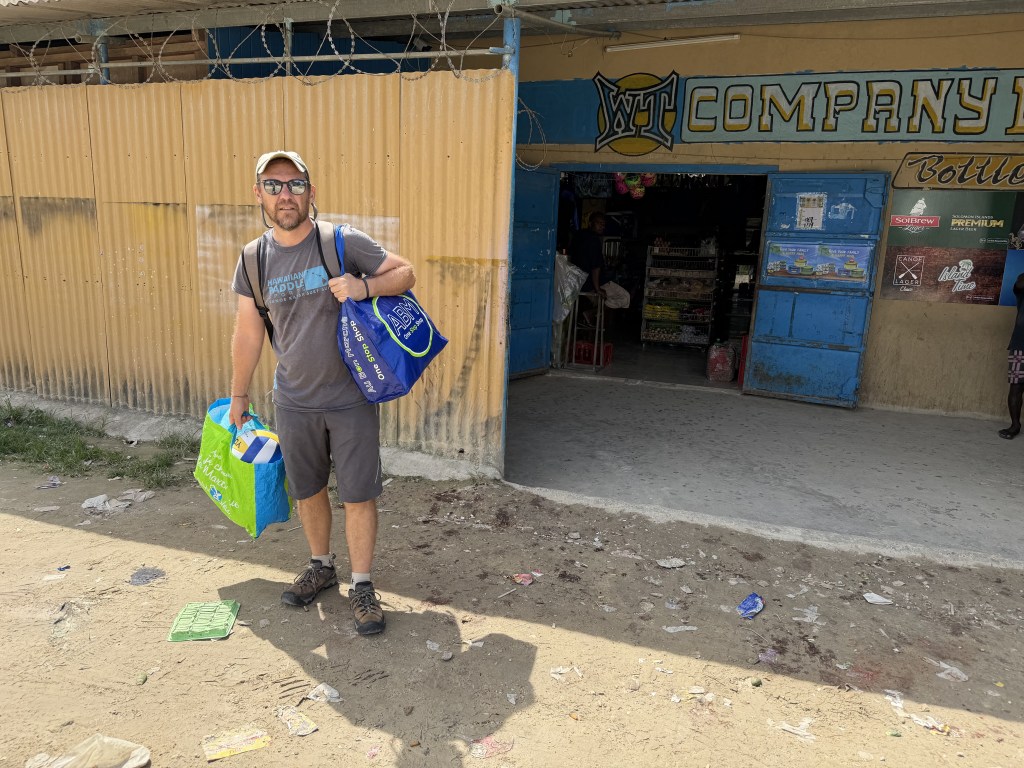
The stores, many Chinese-owned, were somewhat chaotic, with random goods tucked behind counters that you had to ask for rather than browse.
One of our favorite finds was a wonderful open-air secondhand clothing market, where we loaded up on freshly washed clothes to bring with us to the villages of Papua New Guinea—especially children’s clothing. At other stores, we stocked up on gifts and trade goods for the villages ahead: balls, snorkel masks, towels, flashlights, and whatever else we could imagine might be useful.
That evening brought the scariest experience we’ve had in three years of cruising. We had just sat down to dinner, and I put out the cooked crab we’d been given that morning; Calder immediately dug in, devouring an entire leg and some of the body meat. Then he paused and asked the question that suddenly changed the entire evening: Could these crabs carry ciguatoxin? We looked it up, using a photo of the exact crab we were eating. The first thing that popped up was: “Stop eating immediately and head to the nearest emergency health care facility.” Wonderful. Further searching only made things worse. This was a red reef crab—locally identified as a splendid spooner crab—reported in this region as capable of carrying a potent neurotoxin that can cause severe illness and respiratory depression. We stopped eating immediately and kept searching for anything that might reassure us. Maybe we had identified the crab incorrectly? Nope. Every photo and description seemed to confirm it: this was emphatically not a crab we should have been eating. Chris and I had taken only the tiniest bites, but Calder had eaten quite a bit, so we made him vomit and then watched him closely for any symptoms.
I immediately started messaging everyone I had been in contact with in Noro on WhatsApp, and within minutes we found ourselves surrounded by very good people in a very stressful situation. Fred, the owner of the marina area, told me he had already arranged for someone to take us to Munda Hospital—a 20-minute drive away—if we needed to go, and said he would keep his phone nearby. The diesel dock coordinator then gave me the contact information for Dr. Raymond, the on-call physician at Munda Hospital, who told me he was standing by and to call if we needed him. Everything I could find recommended keeping Calder completely still and giving him nothing by mouth—no food, no water—to keep his digestive system inactive. After an hour, we felt a tiny bit of relief. At three hours, a little more. I set my alarm for every 20 minutes and checked on him through the night until we reached the six-hour mark. When morning finally arrived and Calder was 12 hours out from eating the crab with no symptoms, we could breathe again. We slowly rehydrated him and got some food into him, enormously grateful to see him sitting there acting like himself.
For me, this was far more frightening than our jetboat accident in New Zealand, largely because of the lack of appropriate medical facilities. Munda Hospital did not have the airway equipment that would have been needed if Calder had developed respiratory paralysis—although, between my medical supplies and those aboard a nurse’s boat nearby, we could have pieced together what was necessary—and the nearest hospital with appropriate capabilities was a flight away in Honiara. The feeling of being so far from definitive care, with our child potentially facing a rapidly progressive neurotoxin, was terrifying. We felt helpless and very afraid. But we also felt profoundly grateful. Fred, Dr. Raymond, the dock coordinator, our buddy boats all stepped forward without hesitation, each offering whatever they had to help us. There are good people everywhere. Sometimes you just have to be willing to reach out and ask. We’ve also learned not to eat any unknown food without very good research first, mainly in these remote regions.
The following morning we tried again to get propane (the guy was out sick), but did successfully get diesel, petrol, more tinned food and gifts. In one store, we spotted some other white faces—yup, apparently that’s what we’re called here (and there’s no negative implication)—so naturally I asked where they were from. Hawaii and Alaska! They were part of a team of local islanders, historians, and archaeologists working together aboard a boat to locate and repatriate the remains of the more than 5,000 people still missing from the Solomon Islands from World War II. It was fascinating talking with them, and it also gave us cruisers a valuable contact for the times when local islanders show us WWII dog tags they have found on their beaches and in the jungle. Back to the boat, Customs, Immigration, and Biosecurity all onboard for check-out; they let us stay until the next day for departure, which is a nice bonus.
We had met some carvers from a nearby (45 min panga ride) village and had arranged for them to come back over so we could see their carvings, but more importantly advertise their village on No Foreign Land, the cruiser-created App that most cruisers use when deciding where to go. When they said that they offered hull cleaning services, despite the crocs, they joked that the crocs left black people alone and only ate the white people with “white meat that tastes like chicken.” Again, no racial tensions here, just good-natured joking.
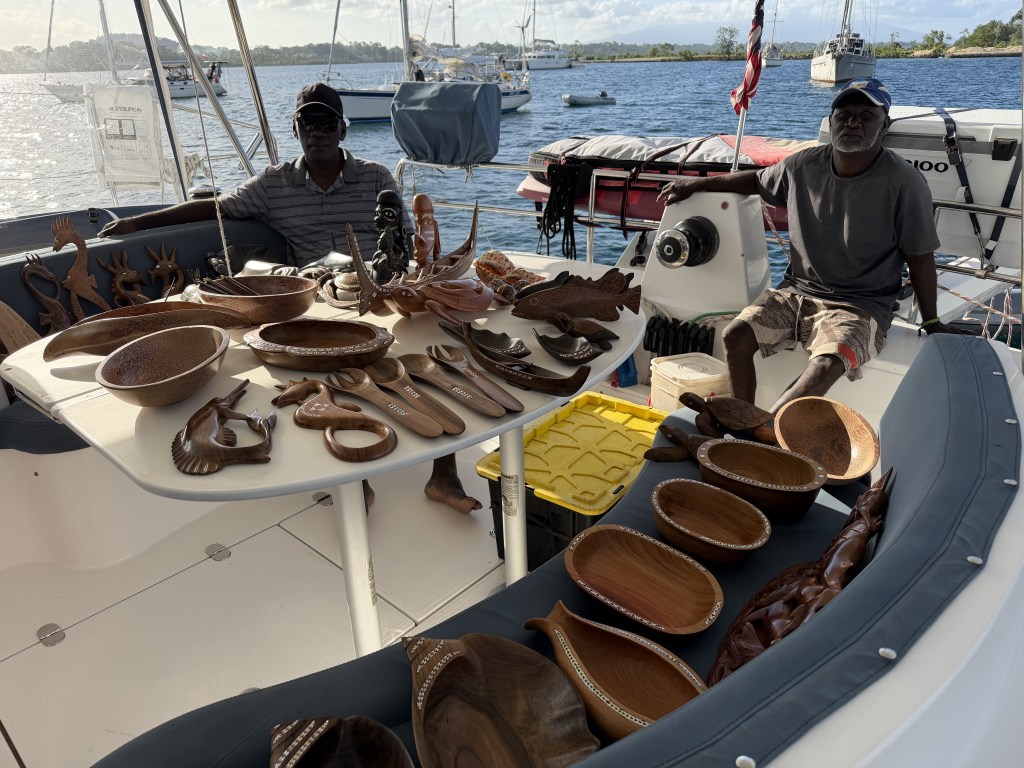
The one guy’s claim to fame was that his grandfather helped save John F Kennedy during WW2. When JFK’s boat exploded, he carved a rescue message into a coconut husk using a knife; locals paddled 35 miles in their canoes through enemy waters to deliver the message to the Australian coastwatcher who then coordinated with Allied forces to dispatch a successful rescue mission. Back to the carvers, they put out all their carvings on the table in Terikah; we were having a full-on carving show!
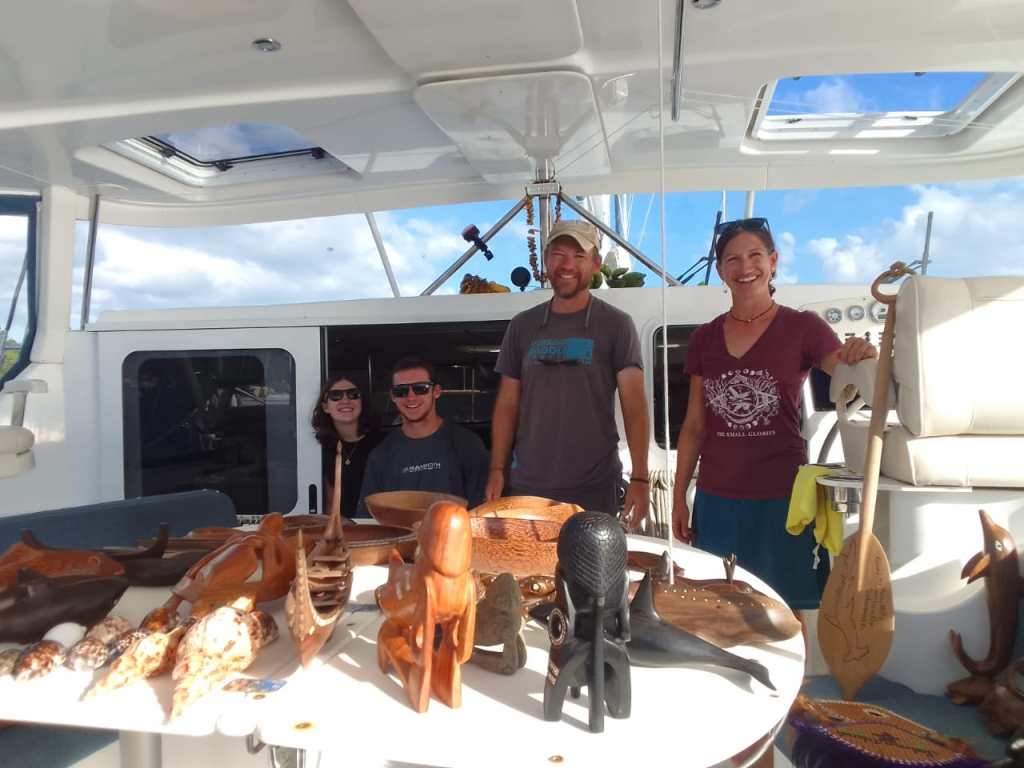
We took photos, traded for a couple carvings, and posted online. We were tired, but it was great to hang out and help them out. Just a few days later, I received a thank you from him that he already had a cruiser reach out to him, asking him to take him on a dive trip.
The Solomons are a baffling place that we struggled to understand. As one of our friends said to us recently, “You are really in it, in it.” There’s been the good (the smiles, good people, the beautiful jungle and ocean), the bad (poverty, lack of jobs, expensive education), and the ugly (boat boardings/security issues, neurotoxic crab, betel nut spit).
I’m glad to have experienced the Solomons this month. I will remember children’s laughter, Hilda and Melody’s welcome baskets, playfulness as Ugi Island kids jumped off our swimsteps, the kind brothers of Roderick Bay, gentle Chief Clement and funny Chief Luton, the sound of pipe music, beautiful carvings, and dugout canoes next to our boat.
Thank you Solomons for your kind welcome and our safe transit through your archipelago. Anchor up and on our way to Papua New Guinea (PNG).


One response to “Marovo Lagoon & Noro: Goodbye Solomon Islands”
Very happy to learn that Calder was ok. It’s not like you would plan to keep a ventilator onboard for anything before you left San Diego…..lol I am going to be very sorry when your journey comes to an end. Be safe in your travels. Take care always.
LikeLike