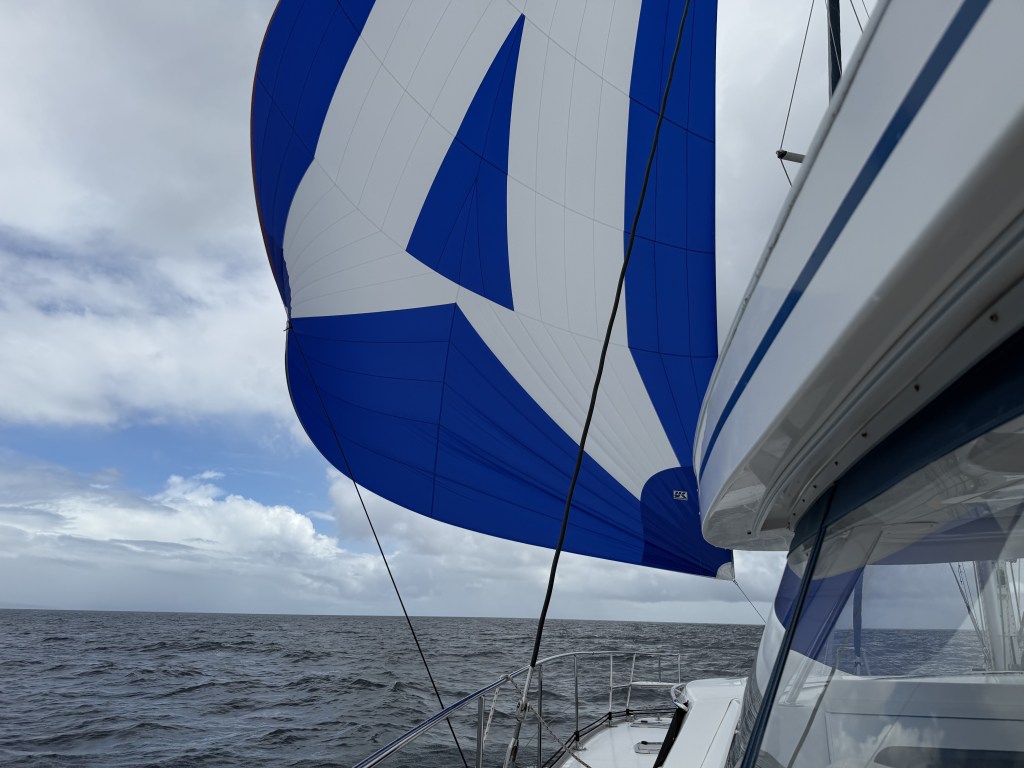
We’ve decided to spend more time in fewer places in the Solomons, going on longer overnight passages to get to safe places to spend 3-5 nights. We left Ugi Island on a 136-mile overnight passage, initially flying our large asymmetric spinnaker, which Calder and I had to get down when winds became squirrely with squalls.
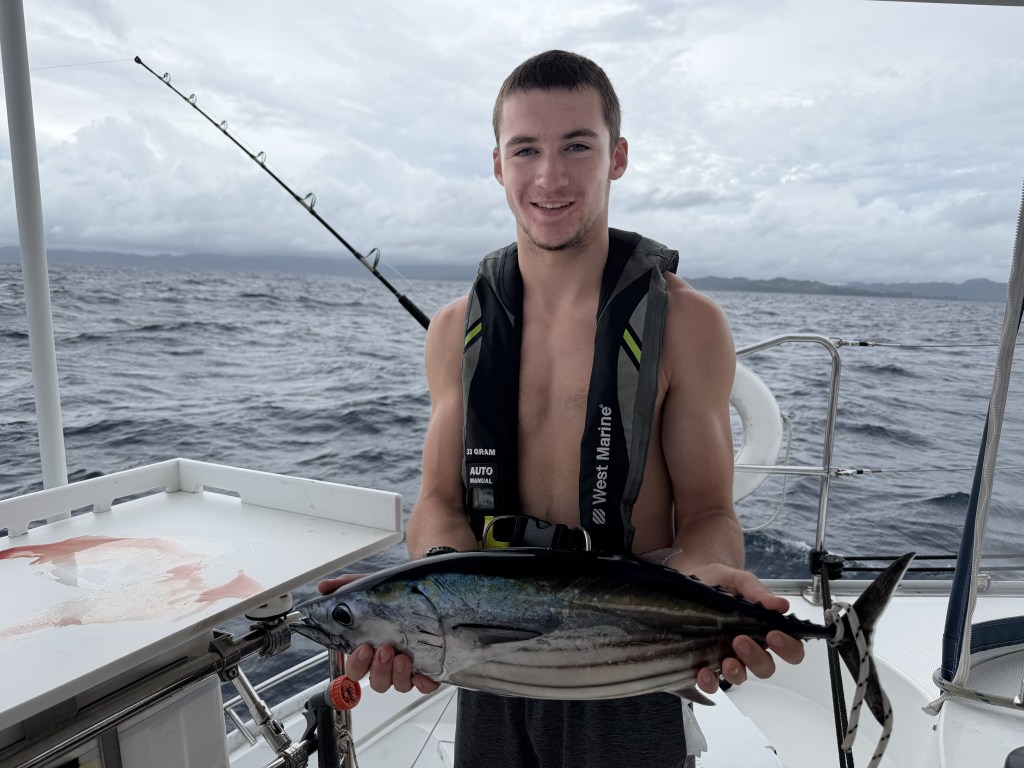
We had many sail changes on this 24-hour passage, encountering up to 2 knots of counter current and many squalls. We had a bit of tension when the satellite images showed a “wall of thunderstorm death” heading our way, trying to move the boat along faster and losing a large fish in the process; all that said, we survived but are sad that perhaps the fish didn’t. We were still gifted with a skipjack tuna that made for amazing sushi that night.
Entering Sandfly Passage, we felt tired from the overnight trip with all the sail changes at all hours, the uncertainty of our weakened genoa tack webbing, and high CAPE with squalls about. We were exploring the Florida Islands, a gorgeous scattering of islands just east of Guadalcanal. Unfortunately, the area also has a reputation for petty crime and the occasional security problem for visiting boats. We’d been given plenty of warnings to be careful about where we anchored. Fortunately, we were also told about two magical little anchorages that were considered exceptionally safe—places where cruisers could actually relax, explore, and sleep soundly at night. Off we went to find the safe havens…
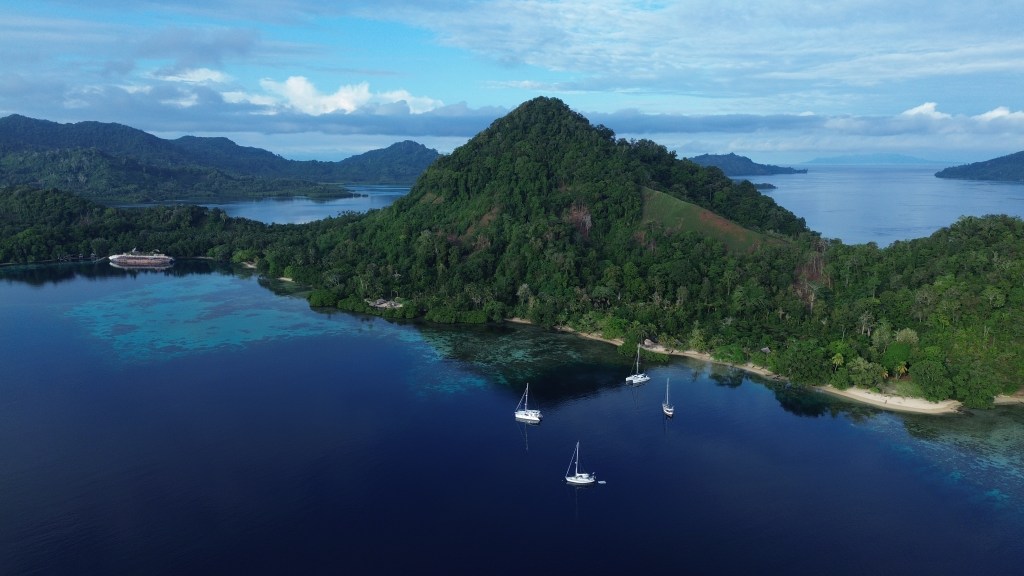
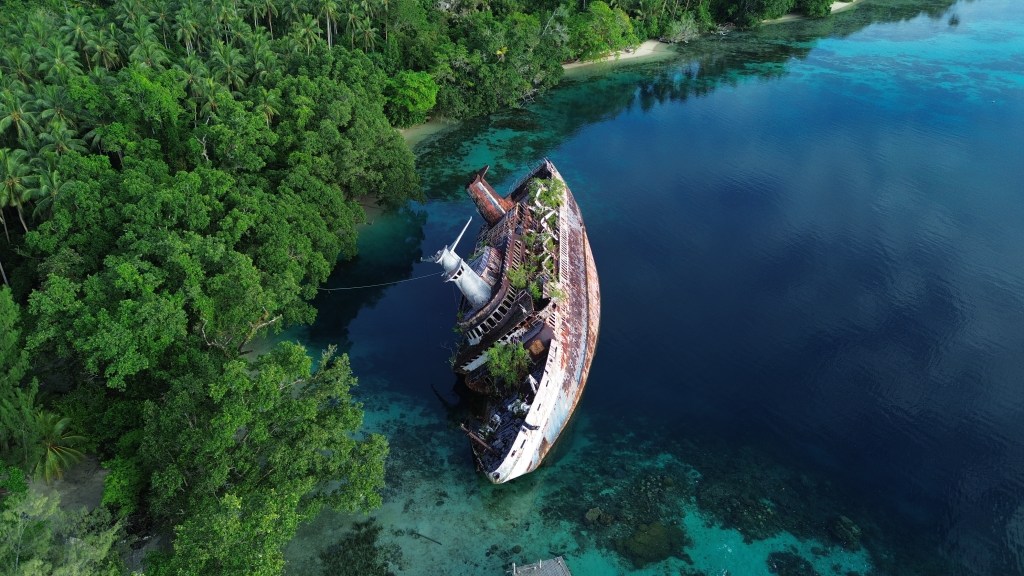
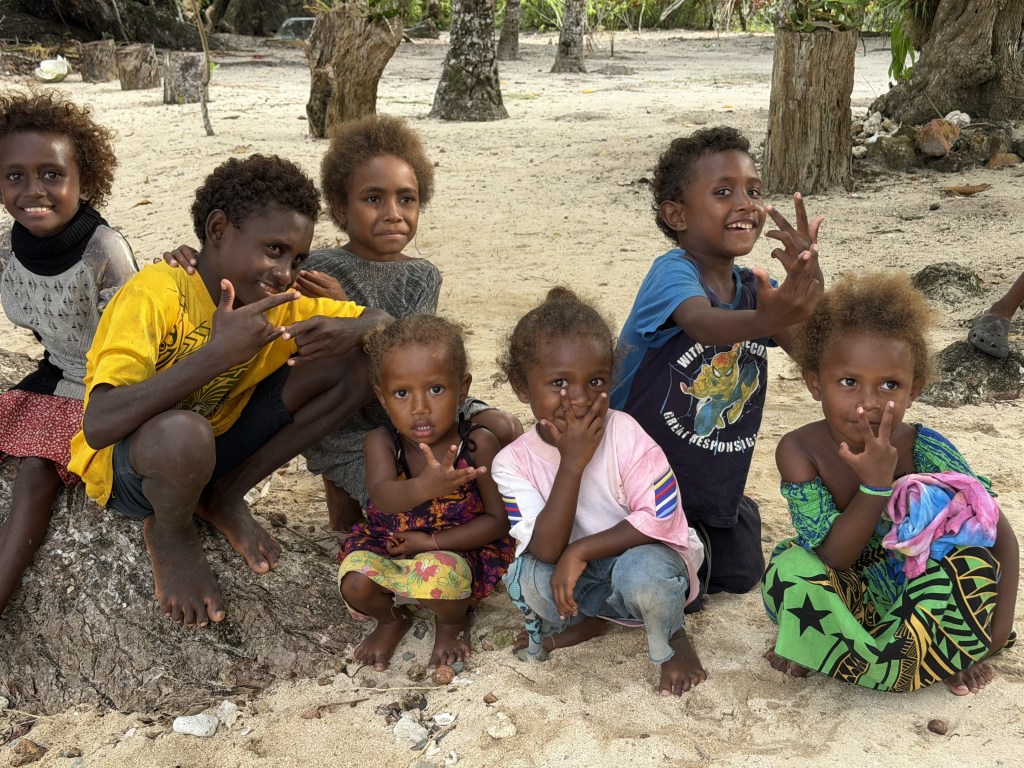
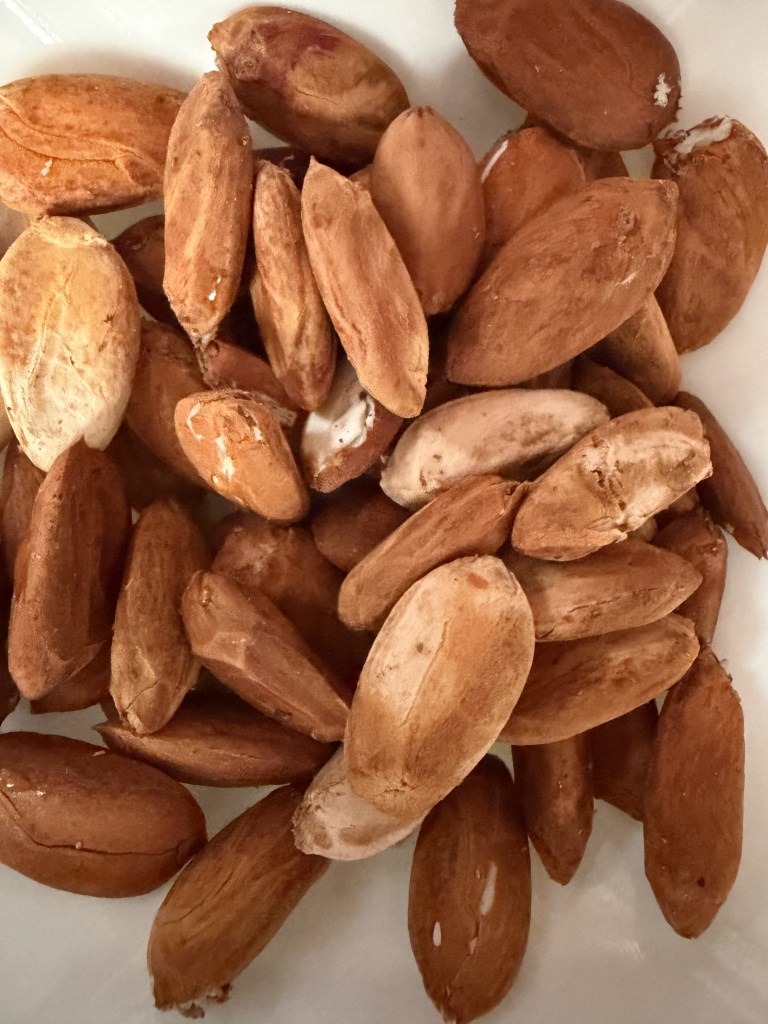
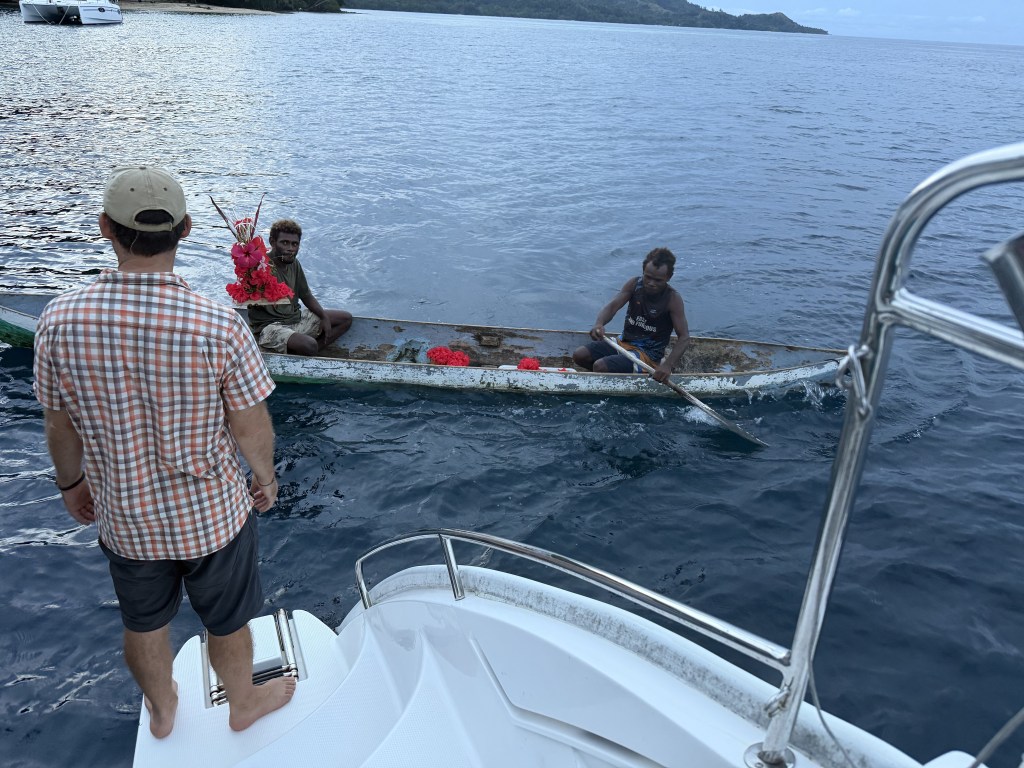
As we arrived to Roderick Bay, the two sons (Joseph and Robert) of Chief John were waiting in their dugout canoes by the mooring ball that would become Terikah’s home for the next 5 nights, with this wonderful family village. Chief John has been hosting cruisers safely since at least the 1990’s and now, as he lives in Honiara, his sons have done a great job taking over this role and we were shown first rate hospitality. They have put in 3 mooring balls and charge 50 Solomon dollars ($6 USD) per night and ensure our safety and comfort. As Robert took our line he greeted us, “Welcome brother. Welcome friend. You are part of our family. You rest, come to shore at 4pm.” The daughter of the Bigman (chief) stopped by with a plate of Ngali nuts for us; we peeled off the skin, ate some raw, then toasted some with a touch of salt.
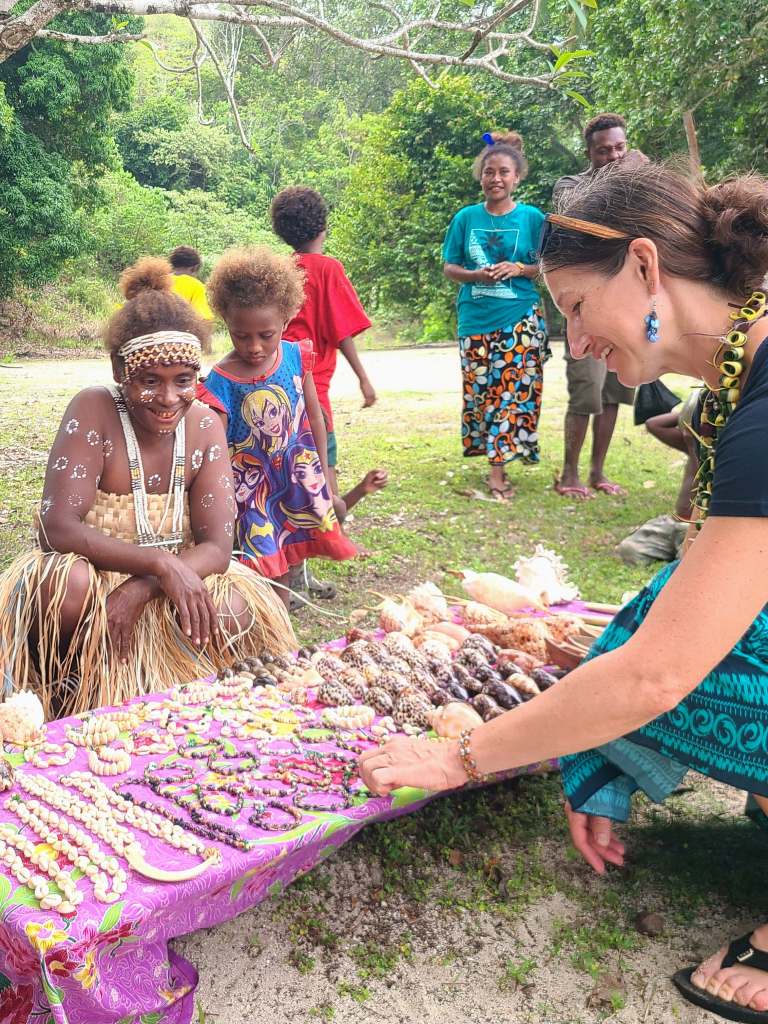
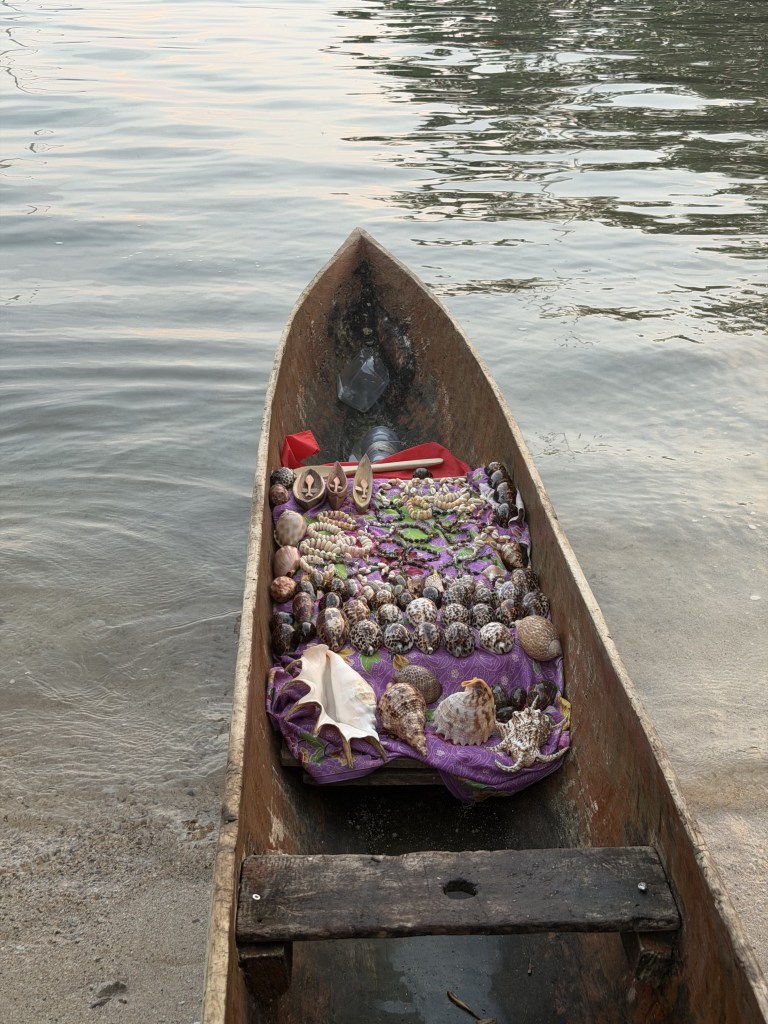
Lots of small dugouts were in the bay fishing. Greatly refreshed after food, naps, and showers; we went to shore and the local artists had set up tables of carvings, shells, and jewelry. The Solomon Islands are also renowned for their beautifully intricate carvings and traditional shell jewelry, and I couldn’t resist a little wooden carving of cuttlefish for 10 USD. We hiked up the hill with Joseph, as he told us about various plants and their uses, to a stunning view over the channel and landmarks.
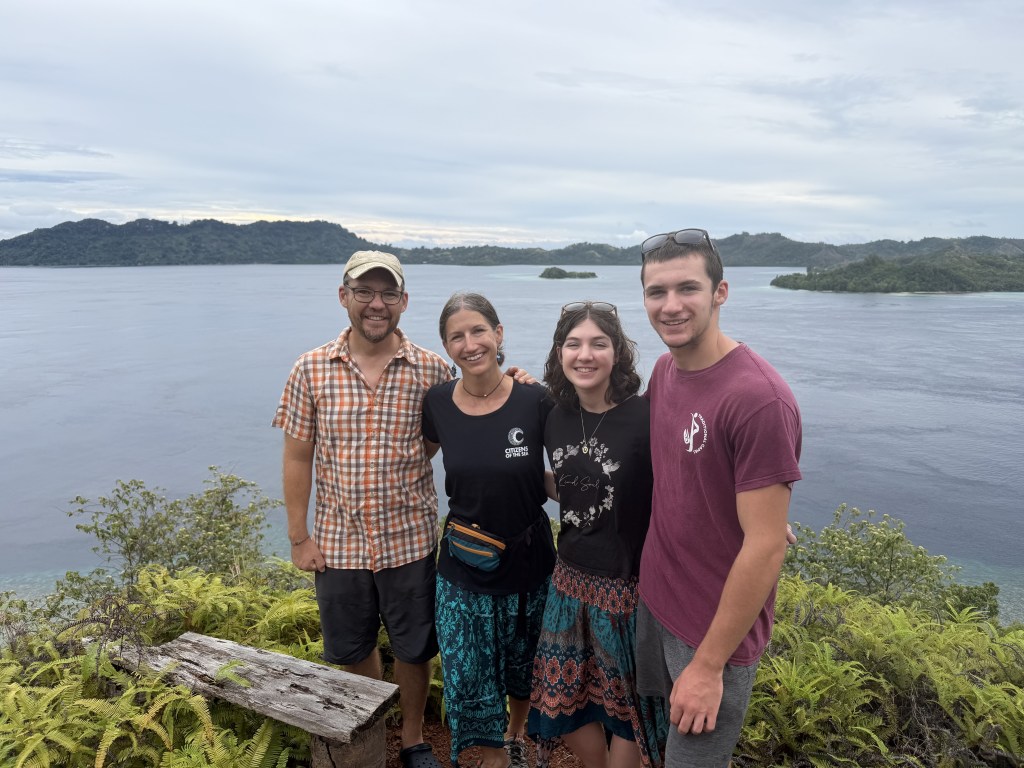
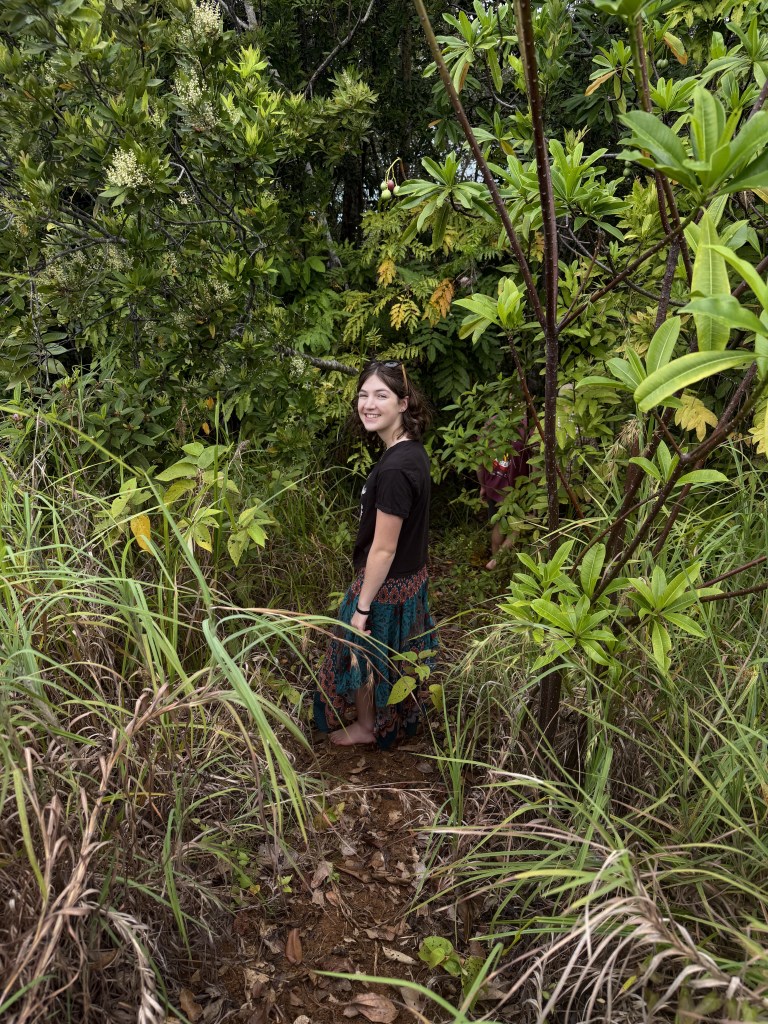
He told us a few terrifying stories, one of a crocodile pulling a cruiser off his swimstep and the other of rascals and a gun fight on an island we were looking at just a couple miles distant; rare events but certainly gave us pause. He knocked a “cut nut” from a tree, cracked it open, and showed us the nut inside, which we happily ate. This family village has such an openness to share their home and culture.
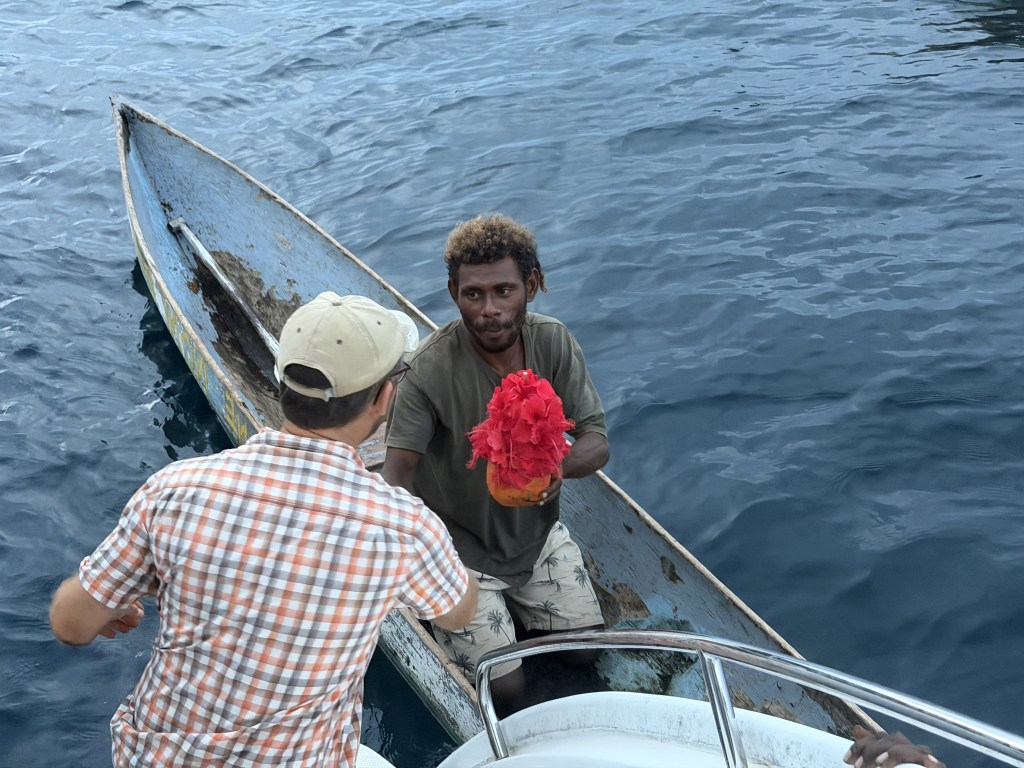
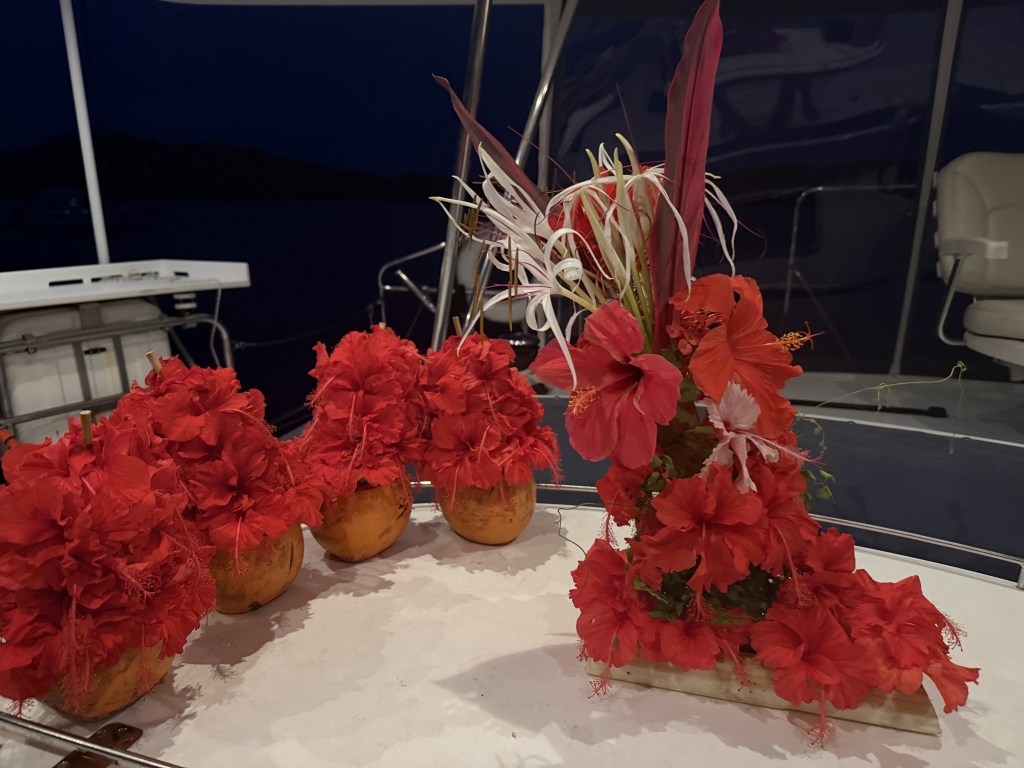
Walter stopped by in a canoe to trade bananas and limes for USD 3 and sweet biscuits (cookies). We traded a small wooden boat made by Joseph (he wrote “Joshep” on the side) for sandpaper and a chisel. Joseph and Robert brought us a massive hibiscus welcome flower arrangement and 4 drinking coconuts with hibiscus decorated straws, stunning.
Woke to the sounds of the cockerel (rooster), pipe and singing practice, and the activity on shore of raking the meeting area and beach, setting up for our kustom music and dance gathering that night. We had a big breakfast to celebrate the start of new school year, Cora entering high school, Calder staring his junior year. Wasn’t long before we had our first canoe of the day, a small boy in a large canoe, battling the gusty wind who traded a bundle of some edible leaf, asking for rice. Next boat, a gift of fresh mint for us. Next boat, drinking coconuts for rice, then sweet biscuits given to the young boys that brought big smiles. Next boat, John Jr (another brother) showing us his carvings, so hard to say no, but our “maybe” ended up with many more visits (and hopefulness) until we finally bought a somewhat quirky face carved out of stone.
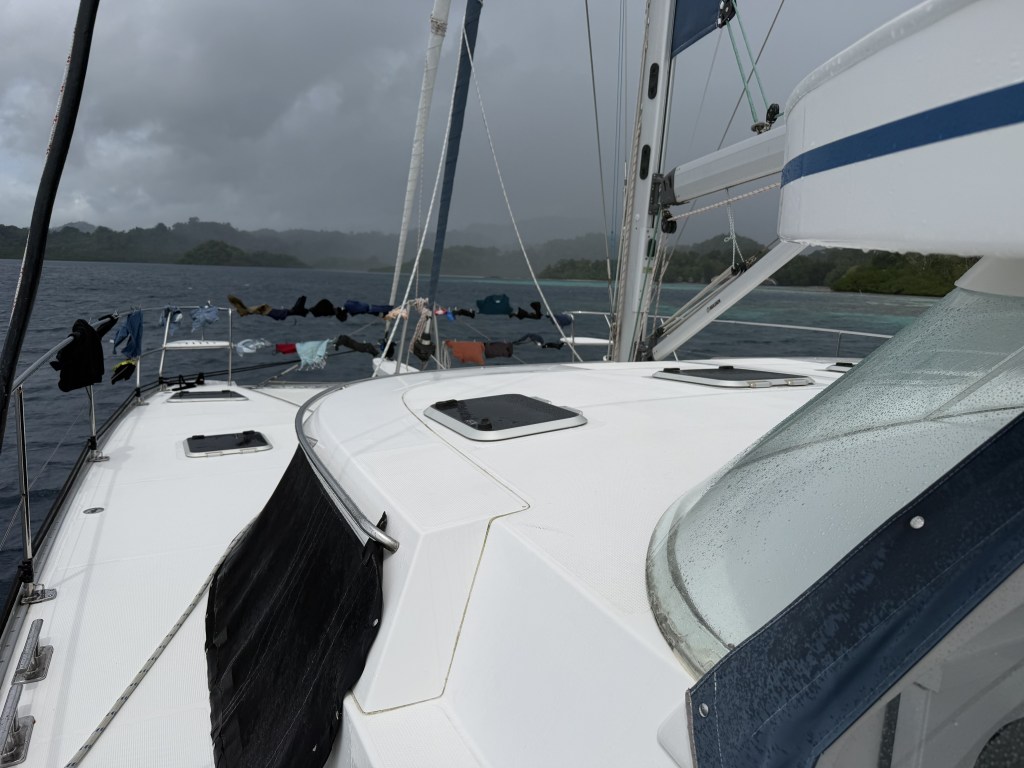
I spent the entire morning doing food prep, from making bread, to getting the yogurt going, to the cleaning and storing of fresh produce to make it last, our freezer full of bags of frozen papaya and plantains. I made a large bowl of bean-noodle salad to bring to tonight’s shore gathering, as we were doing a potluck with the village (more on the definition of “potluck” later!). We made fresh water, ran our generator (not quite enough sun yet to be fully solar-powered), helped a buddy boat with their generator (we happened to have just the right size bearing!), and put the laundry out to dry (a battle of rain squalls and sun, that finally resulted in clean, dry clothes that didn’t smell like wet dog – the small joys in life!).
Samuel stopped by in a canoe with a shell money necklace that he exchanged for one of Calder’s shirts for his son, then, after talking to Chris for a while, handed him a gift of a wooden canoe carving for Chris with genuine sincerity. We gave him some more clothes and batteries.
Then to shore with the other 4 boats for a cultural night. As we pulled up to the beach, the women welcomed us wearing traditional grass skirts and headbands, with their bodies decorated with white lime made from coral, a striking form of traditional dress and ceremonial adornment.
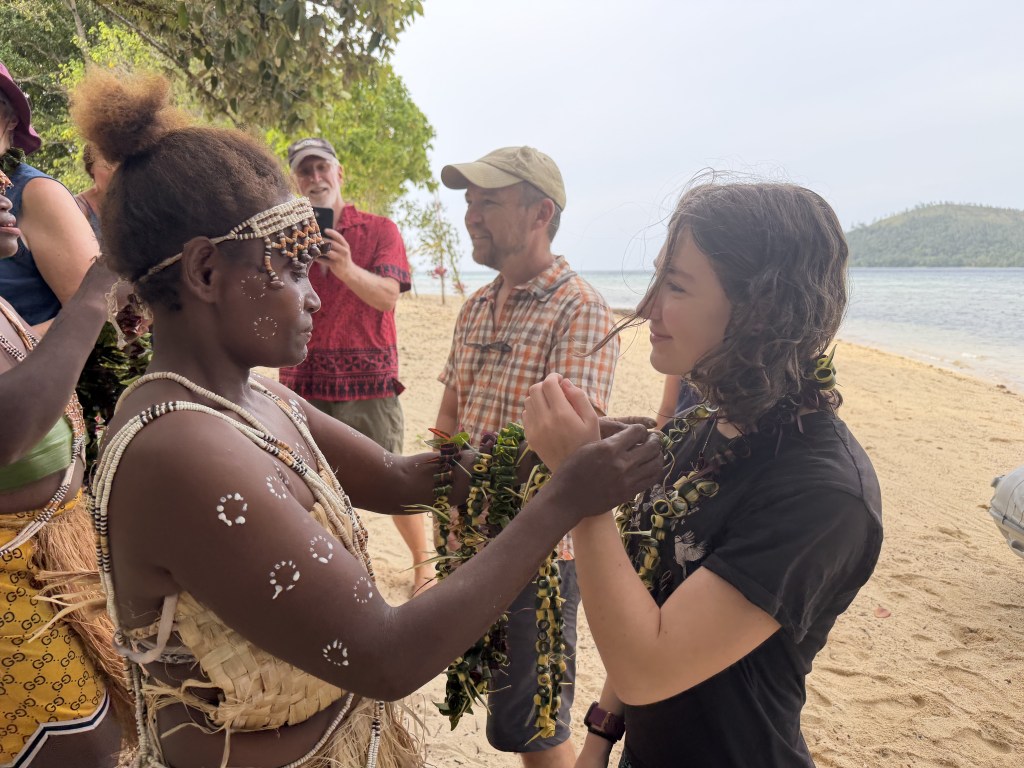
They placed leis of palm leaves around our necks and we perused the items for sale/trade; we traded seed and shell jewelry for sandpaper and clothing and purchased a small dolphin carving.
We sat on benches while the women sang and danced, accompanied by the men playing panpipes and large bamboo percussion pipes, creating lively traditional music for the performance.
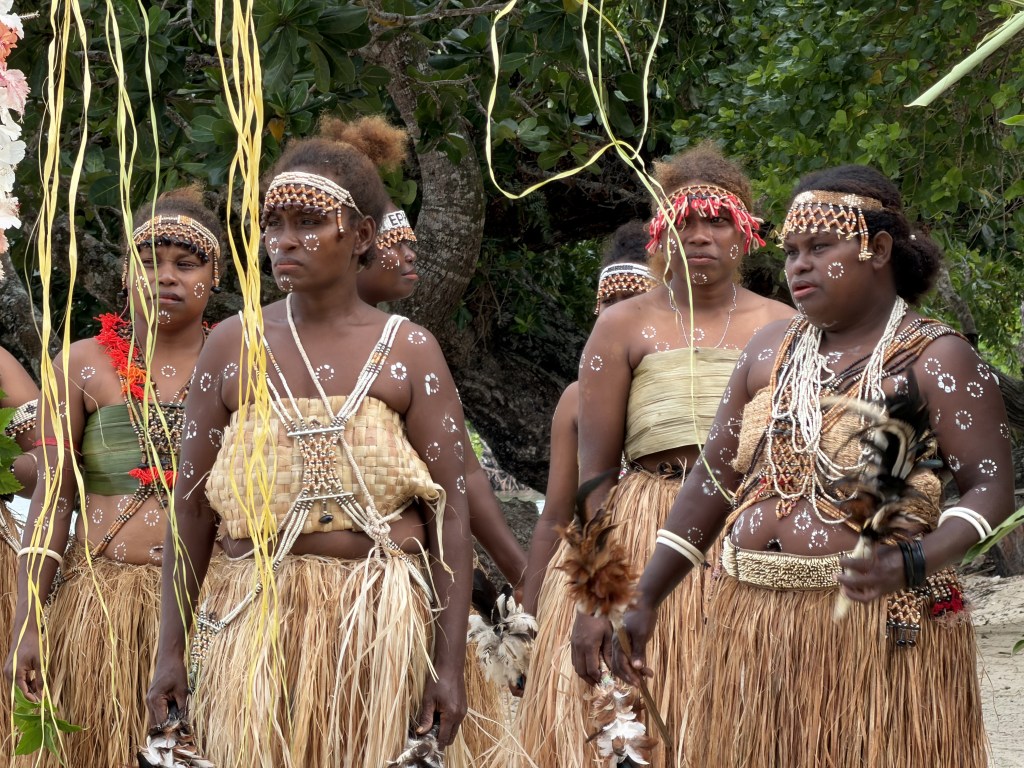
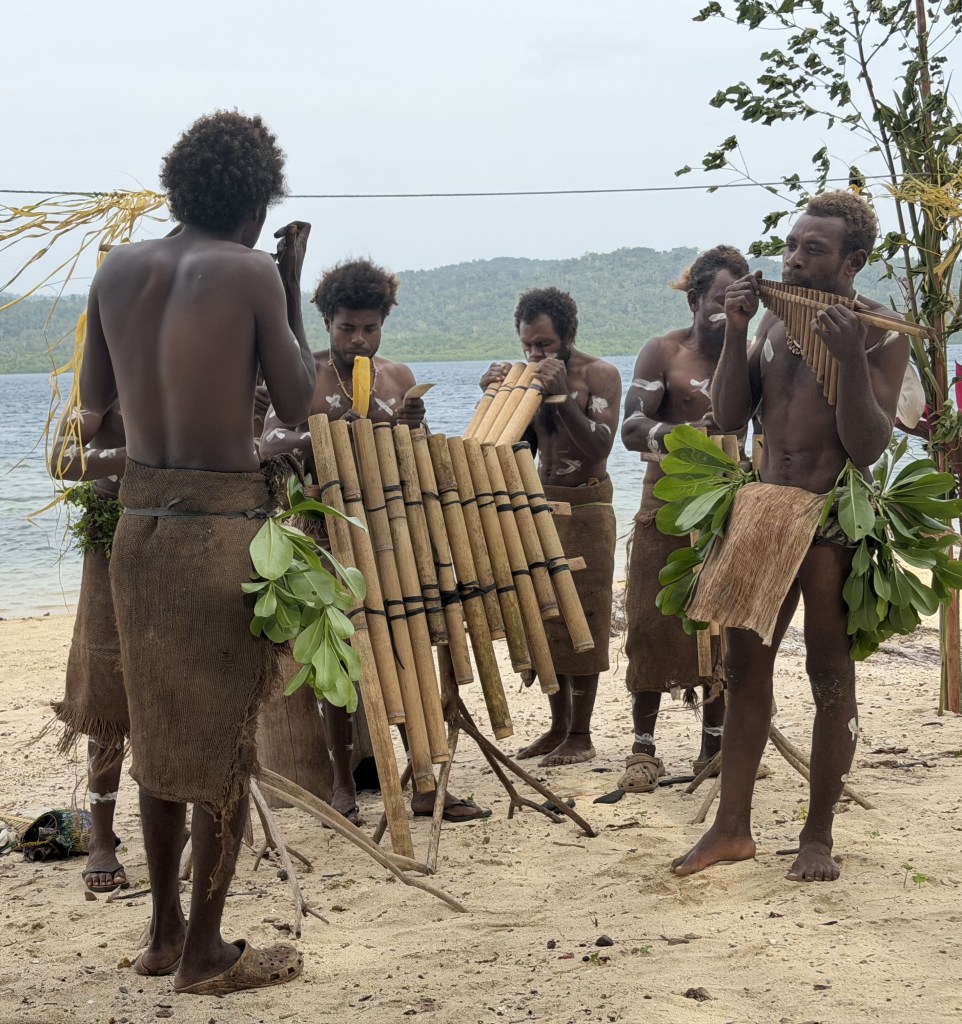
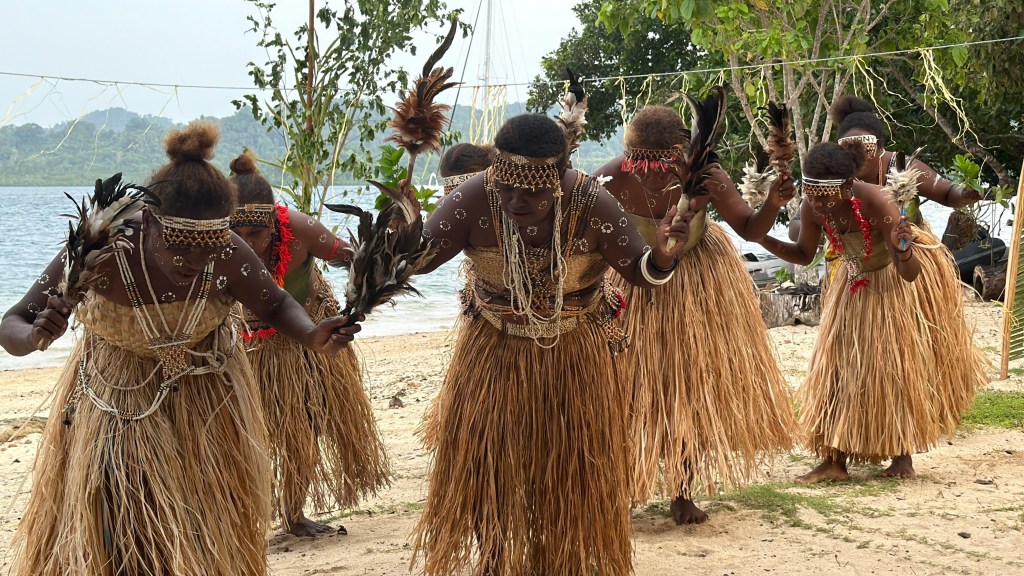
All the cruisers had brought big dishes of food to share as part of the potluck but, but we soon learned that “potluck” had a bit of a different connotation then we had expected. They had prepared traditional foods in a bowl for each of us, mostly root crops nestled in a delicious clam curry (we saw them gathering the clams today) and told us that if any of “their food” was leftover, we could have that too. “Their food” referred to the food we brought and the village descended on it quickly, ate it all, washed our empty containers, and set them back out for us to pick up before we finished our bowls. Hilarious.
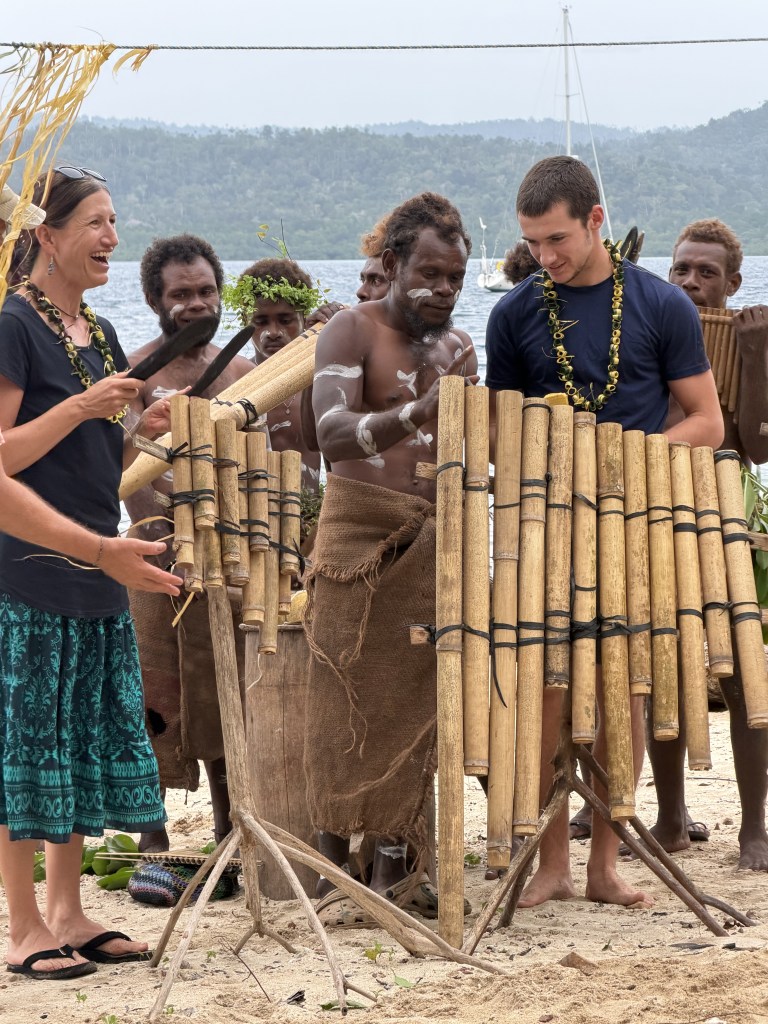
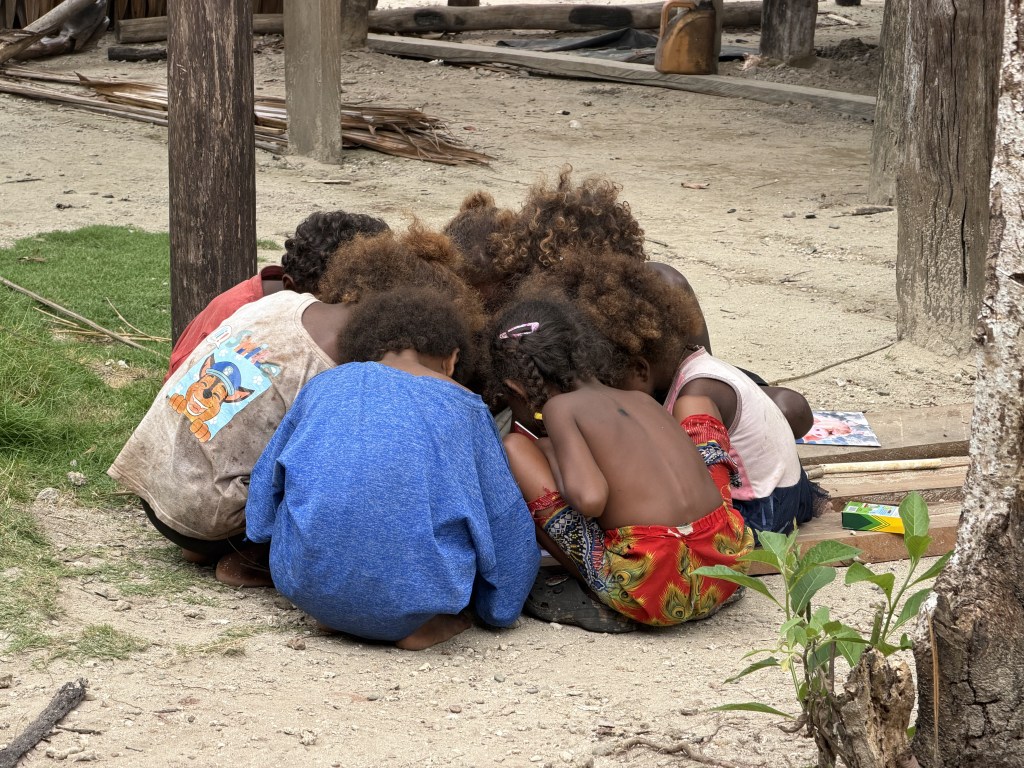
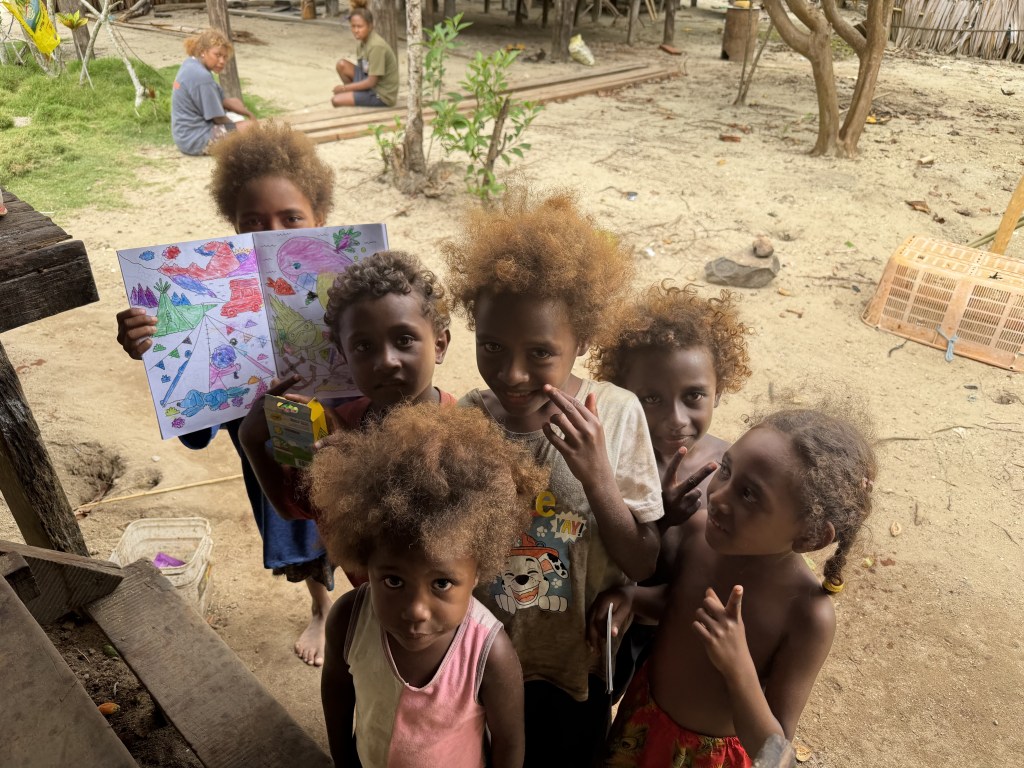
The men started a beach fire. I pulled out some books and read to the children, loving the cultural nuances of reading our books to Solomon children. When I showed a picture of bat ears and said, “Who could it be?” they answered, “It’s a flying fox!” instead of bat. Back to the boat after a stellar evening. The brothers take turns staying up overnight to keep watch on us to ensure our safety, and were so worried about our friend’s boat further in the bay that they sent another brother there to camp out and watch all evening. They want us to feel safe and relaxed in their home, but it is interesting that this watchfulness is needed. That evening, from shore we could hear upbeat Christian music punctuated with the squeals of flying foxes being hunted.
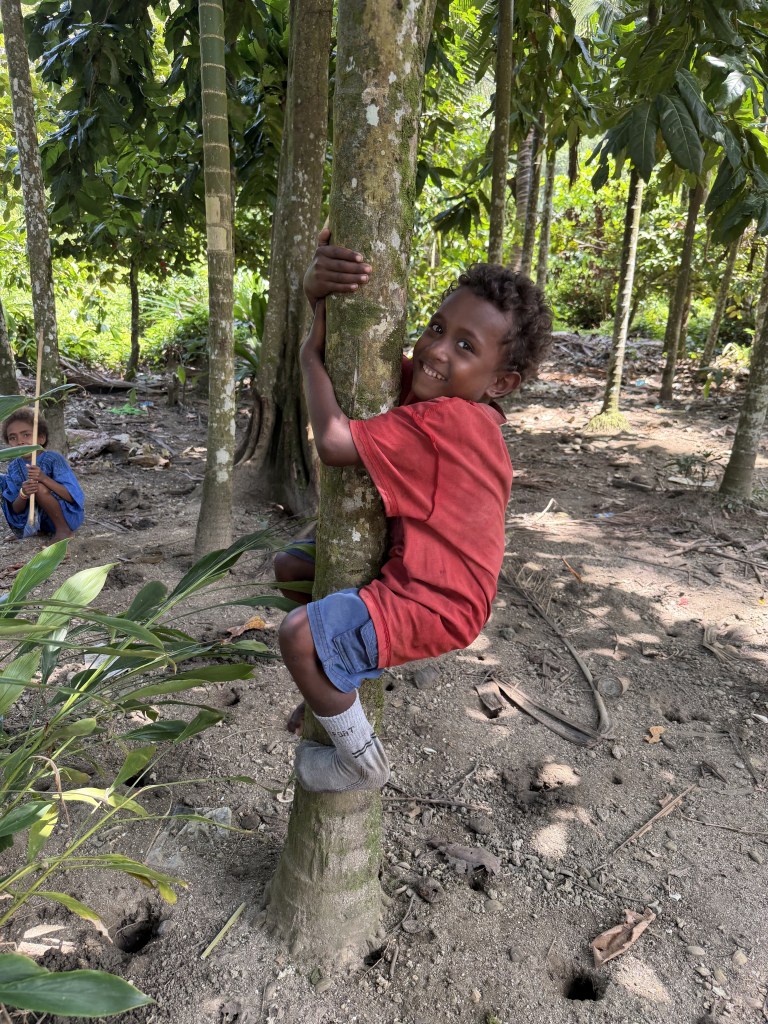
The next morning – calm, sun, and blue skies! The sound of cockerels, white cockatoos, radio music, and laughter. A dad and his 3 small children paddled out and we traded starfruit for rice, tuna, and cookies for kids. We gave him a shirt and fillet knife for a wooden fish carving. Sorry to get sentimental, but there are times when I take a step back and feel overwhelmed by the wonderful man I married. This week, he spent hours patiently fixing a boat part for a friend. He offers a smile, kindness, and presence to each canoe that appears at our boat. He said that for each person in a canoe that comes to Terikah we should not ask, “What do they have that we may want?” but rather “What do we have that we can offer them?” with trade for the item being not just their currency, but giving them dignity so that they are not receiving donations.
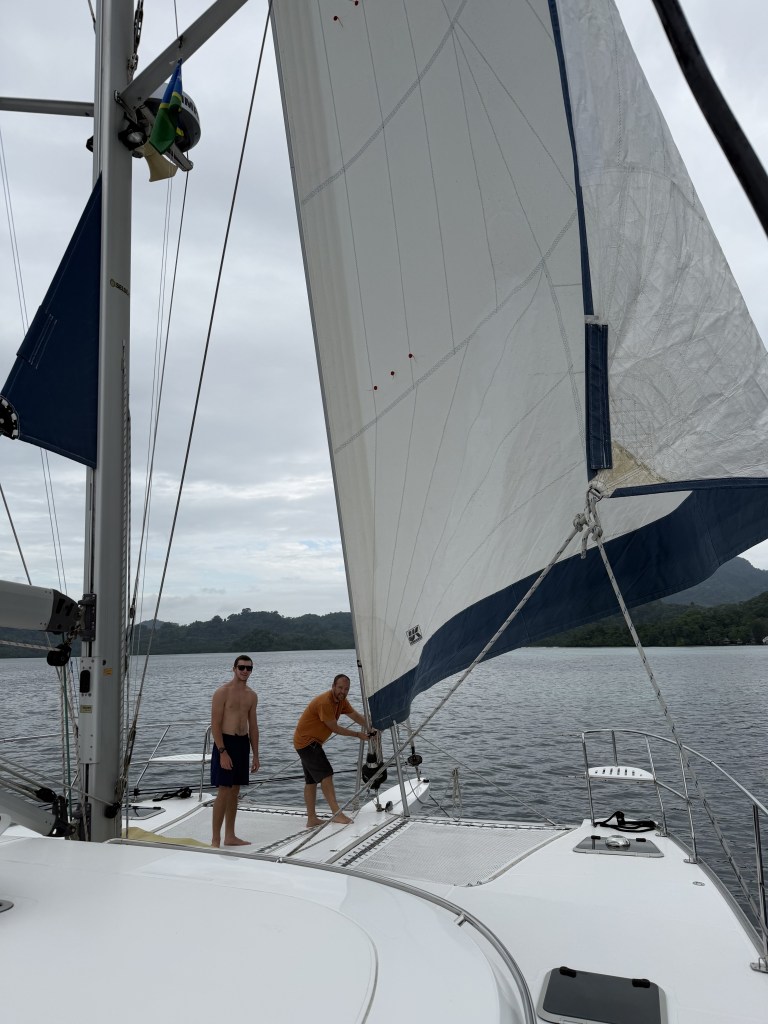
We had a full day of zero rain! Chris and Julie (from SV First Light) spent the day fixing the Sailright sewing machine then repairing our genoa, which turned into quite the major project including some hand stitching using a palm stitcher.
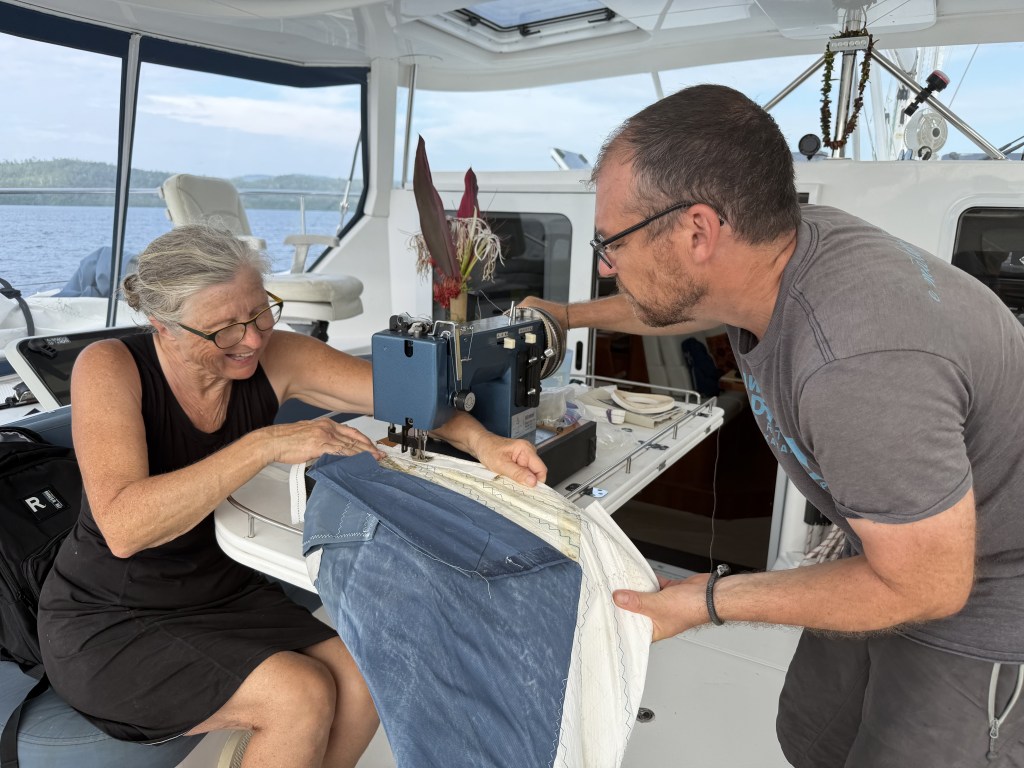
Chris impaled his hand with the back of a sewing needle, quite painful. But the sail is fixed robustly and back up, ready to go; we are so thankful to Julie for her hours spent with us on this project!
With the sun, our laundry pile is slowly disappearing. More trade at the boat – a fish carving and starfruit for a filet knife, t-shirt, and fishing line. Joseph took us on two walks on their family’s land, stopping at the exact spot of the property line where an old fire ring from generations past was located. Land ownership is a major issue here with the coral reefs and bays considered an extension of the land itself. If we were to walk onto another village’s land or snorkel their reef, we would be charged 50 SD each person (about $6), which makes sense given their understanding of property. He walked us through their newly created and planted hillside garden.
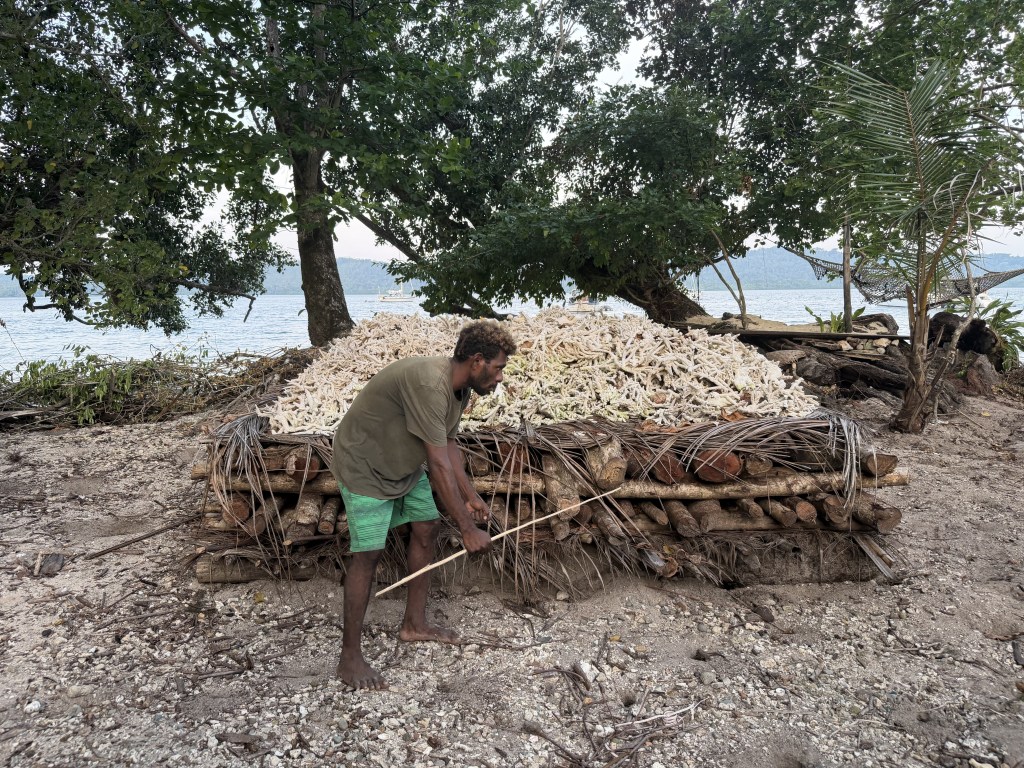
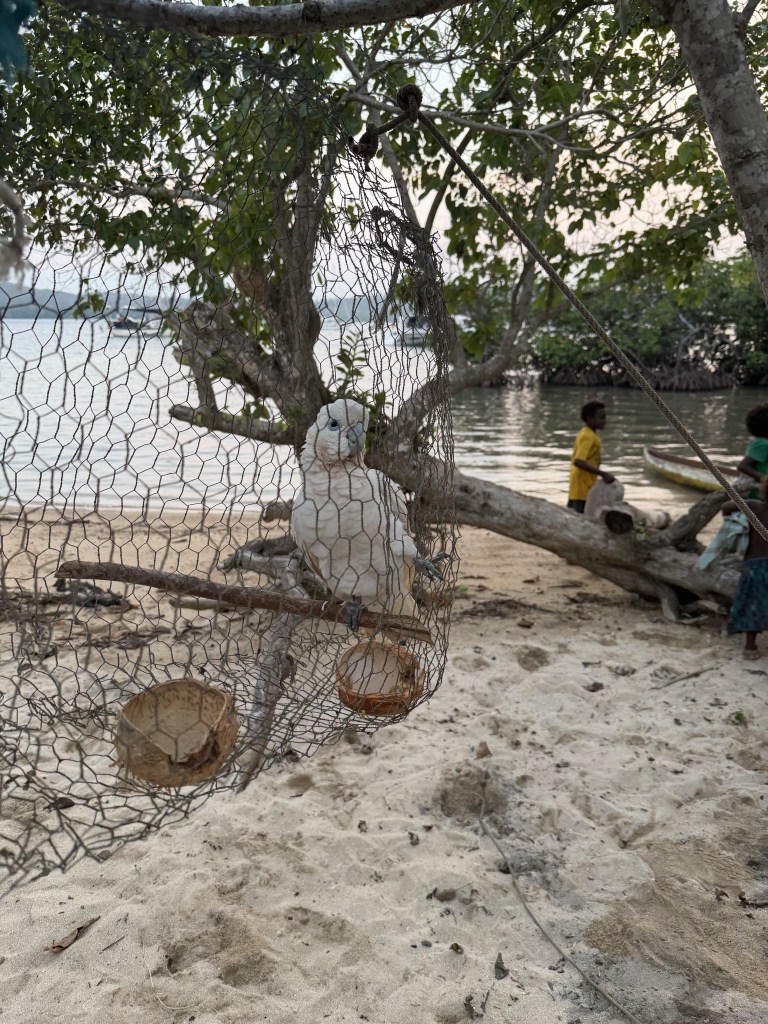
It was fascinating to see the massive pile of dead white coral on a wooden pyre, that would then be burned in the process of making the lime used to chew with betal nut, which they exported to Honiara as well as Vanuatu and PNG. In a cage was a cockatoo that they captured and trained, which could be sold as a pet in Honiara.
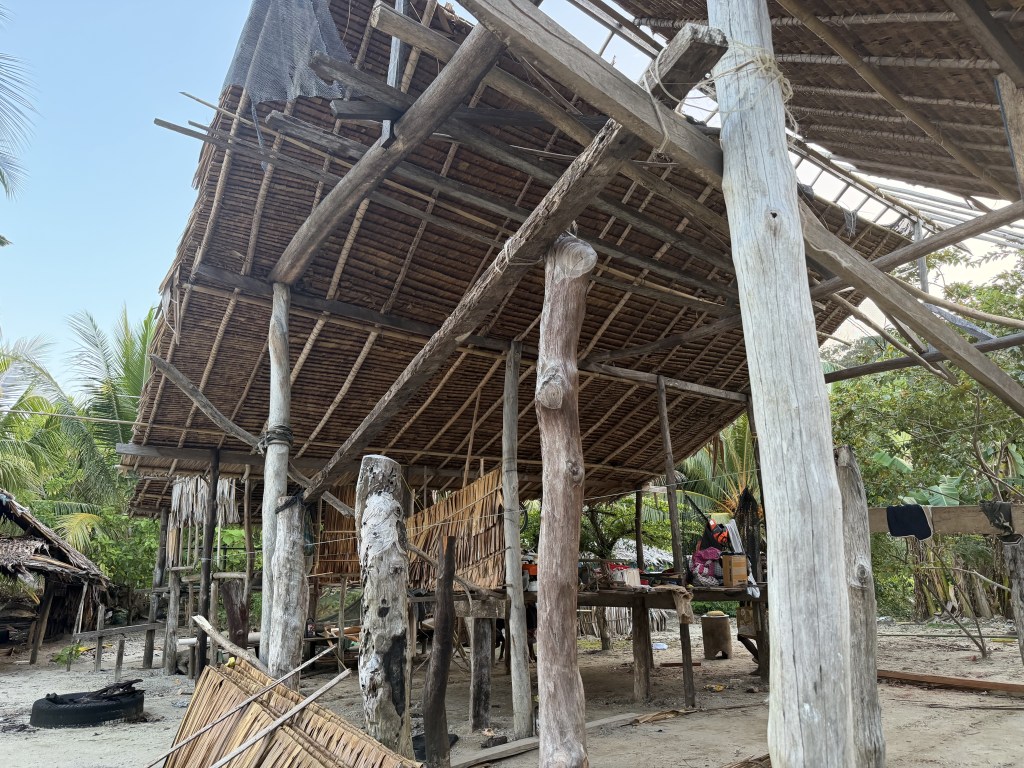
Various ways to earn money, which the Solomons seems to be struggling with. It was interesting to see a new house being built with solid construction of natural materials, the homes here having different levels and rooms unlike we’ve seen before in the South Pacific.
There were thin pieces of bamboo drying to be made into panpipes.
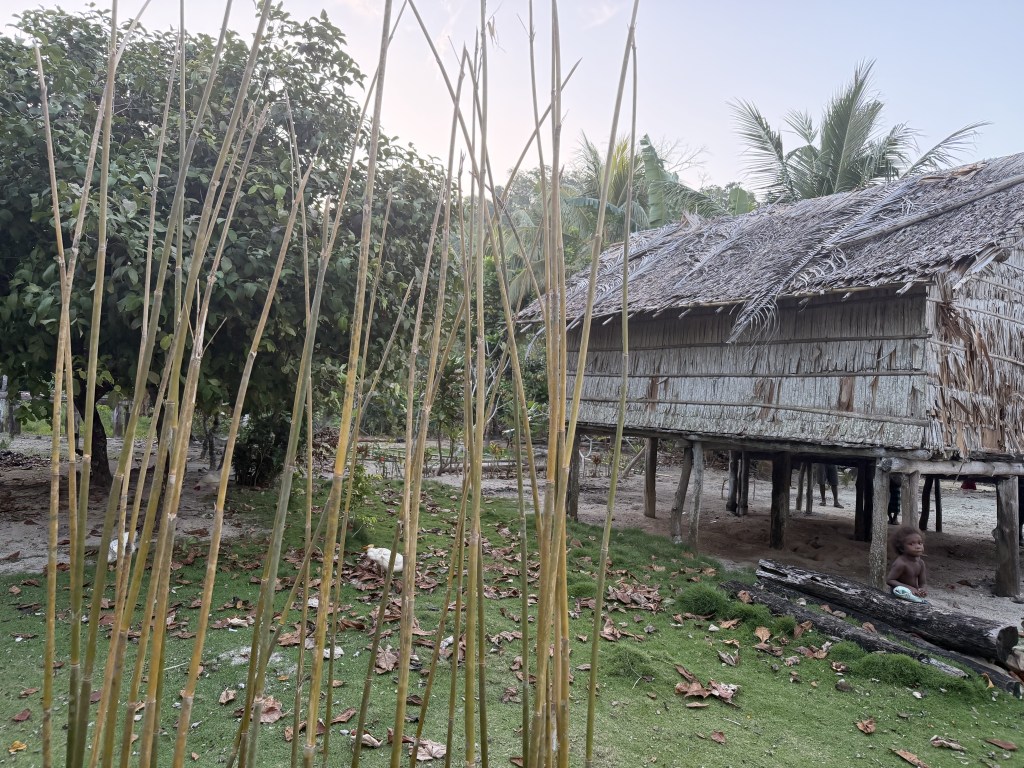
The ground had litter of Coke and Whiskey cans. Just after sunset, one of the brothers will canoe the circuit of boats just to ensure all is okay and Chris has enjoyed these evening conversations. A great quote from Joseph was, “The crocs are not yo brotha.” Nope, not our brother! We have little scraps of paper scattered about the table with words in the local dialect that we try to use. Our family jokes about the amount of random green leaves that I feed them, wondering if when we arrive home to Alaska I’ll be out harvesting random leaves from our yard to cook up in curry.
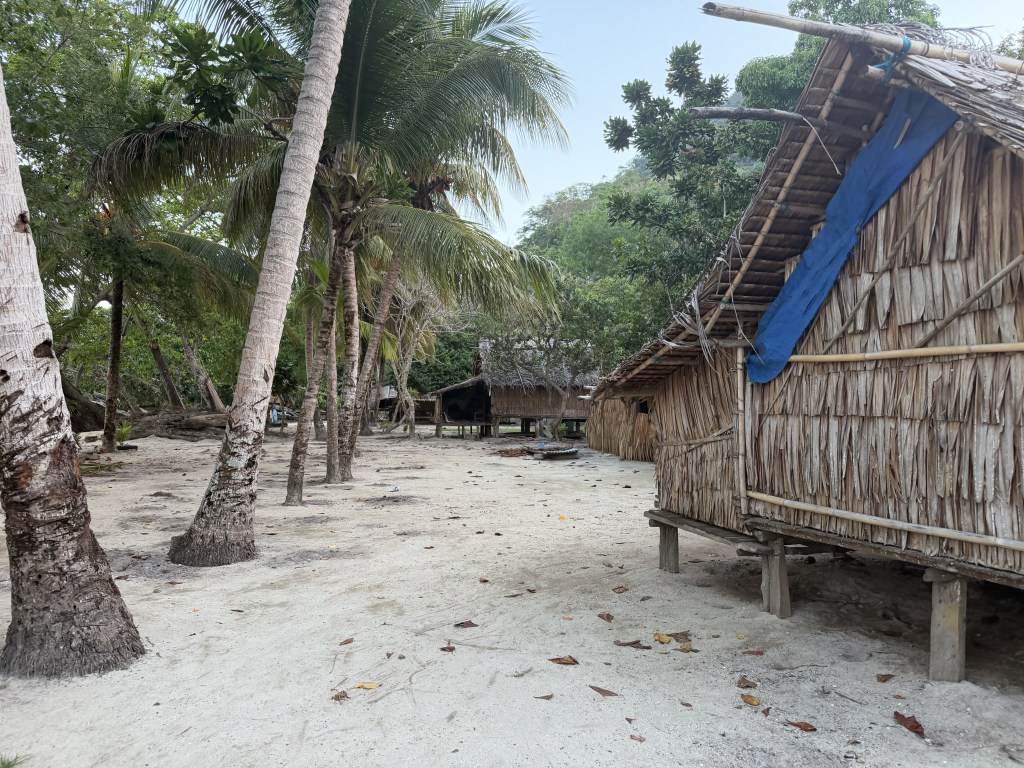
One cruiser offered a morning yoga session on the beach, with a few brave village children joining us with their big smiles doing the poses, many other villagers looking on curiously. We noticed that English fluency seemed to decline across the generations we met—grandparents often spoke very well, while parents spoke less and many children spoke little or none—perhaps reflecting the shift from English-dominant schooling and formal life in earlier generations to greater use of Pijin and local languages in everyday life today.
Another day, when we went to shore, we reviewed and signed the guest book that dates back to 1996; this family has been connecting with cruisers for a long time. We heard a story about their cockatoo that would follow them where they went, even carrying messages tied to its leg. I read more books to the local kids, as well as did some coloring.
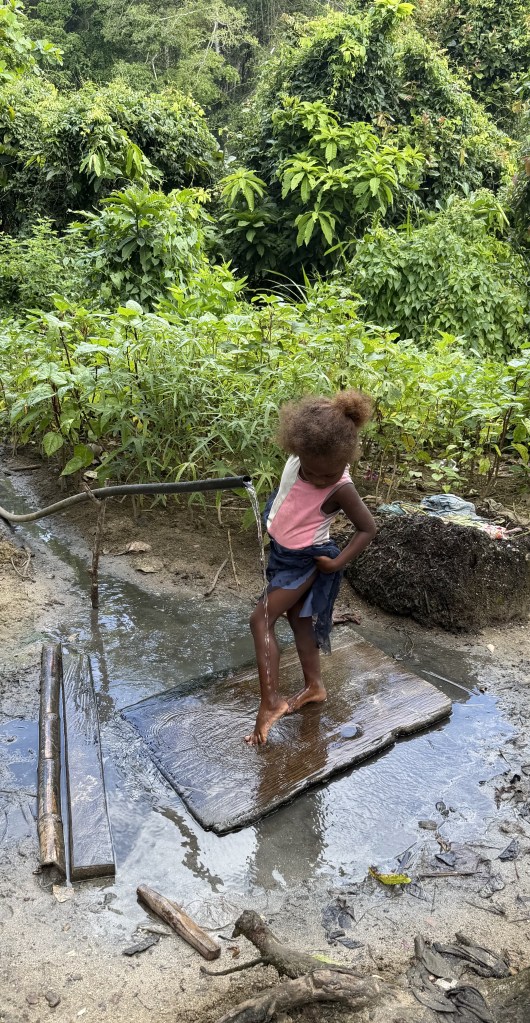
We saw their fresh water source, piped from a nearby spring.
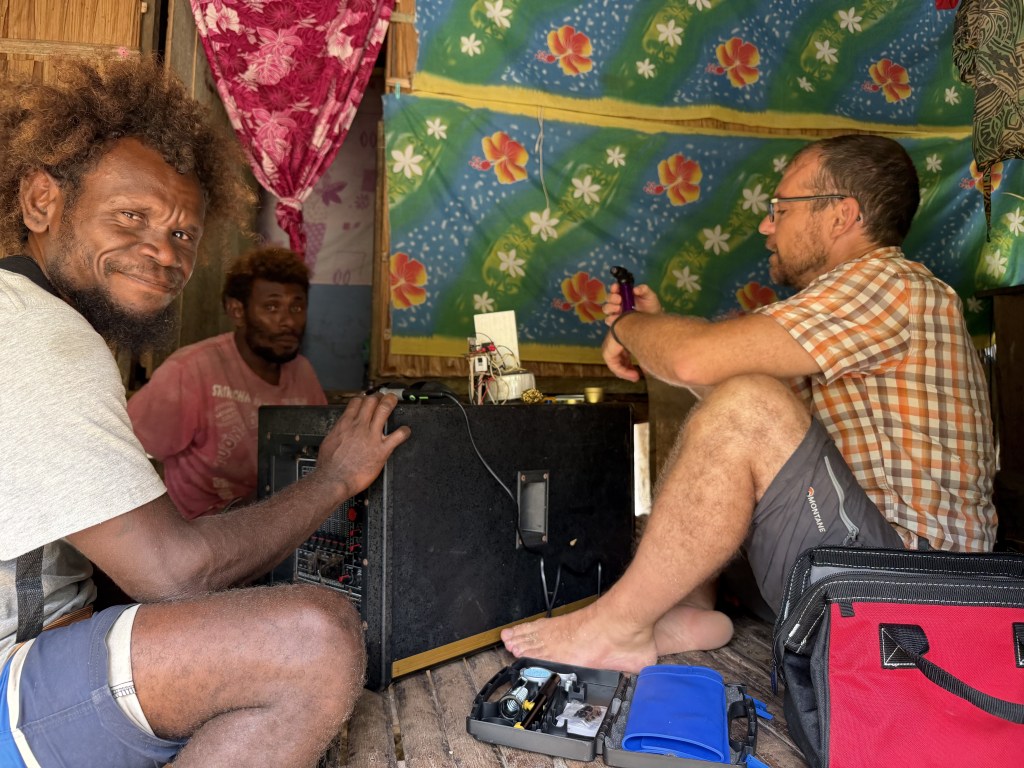
Chris worked with the bros to solder wires in their speaker for music.
At one point, Chris and I were on shore with the kids back on boat; we looked out and there were 2 canoes off the back. It was fun to see them trading without us around; we came home to find a large fish carving that we named Willie and some fresh eggplant that they traded for. There was also a phone charging, which we find is a common request. There was a family that needed to get back to their village, but it had gotten too rough for their small canoe; off went Calder around the point to their home, then fishing with Joseph for a while. If we didn’t feel exceptionally safe here, this would not have happened. Later that evening, just before dark, the carver who had traded with the kids came by with his 2 children wearing beautiful flower crowns made for us.
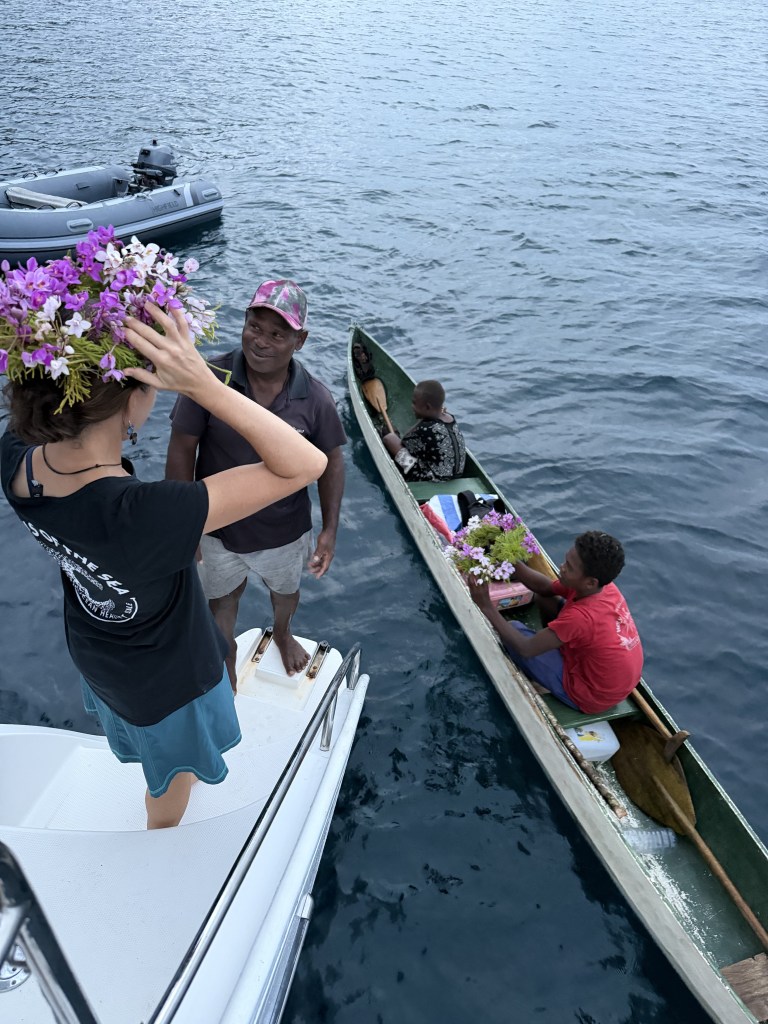
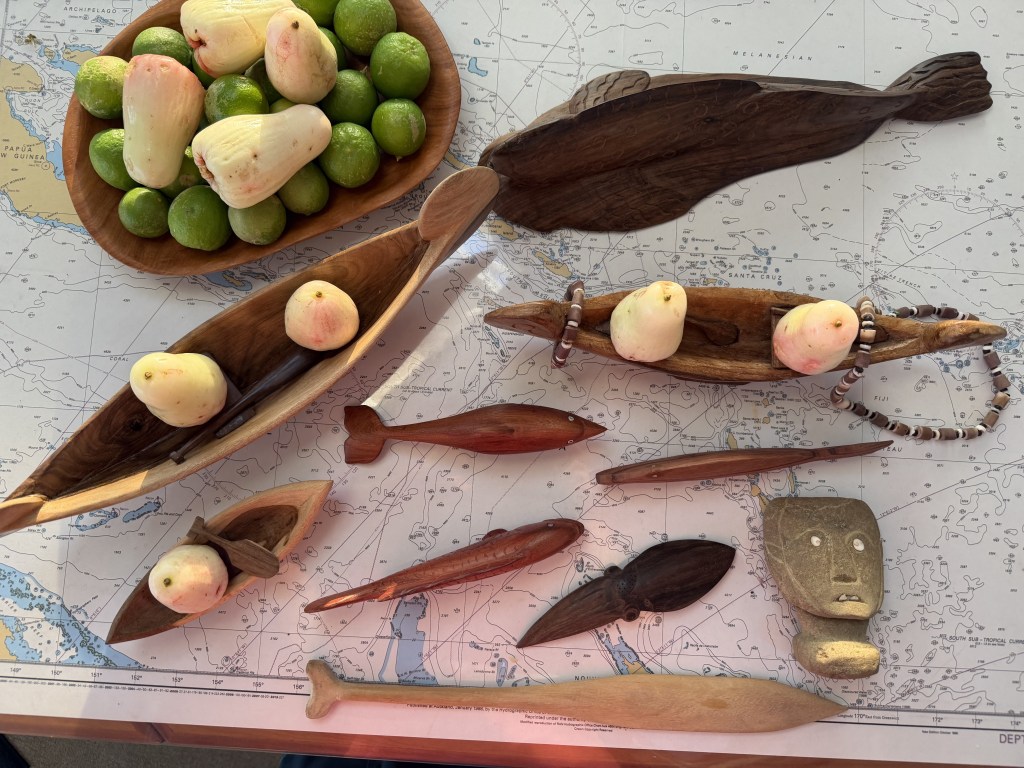
He had the kindest smile as he gave us these gifts. We couldn’t help but buy a stunning carved boat and bowl. Our table is covered with the small carvings of this area, simple and beautiful, growing daily. Each carving ranged from $6-20 USD. In the Solomons, they accept USD, Solomon dollars, and Australian dollars.
After 5 wonderful nights and the feeling of safety and being so welcomed, it was hard to leave, but we were off to a nearby anchorage. Simon’s Nature Reserve is essentially one man’s long-term effort to restore and protect his home reef. Since 2004, Simon has collected and replanted different corals, removed coral predators such as crown-of-thorns starfish, and prohibited fishing, creating a remarkably diverse coral garden and nursery for young fish.
That night we went in briefly to introduce ourselves and check-in, a good practice wherever we anchor where people live.
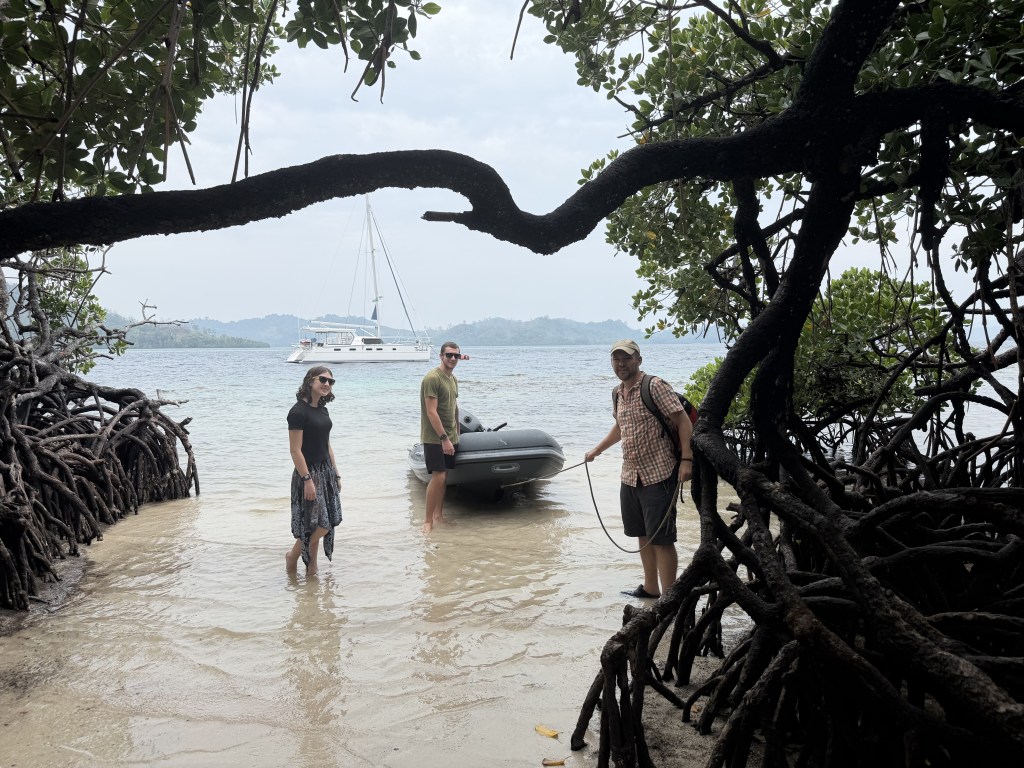
We were immediately struck by his eccentric nature, as he shook our hands and shuttled us over to a bench where he showed us some paperwork of his reef preservation and advised we take a photo. He had a large ziplock bag with papers in various states of decay, from geology terms to the developmental stages of adolescence, and asked us to help him copy these.
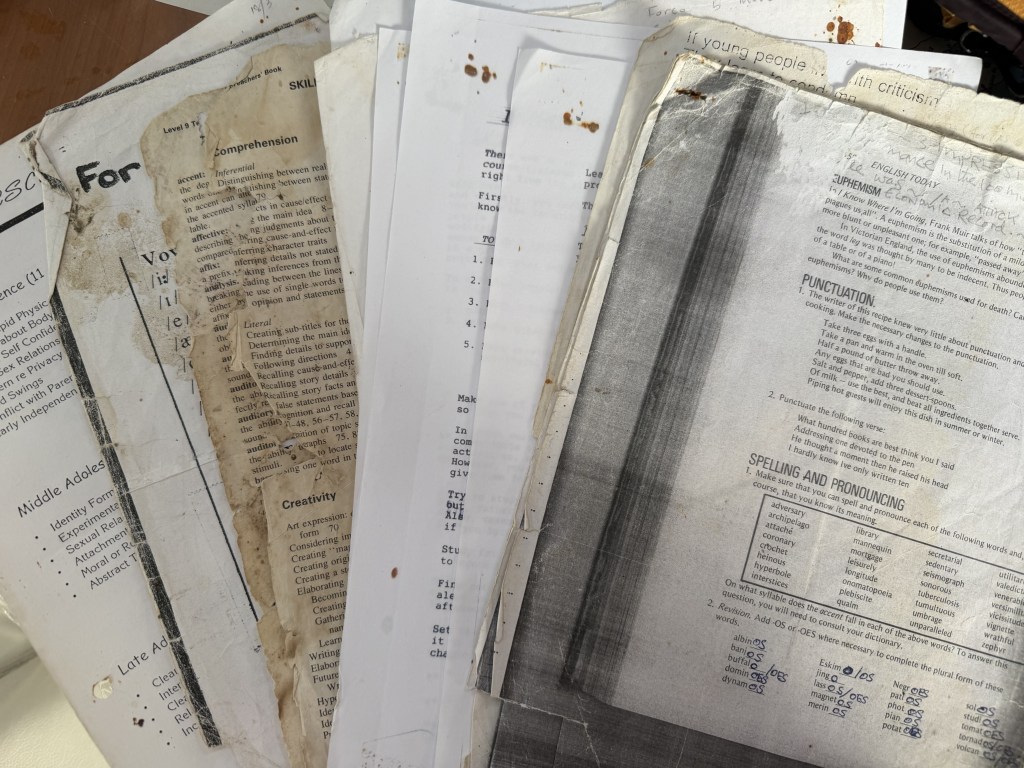
He was very much interested in a list of all the US Presidents in order with their term dates. He explained that he was teaching his village, as his son Greyson and some of the other children could not pay the cash to go to school. It is SO challenging for people to make actual money here to pay for items like school and food. Out to the boat, shy teenage Greyson asked if we could charge his phone; we plugged in his old phone noting that the main screen had Instagram and other social media. The kids played in the mangroves roots, jumping up and down on them, diving into the water. We planned to visit the next day.
Arriving on shore the next morning, Simon handed me two post-it notes with patient information: name, date of birth, chief complaint, address, a bit of medical background and led me to my first patient. And so it began. I saw 5 patients and fitted many more for reading glasses, using physical exam, my stethoscope, and a pulse oximeter.
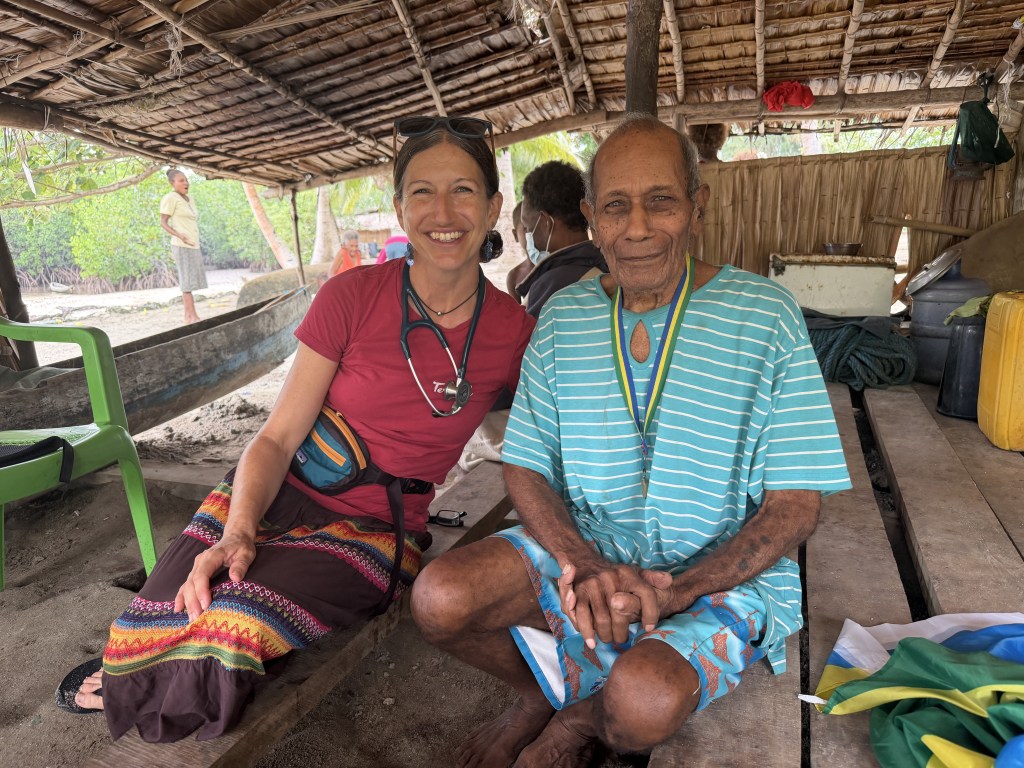
Curious kids perched nearby, giggling, along with the rest of the village; definitely no privacy here. One young girl likely had malaria, but I never secured test kits so her mom will take her to a nearby town for testing and treatment. Otherwise I diagnosed conditions of cataracts, asthma, orthostatic hypotension related to dehydration, arthritis, and vitamin deficiencies. Each person had a small white notebook that they would take to their local clinic with notes and I found it interesting that most plans included the antibiotic amoxicillin and acetaminophen. For example, the diagnosis in one book was fatigue (or other vague diagnosis) and they would be given amoxicillin and acetaminophen. Many had a visit for malaria, making it seem all the more important that our family is on daily prophylaxis for this. They asked me to write down all my thoughts on what was going on with them to bring to the clinic the next time they went.
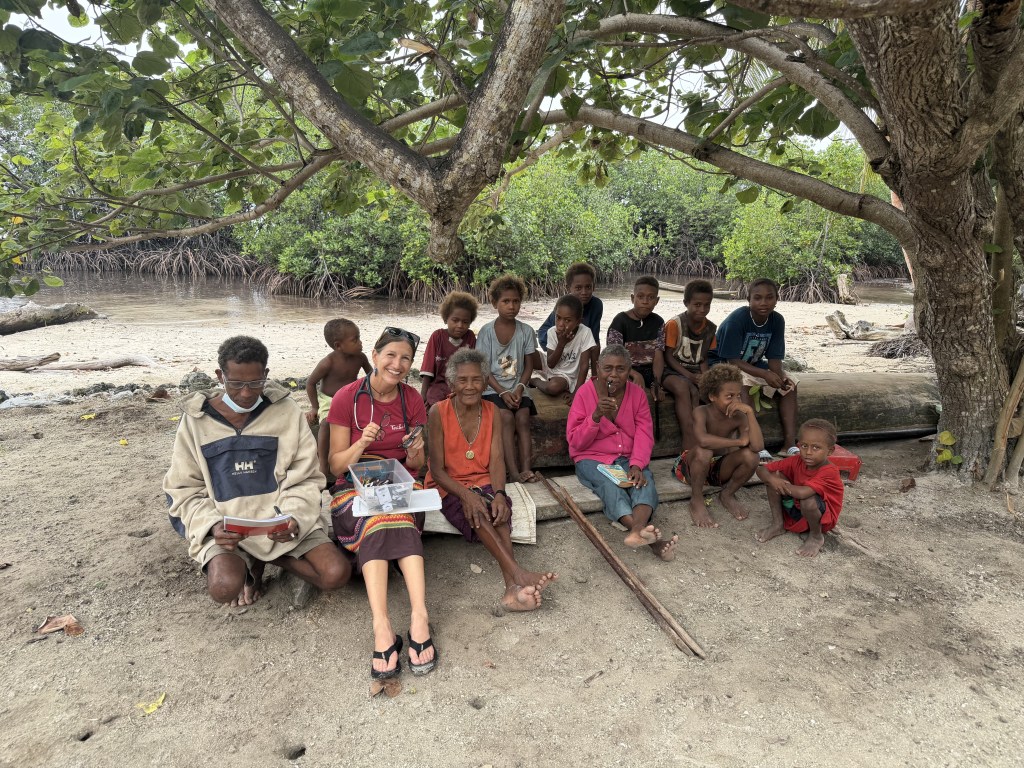
We spent precious time with Chief Clement, as he showed us the medal he was given directly from Queen Elizabeth during a visit to the Solomons for winning a running race, treasured photos of his family, and told us about his life working in Honiara and learning English by reading law books in the legal library he worked in (tough way to learn a language!). We presented Simon with batteries for his little radio (connection to the outside world and music), as well as a typed list of US Presidents that Cora had done (he asked how much he owed her for this). We gave him a book on English grammar, which he grasped and immediately started reviewing aloud past and present participles. When we gave him two more books, one on famous ships throughout history and one on the science of weather, he smiled hugely and put his head onto his lap, so overwhelmed with gratitude. It was so awesome to see his excitement about these sources of knowledge to share with his village. As we pushed off, we said “bommie utu,” the local dialect of good evening, kids climbing in the mangroves and smiling and waving to us as we departed.
It became very windy overnight, keeping us up with our anchor alarm tightly set, given the mooring ball and close proximity of the reef behind us. Still uncomfortable in the anchorage the next morning, Cora and I set off to the school with a task given by a previous boat that was here, to obtain the name of the company that had installed the ablution blocks for the school that weren’t working. It just happened that our friend’s boat had a guest on board that is a septic geologist and wants to help them out.
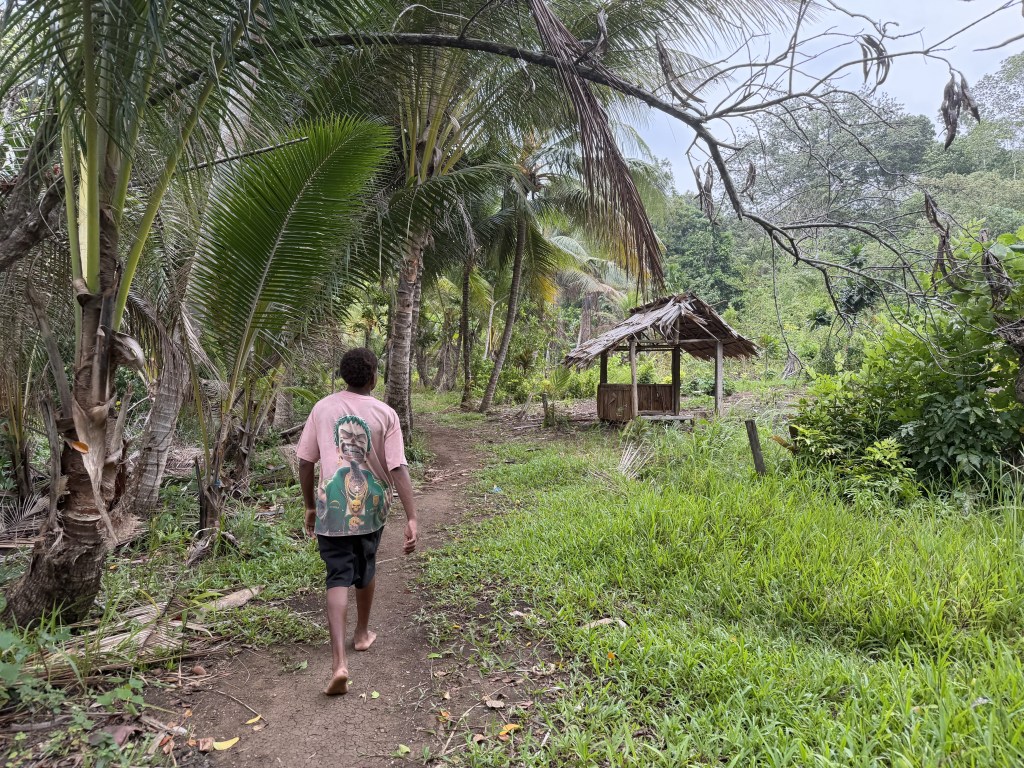
To the village, where Greyson led us along a shoreline trail past many homes to the school grounds to find Mr. Jeffrey, who was teaching a science class of 4 older students. He came out to take us to the Principal, telling me about his health issues and asking for an examination along the way, which I did. He asked me to then come in and teach his science class for a bit. As I talked about the heart, lungs, and oxygen in the blood; I had them use the pulse oximeter and stethoscope on each other.
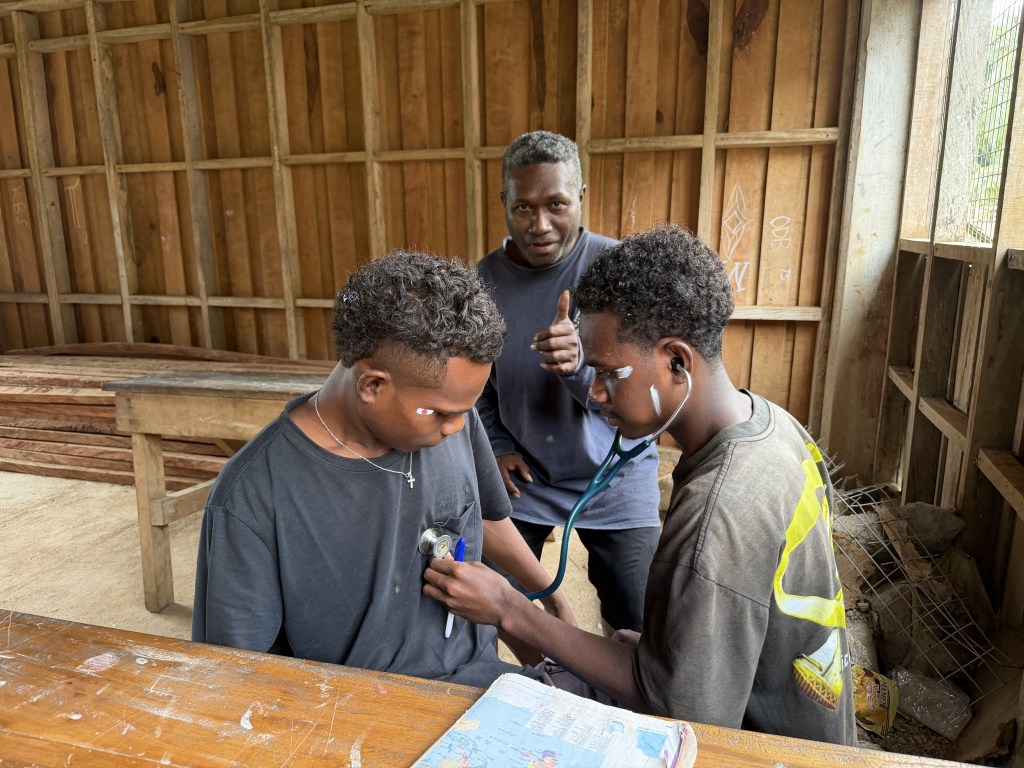
Most of them had never listened to their own hearts with some never having seen a stethoscope. All the other school kids, now on break, gathered outside the classroom peering in to watch. Back to the boat along the trail, I felt like I was in the fairy tale The Golden Goose, gathering more and more people who heard about Dr. Jennifer, as well as the reading glasses that I had. I laughed aloud when a chicken jumped out in the trail, leading our way, with Greyson, some other children, myself, Cora, and men interested in reading glasses all in a growing line! After another medical visit, more glasses fit, and goodbyes to Simon and Chief Clement we needed to be on our way.
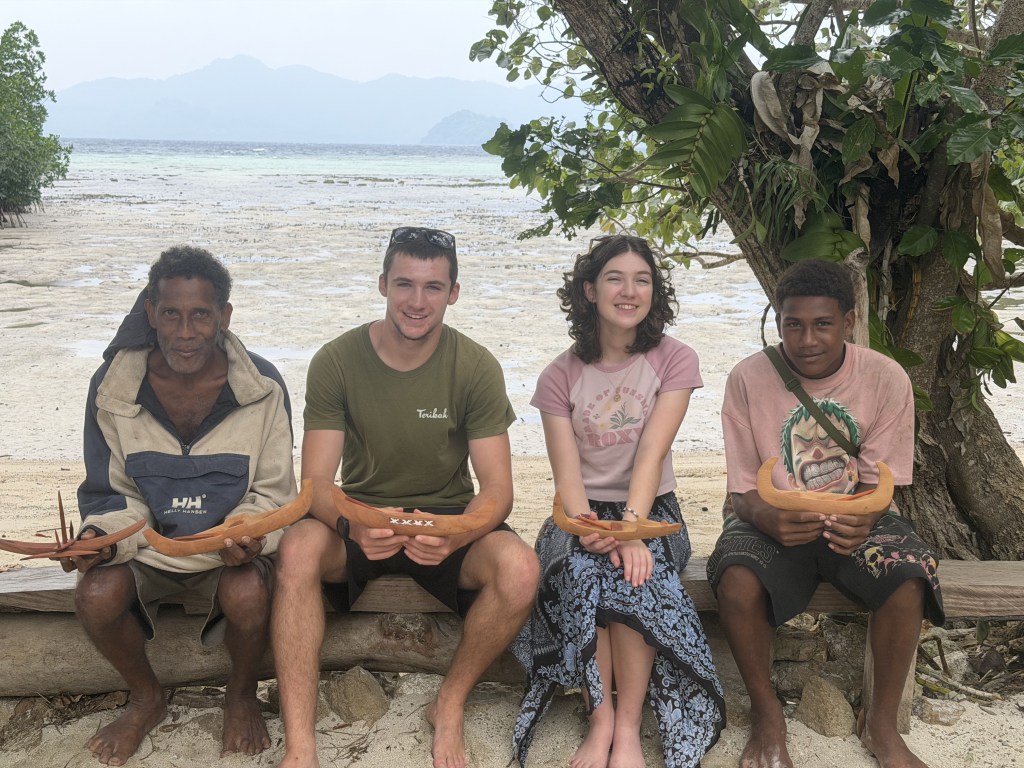
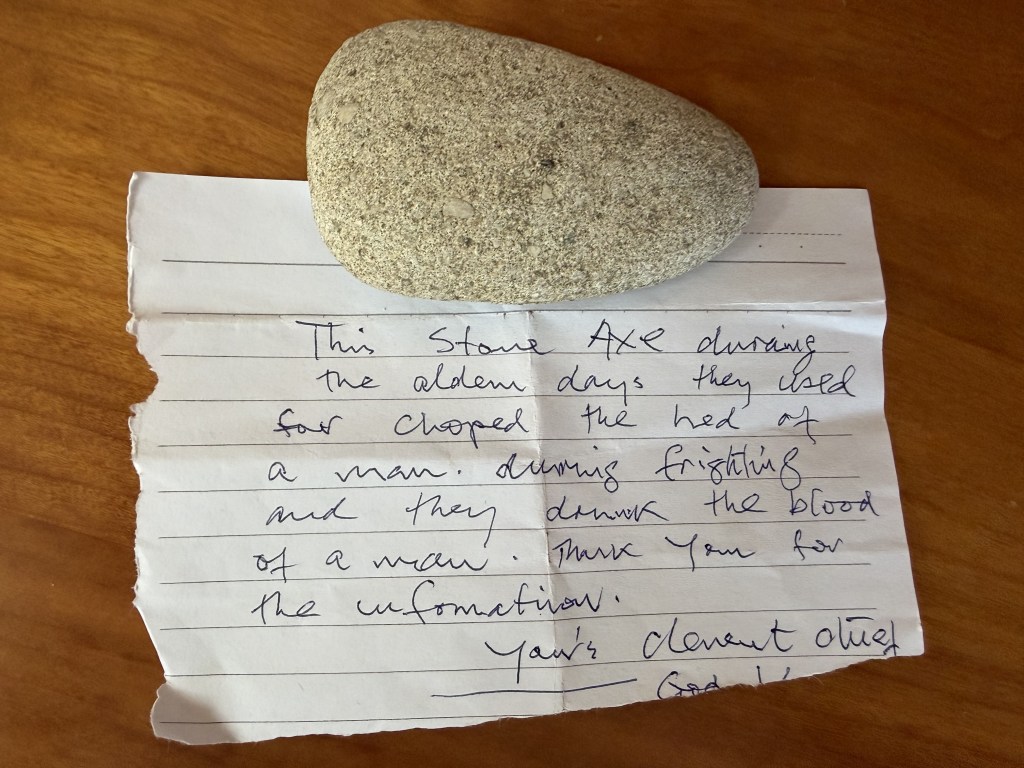
Simon gifted us a wooden canoe. Chief Clement gifted us with some beautiful cowrie shells and a stone ax that he found as a boy in a skull cave from the headhunters, that has decidedly hacked into many a head.
The best parting gift was a blessing that he sang to us to keep us safe on our journey ahead.


3 responses to “Solomons: Florida Islands – We are Family”
Beautiful. Just Beautiful
0477 160 877
*Certified (Photography Institute of Australia) & * *Professionally Accredited (AIPP 2020) *
Commercial, Real Estate, Tuition, Prints & Tours.
“For all of your Photography Needs”
LikeLike
Dear Jenn and Chris,Loved this post! The experiences you’ve been having are really interesting. You are such helpful visitors, I bet the villagers miss you! We are making notes of good things to trade, which is such great intel. Good luck
LikeLike
Yes, I will get you a complete list of items for trade for both the Solomons and PNG!
LikeLike