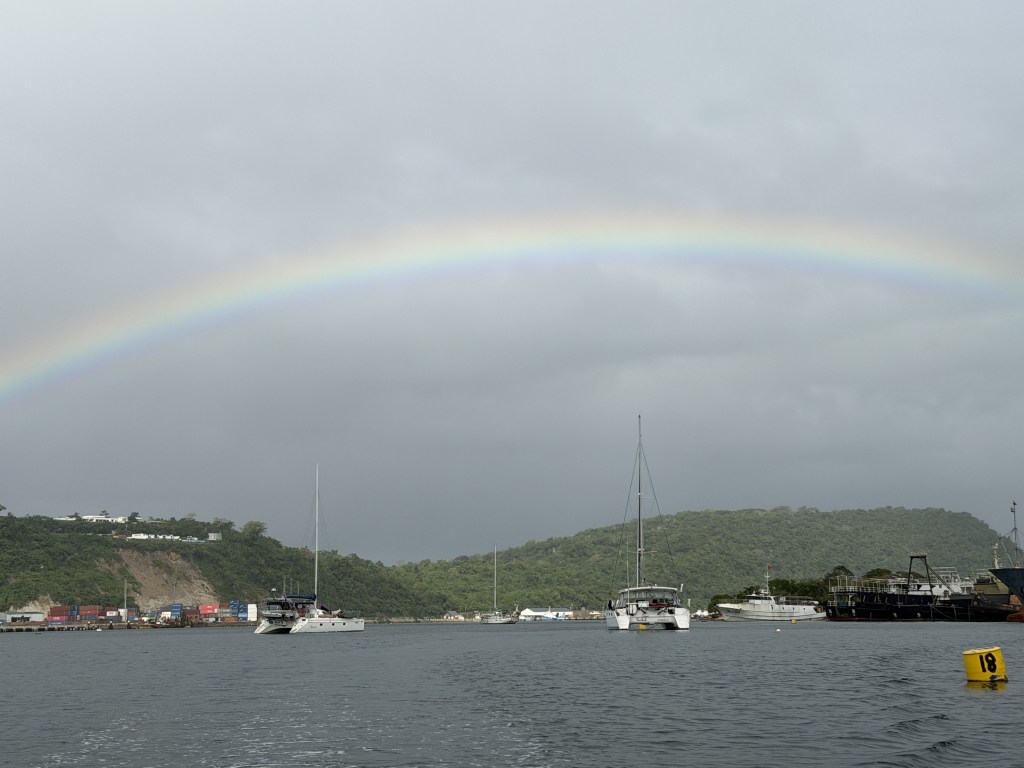
Into Mele Bay, we were met by the local crew of Yachting World Marina in their 14-foot yellow aluminum skiff at our mooring ball to greet us with smiles, waves, and to help us tie up to our home for 4 nights. Port Vila, the capital and largest city of Vanuatu at 53,000 people, is a vibrant waterfront town known for its sheltered harbor, colorful markets, and mix of Melanesian, French, and British influences. It is the country’s main hub for government, commerce, and tourism and Terikah was in the midst of it all. We were moored amongst derelicts, military ships, ferries, cargo ships, luxury yachts, and fishing vessels.
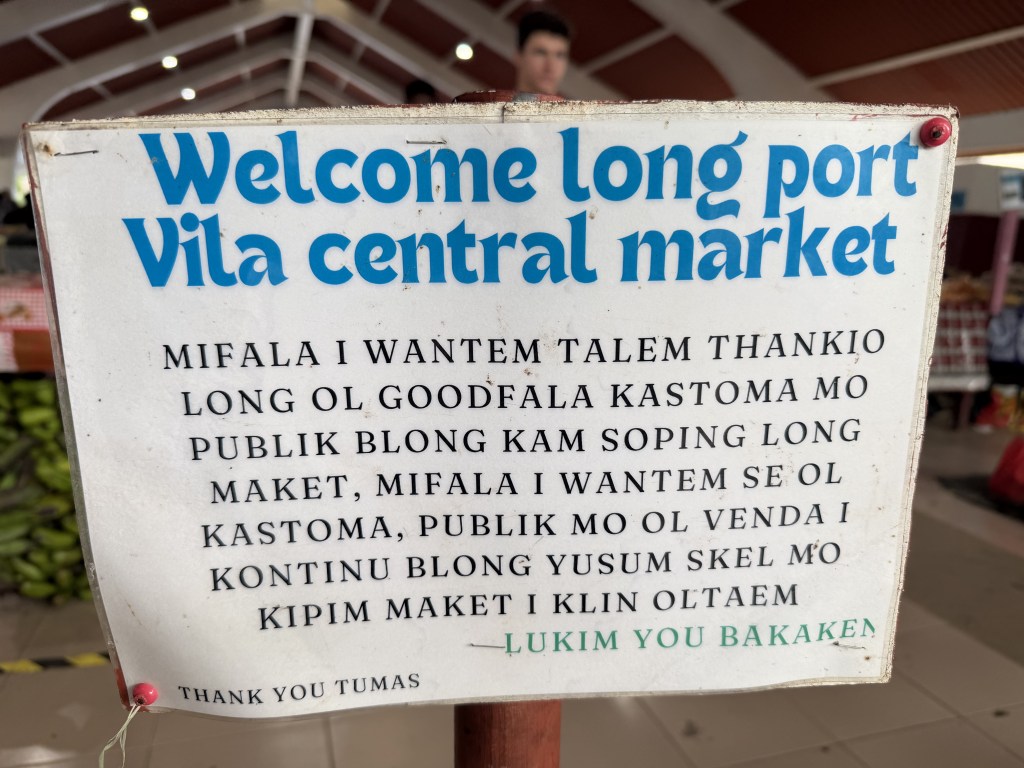
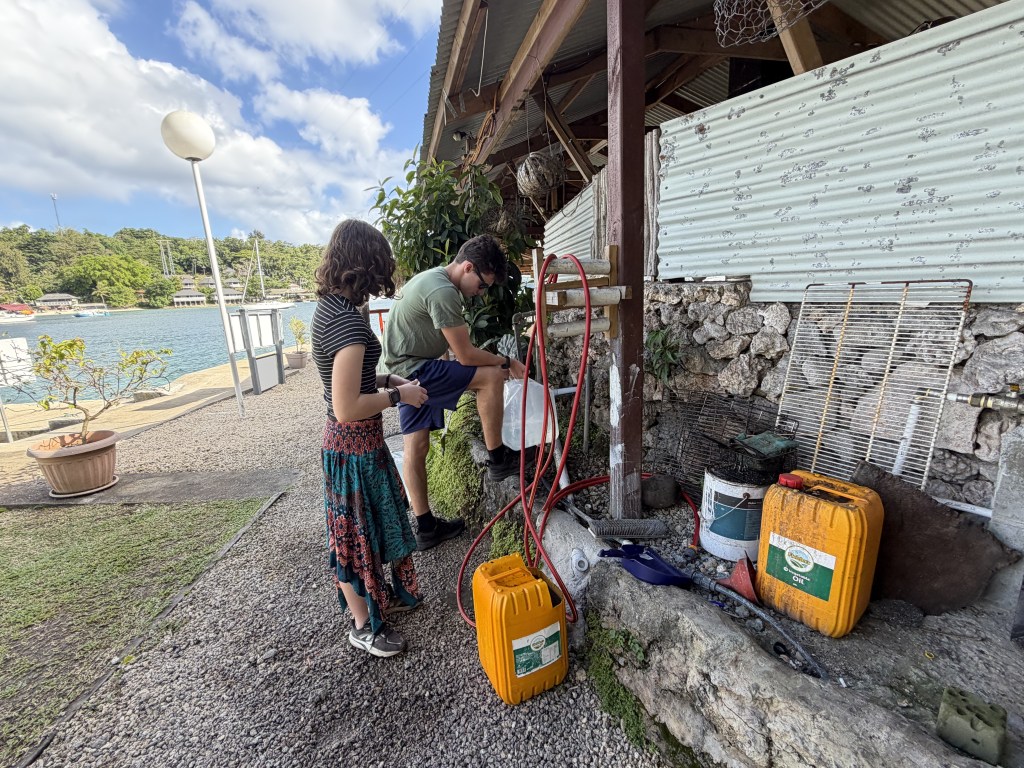
We paid about $25 USD nightly to stay on the Yachting World mooring with access to a secure dinghy dock, fresh water, showers, diesel, and laundry. When we get to a big city, it’s time to get busy and reload Terikah with supplies! We stopped in the office with our mysterious brown envelope from Customs with its multiple seals and stickers, “Port Vila Customs Only” written on it, only to be told by Customs that it’s no problem, just give it to the Sola officials when we check out of the country! We are loving the local language of Bislama and the signs that we can mostly understand, such as the sign in the Taste of India restaurant bathroom: Ples flushm toilet afta you usem.
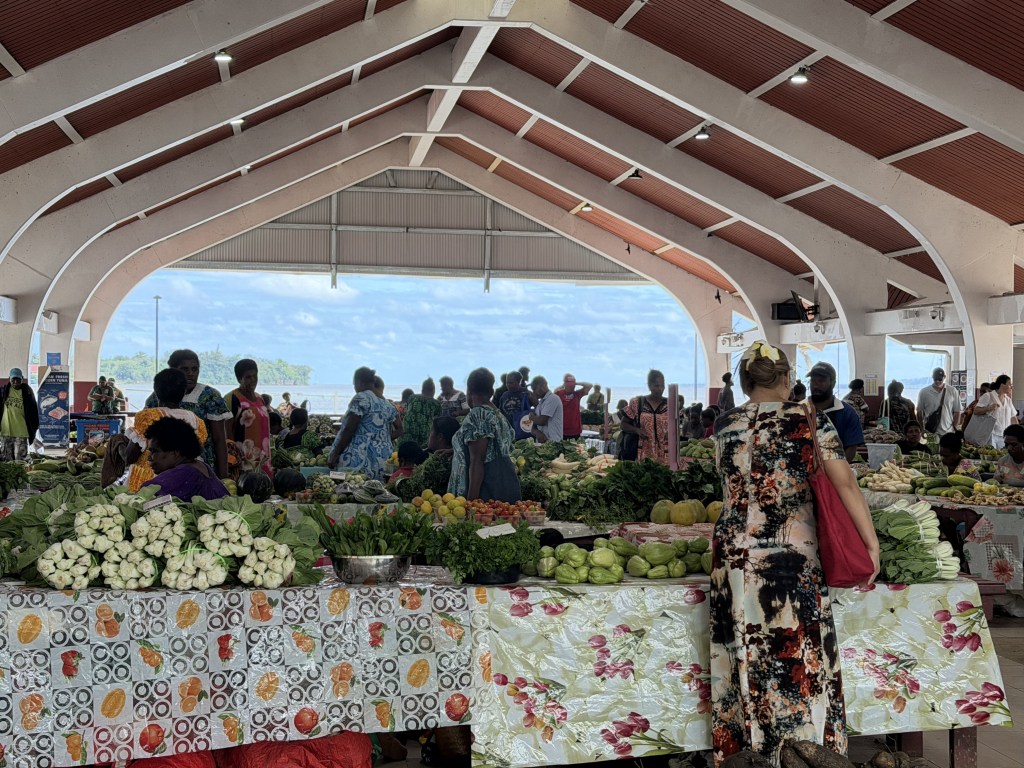
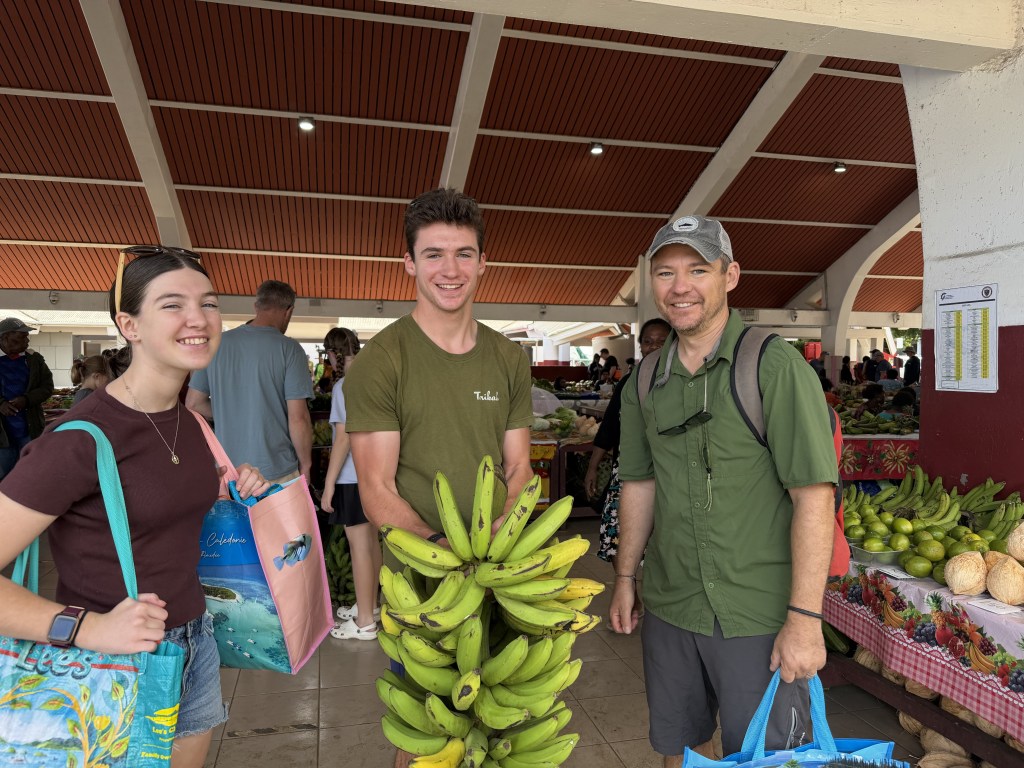
The market a colorful display of fruits and vegetables with the women in their Mother Hubbard dresses, a tradition introduced by Christian missionaries in the 19th century that has since become an iconic part of Vanuatu culture with their vibrant patterned fabrics. Many tourists, mostly from Australia, were out exploring as well. At the craft market, Cora and I bought jewelry made by a lovely couple from a small island across the way.
Sailed the short 4 nm over to Mele anchorage. Interestingly, during World War II, the first U.S. forces landed on Efate in May 1942 expecting to encounter Japanese troops, but instead found the local people and quickly transformed Efate Island into a major Allied base with airfields, hospitals, supply depots, and protected anchorages. By November 1943, Mele Bay had become the rehearsal site for the U.S. Marines’ amphibious assault on Tarawa, where thousands of troops practiced beach landings with amphibious tractors and live naval bombardment before one of the Pacific War’s most significant battles. As we continue our exploration of the South Pacific, we will be learning about WW II in a new way.
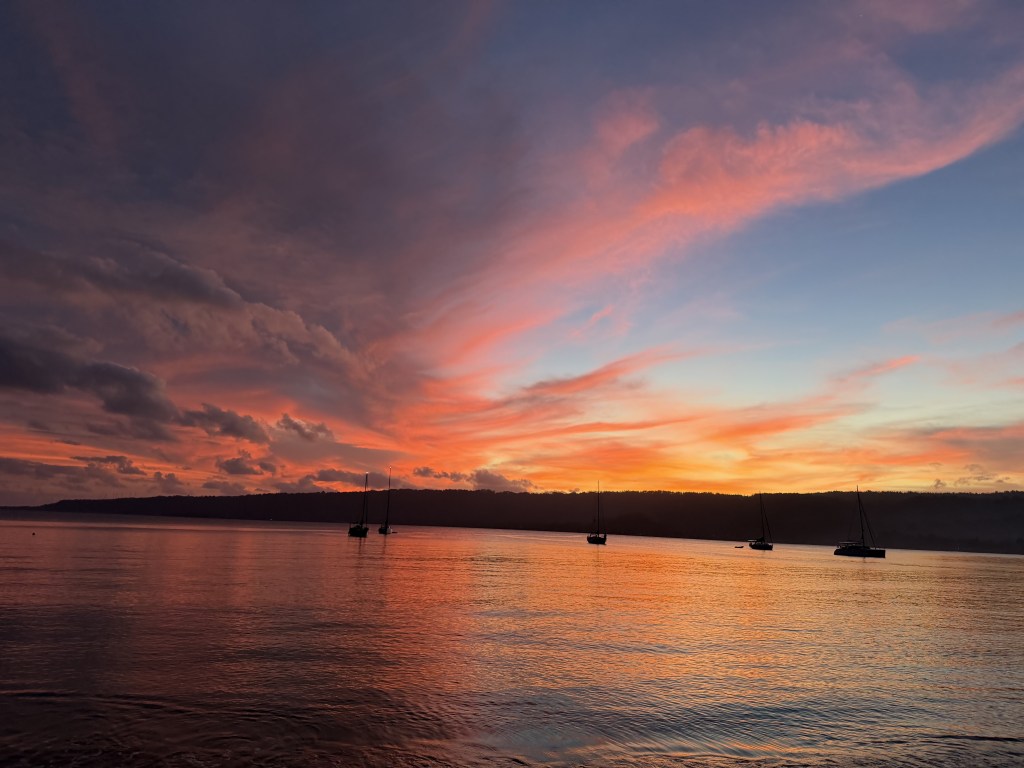
However, we were at Mele for one specific purpose – to see the famous Fire Show at Beach Bar! The show began as a small gathering of local performers and has grown into one of Vanuatu’s most stunning weekly attractions. Today, the volunteer performers (donation bucket passed around as this is their primary means of income) use the show to support local youth by teaching traditional fire dancing, promoting cultural pride, and helping raise funds for equipment, education, and community programs.
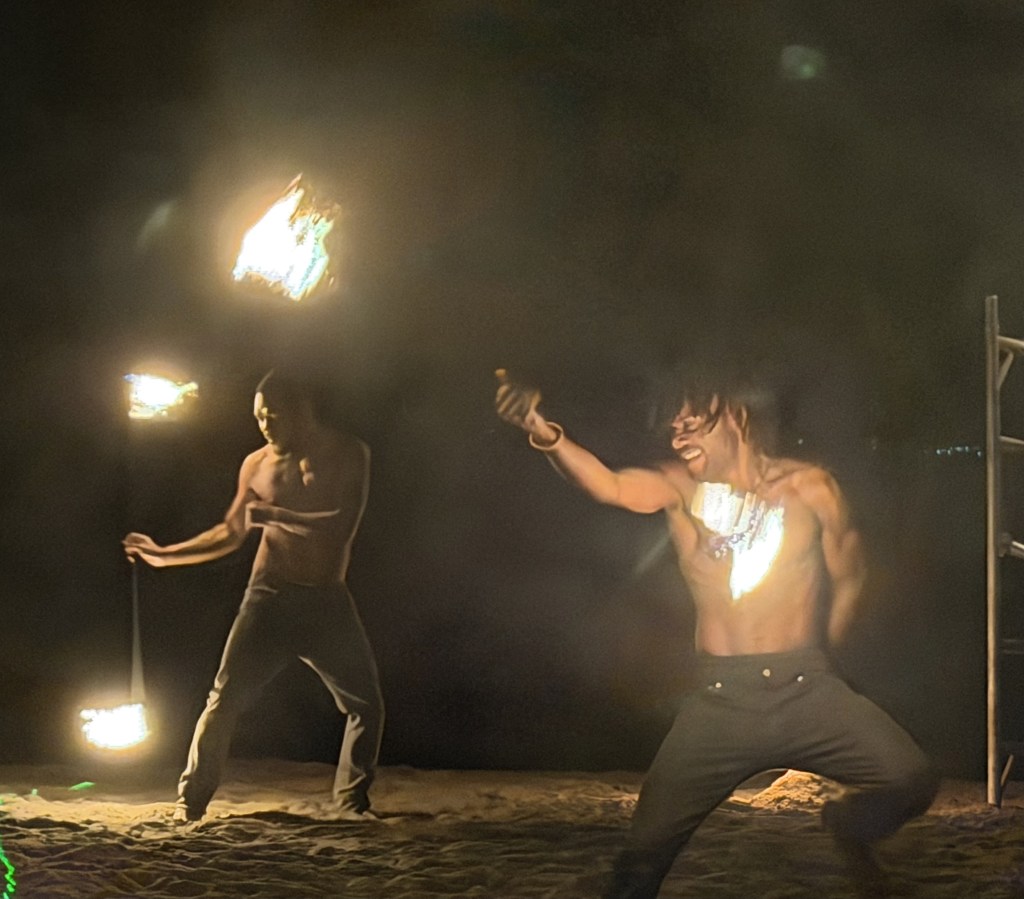
The show was promoted to be the top fire show in Vanuatu and it delivered! Starting right after sunset, the mix of fire poi (flaming balls on chains), fire staff, fire breathing, and acrobatics all synchronized to a mix of thrumming music was stunning!
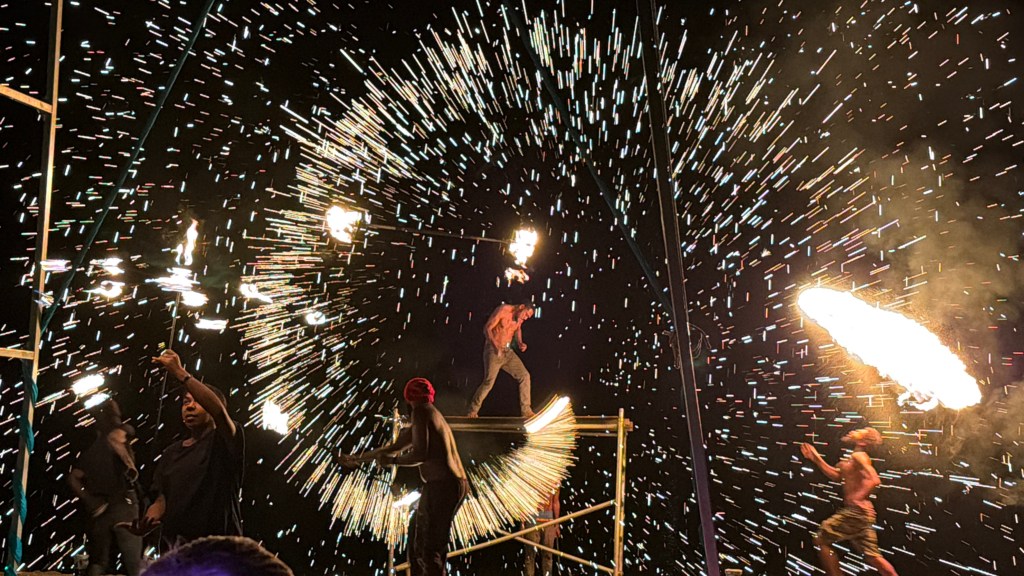
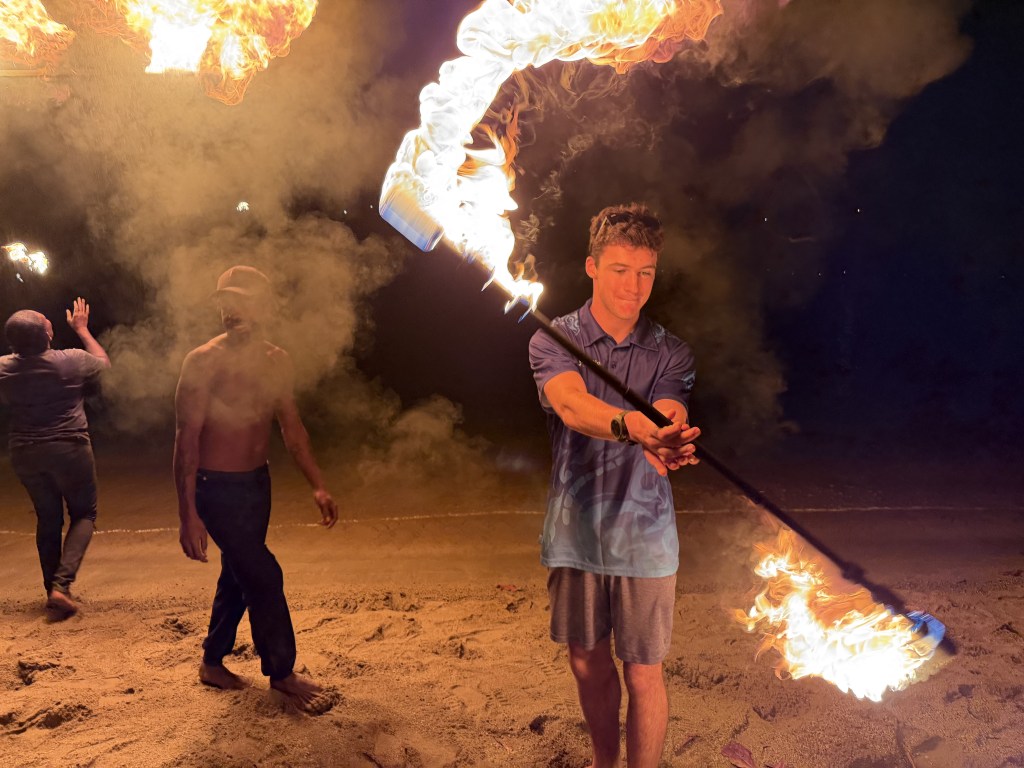
Their energy was contagious and we couldn’t stop smiling, well after the show was over. Calder even got a turn at spinning a lit fire staff.
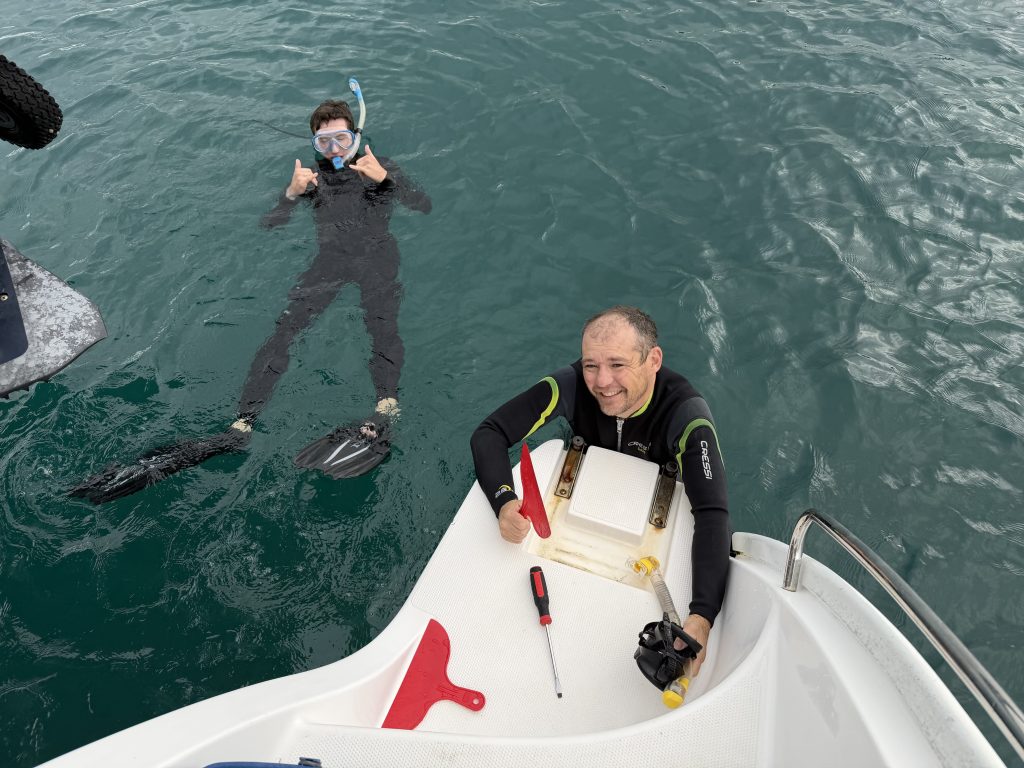
The next day, in the clear water, Chris and Calder tackled the baby barnacles on our hull that threatened to take up residence and now our bottom is squeaky clean again.
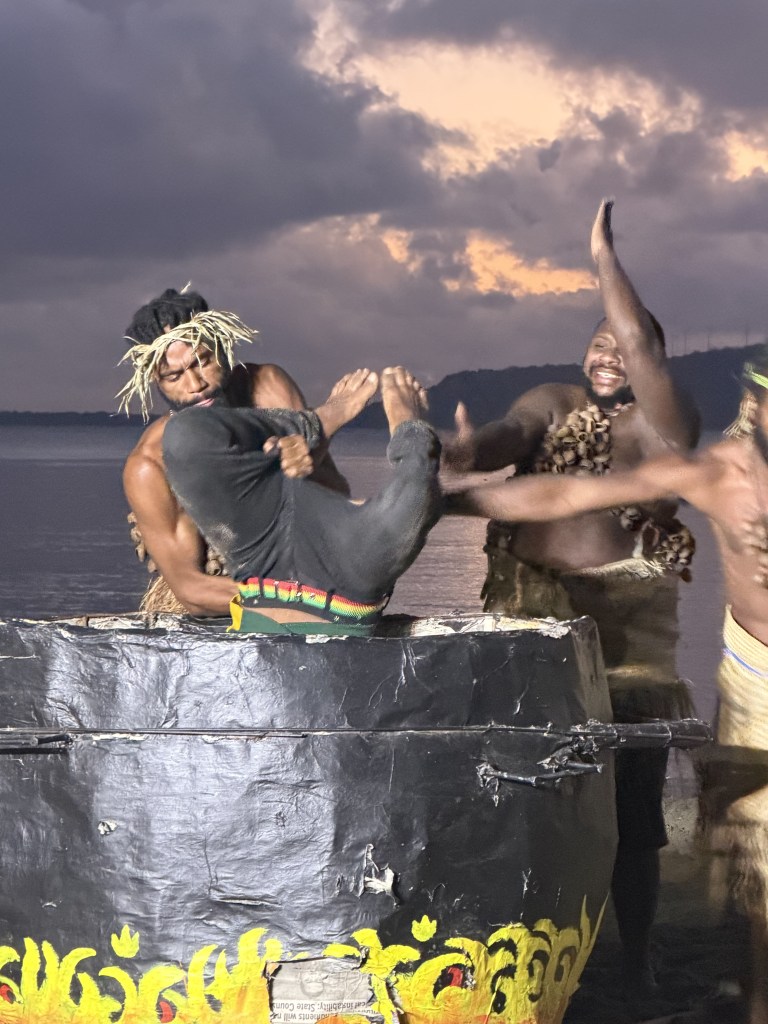
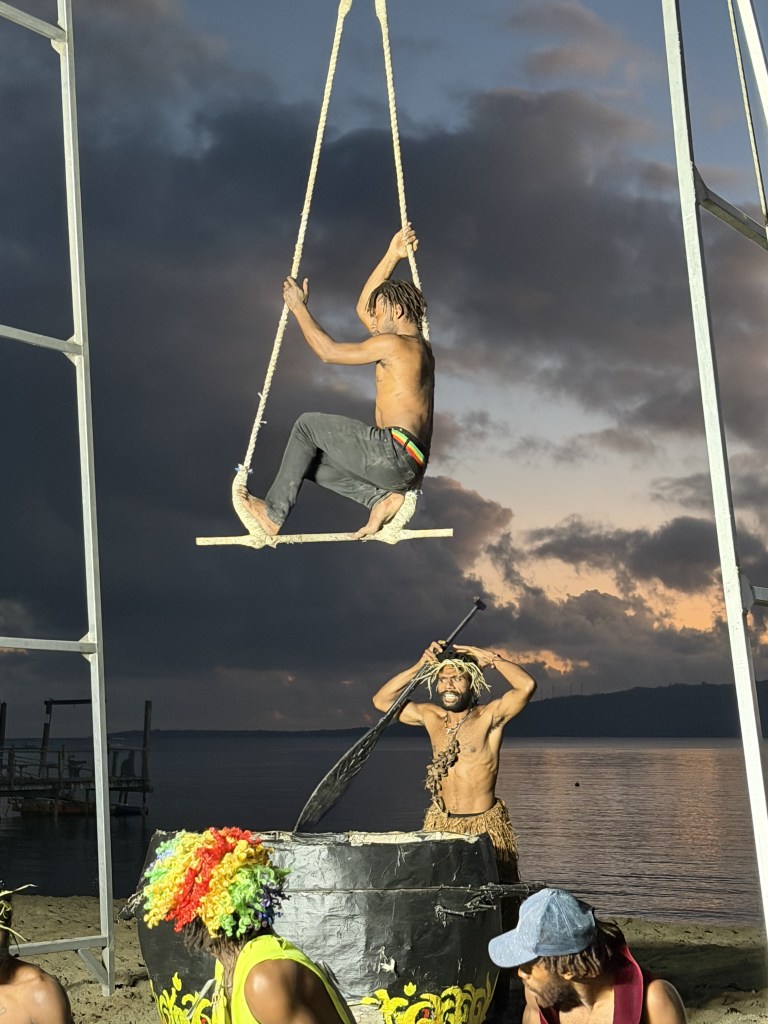
The Beach Bar has just started another weekly show, the Circus and Light Show, so back we went for a sunset circus show that had us laughing at their comic portrayal of putting a human into a cooking pot and other antics.
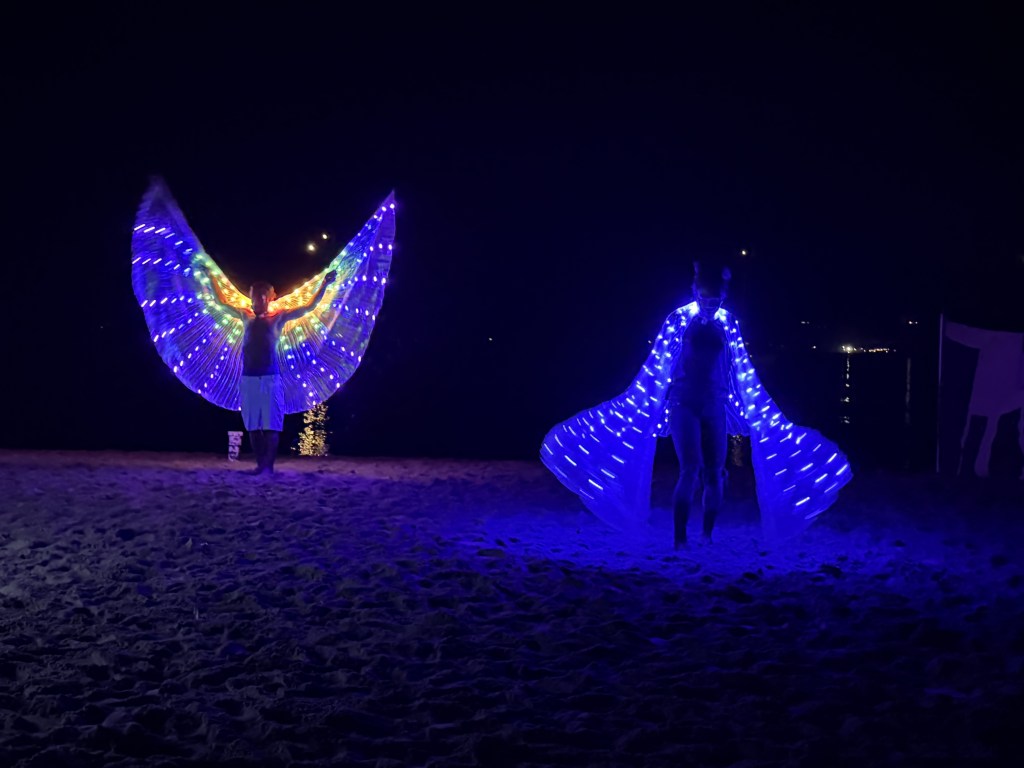
Once the sun set, they turned off all the other lights and did a beautifully choreographed performance using LED and black light. I have a new favorite musician, Tui, from the island of Ambrym in Vanuatu.
Back to Port Vila for two more nights, as one of our good family friends/Cora’s best friend/Calder’s girlfriend (aka Lauren) is flying here to join us for two weeks. We are in the land where mosquitos carry diseases and there is a current dengue outbreak on the island of Efate, so DEET and closed screens have been part of our daily routine. Dengue Fever is a viral illness that can cause sudden high fever, severe headache, pain behind the eyes, muscle and joint aches, rash, and profound fatigue; there is no specific antiviral treatment or preventive medication (very limited world vaccine supply), so avoiding infection is important because severe cases can lead to dangerous bleeding, shock, hospitalization, and weeks of recovery. So, yes, daily DEET. Right now the main concern is dengue, but soon it will be malaria. As we will be living in malaria regions for about 6 months, we need to prioritize taking daily prevention medications in the highest risk regions, as well as ideally having emergency treatment if needed. Before leaving New Zealand, I had secured some of the prevention medicine, but the treatment medication was extremely expensive ($4,000 USD for four emergency treatments) and soon to be outdated in the pharmacy. I decided to see what I could find in Vanuatu. Into a local pharmacy, I talked directly to the pharmacist and, after a bit of discussion, she asked if she could help me. She then apologized that she could not walk me to the hospital pharmacy (!), as she had to leave work, but made a phone call and gave me the name of her friend who worked there. We walked over to the hospital pharmacy and the woman hands us 4 full treatments for malaria…for free. We feel so thankful and so relieved. The kindness of people continues to inspire me.
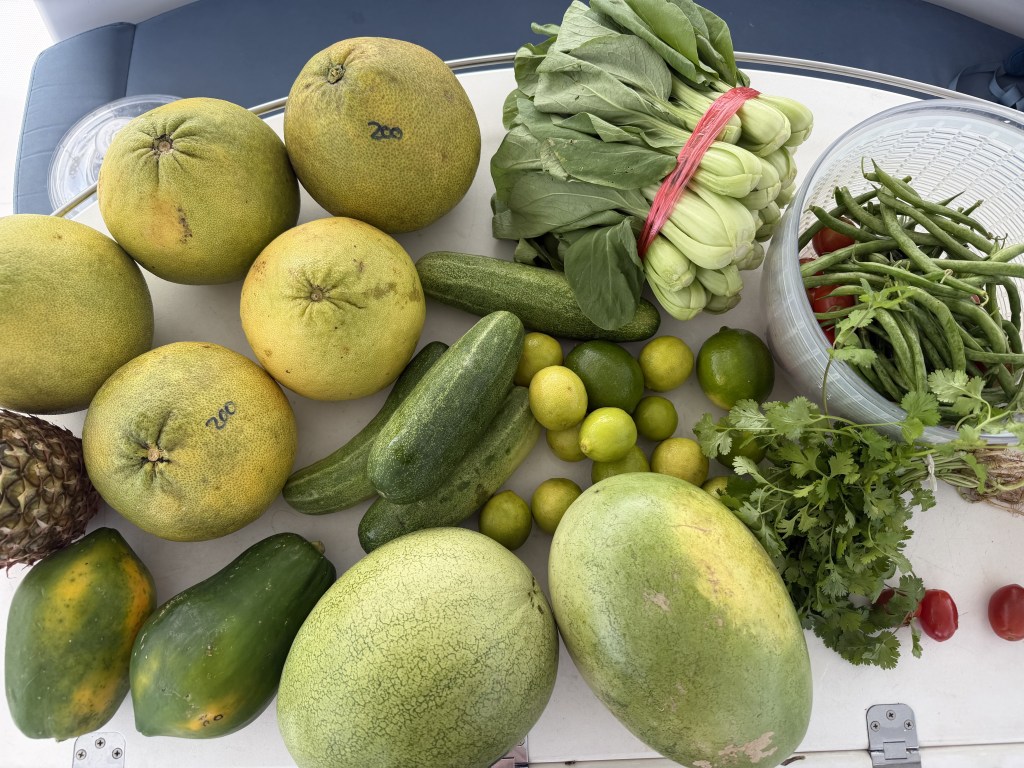
In Port Vila, we felt a part of this friendly country when the Immigration woman from Tanna came over to say hello and shake our hands, recognizing us at the grocery store! We enjoyed our dinner out at Lalala, but enjoyed our conversation even more with some of the staff. One young man from Pentecost Island shared his experience of land-diving, having to overcome fear and transition into manhood; now he is working between Vanuatu and cruiseships (said Alaska was his favorite). One woman from the Maskelyne Islands told us how she was here in Port Vila for her two children to go to school, working to pay for their school at minimum wage (300 Vatus per hour, which is approximately $2.50 USD). The next day, walking down the sidewalk, a truck pulled over and our waiter stepped out exclaiming that Chris had left his hat at the restaurant, quickly fetching it for us. Another small-town island moment.
One day, as we were walking, we saw a large gathering – it was a Solomons Islands independence day parade (48 years), the neighboring islands to the north. Pacific island nations are closely connected, with families, cultures, and communities often spanning multiple islands and countries.
We spent two hours with Edgar, of North Pentecost Island, at the Nasonal Miusium Blong Vanuatu (National Museum of Vanuatu). Our main reason for going was to see the art and language of sandroing (sand drawings) and Edgar was an artist.
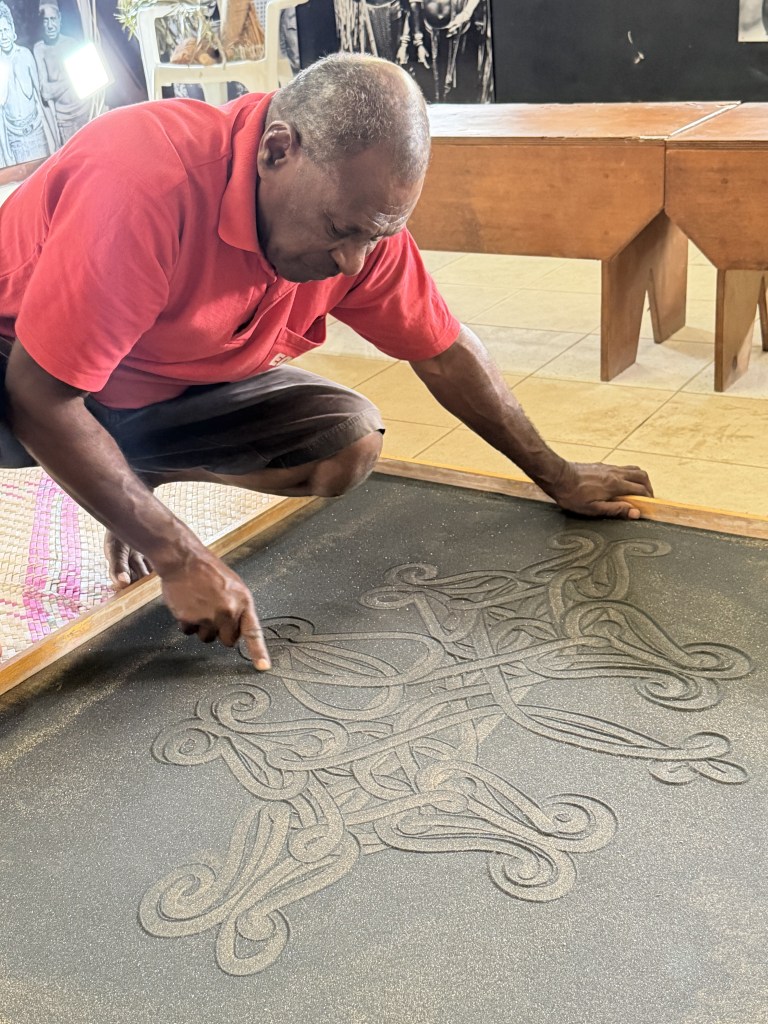
We each learned how to introduce ourselves in Bislama: Nem blong mi Jennifer. Mi blong Petersburg, Alaska. Tankyu tumas. He then shared his art with us. Vanuatu sandroing (sand drawings) are geometric designs traced as a continuous line, often without lifting the finger from the ground. Calling them drawings is misleading, because they are a form of script that predates the introduction of European education. They are used to leave messages, explain concepts and teach children, often accompanied by stories or songs. In 2003, UNESCO proclaimed Vanuatu sandroing to be a “Masterpiece of Oral and Intangible Heritage of Humanity.”
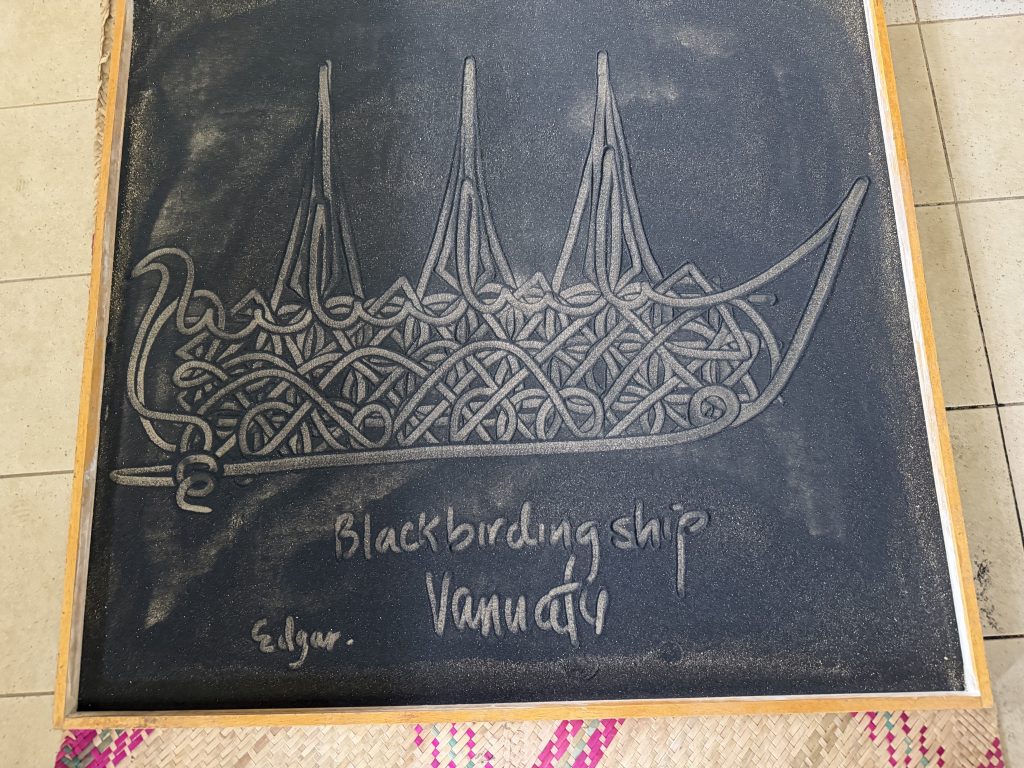
Edgar’s first story and drawing told of the history of a Blackbirding Ship going to a village and stealing people to work back in Australia. Between the 1860s and early 1900s, ships from Australia kidnapped through a practice known as blackbirding thousands of ni-Vanuatu to work on sugar cane plantations under harsh and frequently exploitative conditions. He then did a sandroing with both Calder (a butterfly) and Cora (a kingfisher).
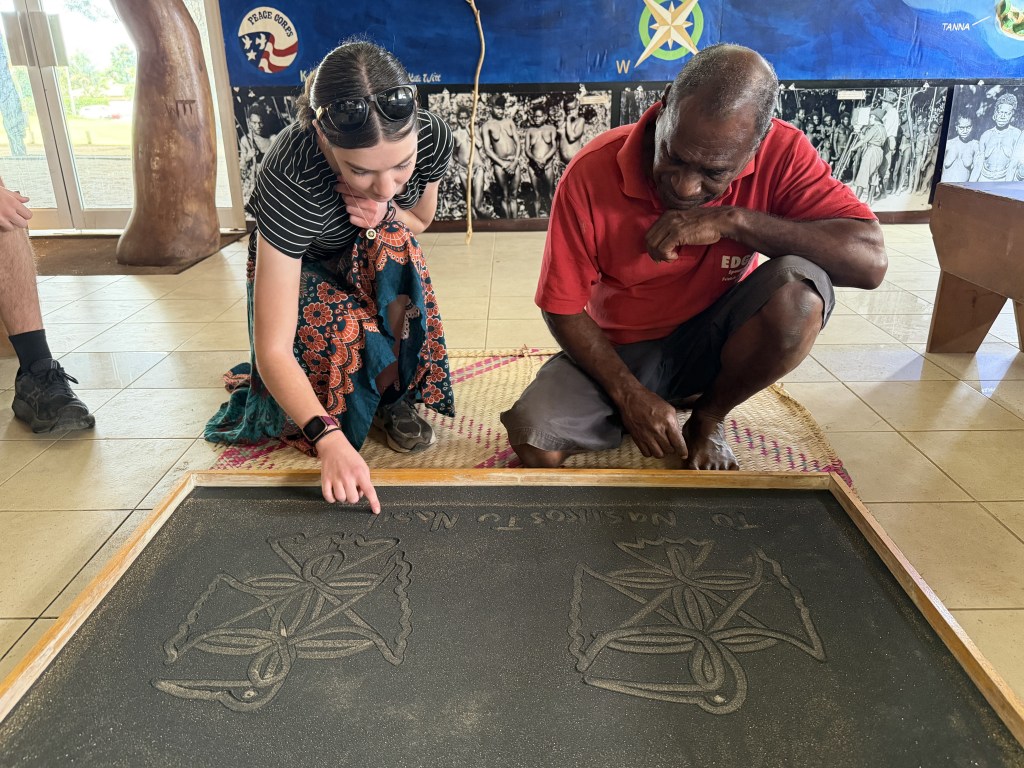
Edgar also explained the provinces and islands of Vanuatu, including their original names and meanings, and the symbolism of the flag.
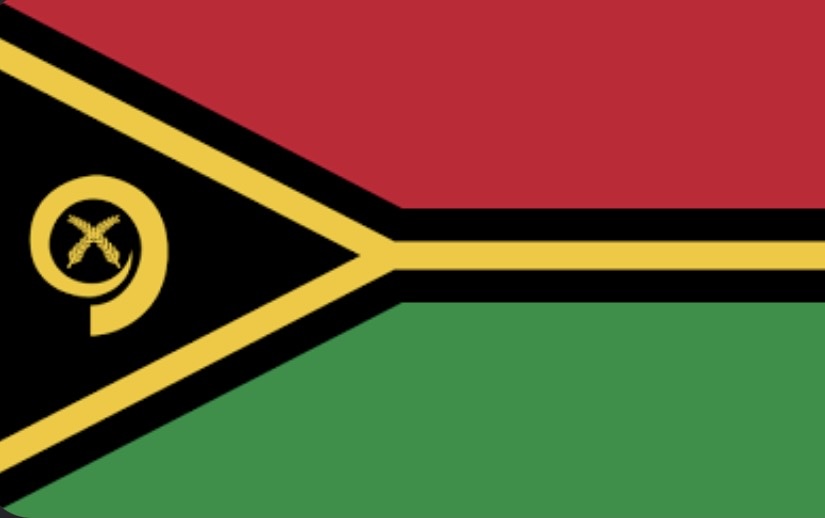
The Vanuatu flag symbolizes the nation’s identity: green represents the islands’ lush vegetation, red the blood and sacrifices of its people, black the Melanesian people, the yellow Y-shape the islands spreading through the Pacific and the light of Christianity, and the boar’s tusk and crossed namele leaves represent prosperity, peace, and traditional authority.
Edgar demonstrated two traditional ni-Vanuatu instruments: an end-blown bamboo flute and a set of bamboo panpipes, whose bamboo tubes of varying lengths each produce a different note. He played and sang the national anthem. Vanuatu gained independence from the British and French Condominium (had not just one colonizer, but two!) on July 30, 1980. As of 2026, Vanuatu has been independent for 46 years.
After one last quick market stop for last minute passionfruit and another fill of our fresh water, had a full daysail along the western side of Efate Island. Efate is Vanuatu’s third-largest island, home to about 70,000 people. We are solidly in the southeast trade winds and it has been wonderful to simply sail northwest.
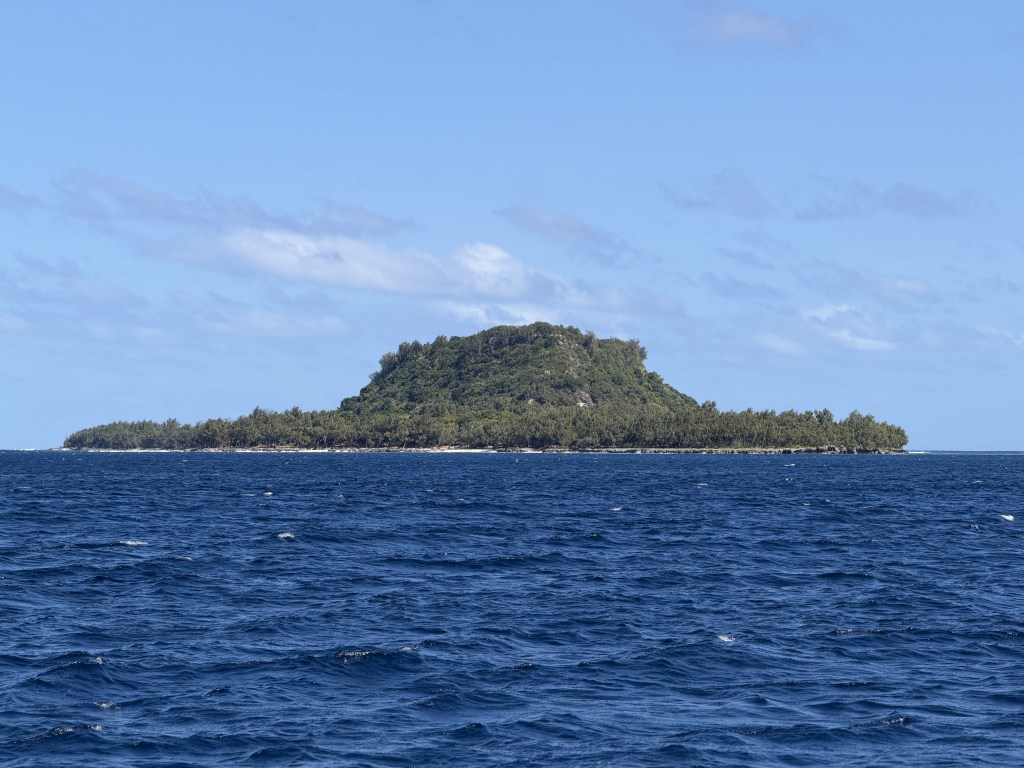
Sailed past Artok Island (formerly known as Hat Island and traditionally called Eretoka), the burial place of the legendary Chief Roi Mata, a 17th-century paramount chief remembered for ending generations of warfare and uniting many communities across central Vanuatu. According to oral tradition, about 50 of his wives, family members, and loyal followers voluntarily accompanied him in death and were buried beside him in a remarkable mass grave that was later confirmed by archaeologists, contributing to the area’s designation as a UNESCO World Heritage Site. Edgar shared this story, also stating that the island became fenua tapu (“forbidden land”), and for more than 400 years many people believed anyone who entered without proper permission risked angering the spirits and being driven away by misfortune or unexplained events.
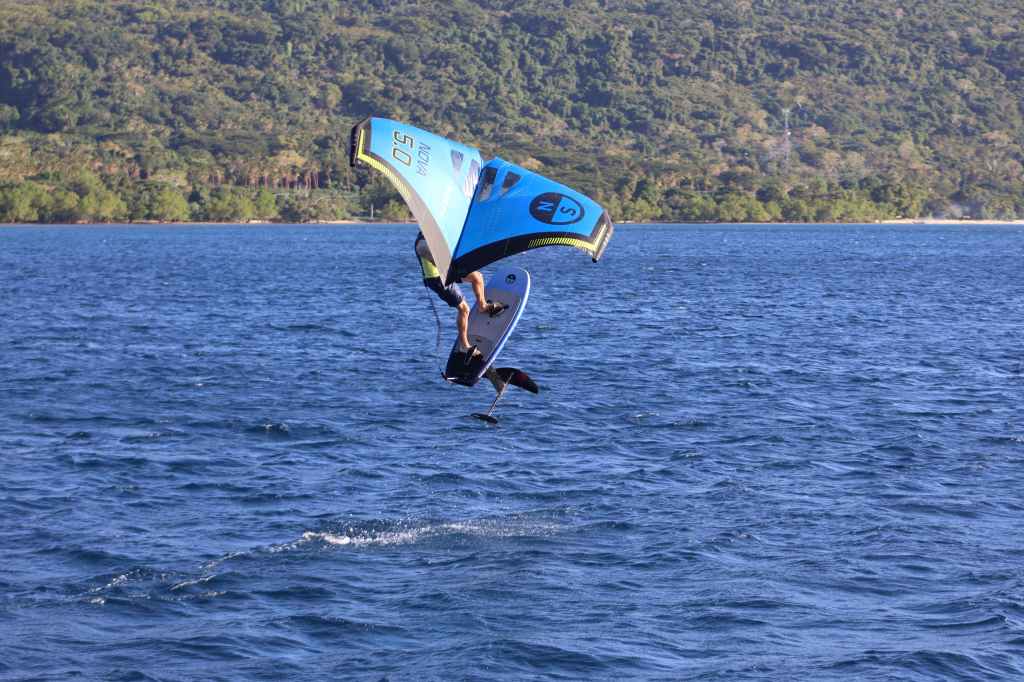
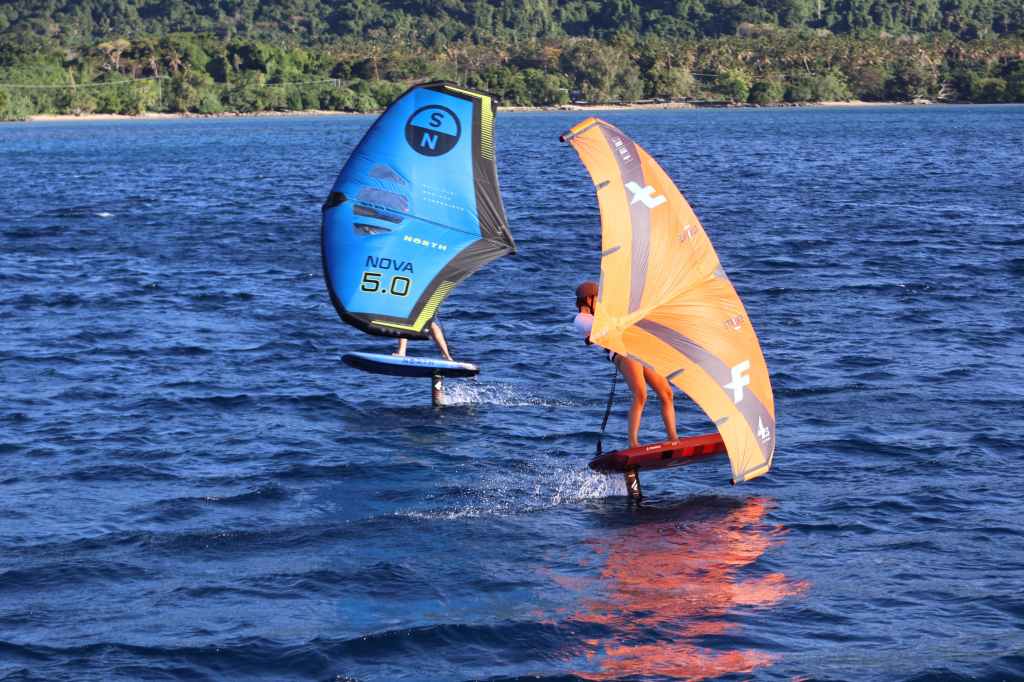
Safely past Artok Island with no mishaps, we anchored off Kakula Island, where the wind filled in nicely for a late afternoon foiling session for Calder and Lauren.
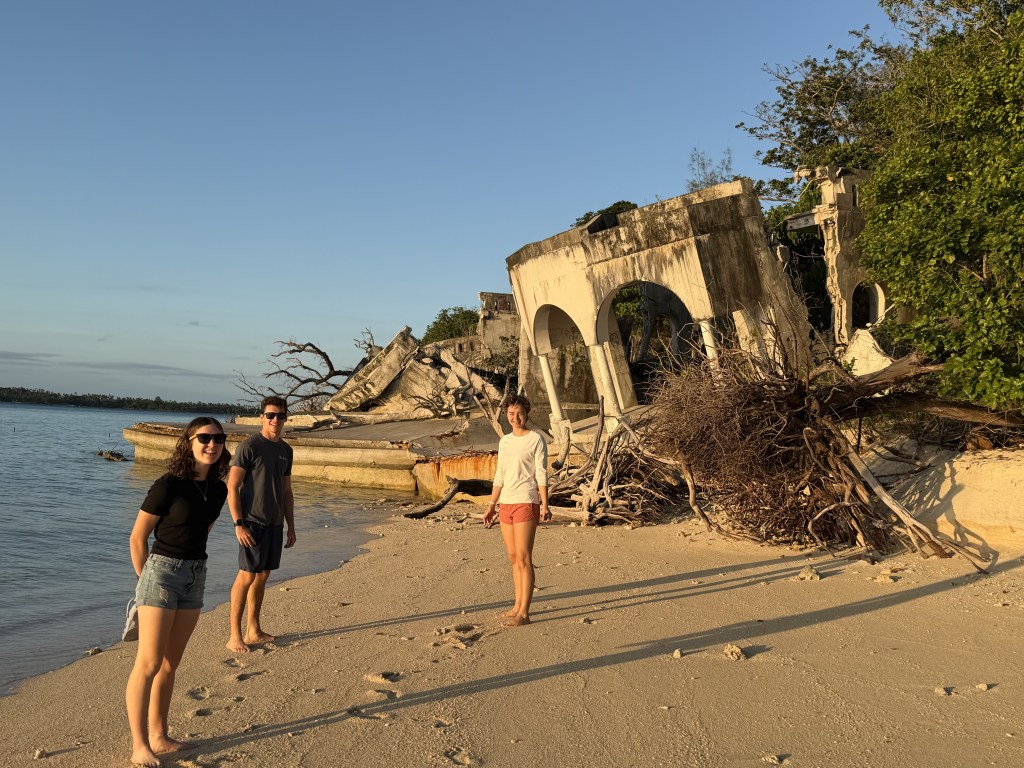
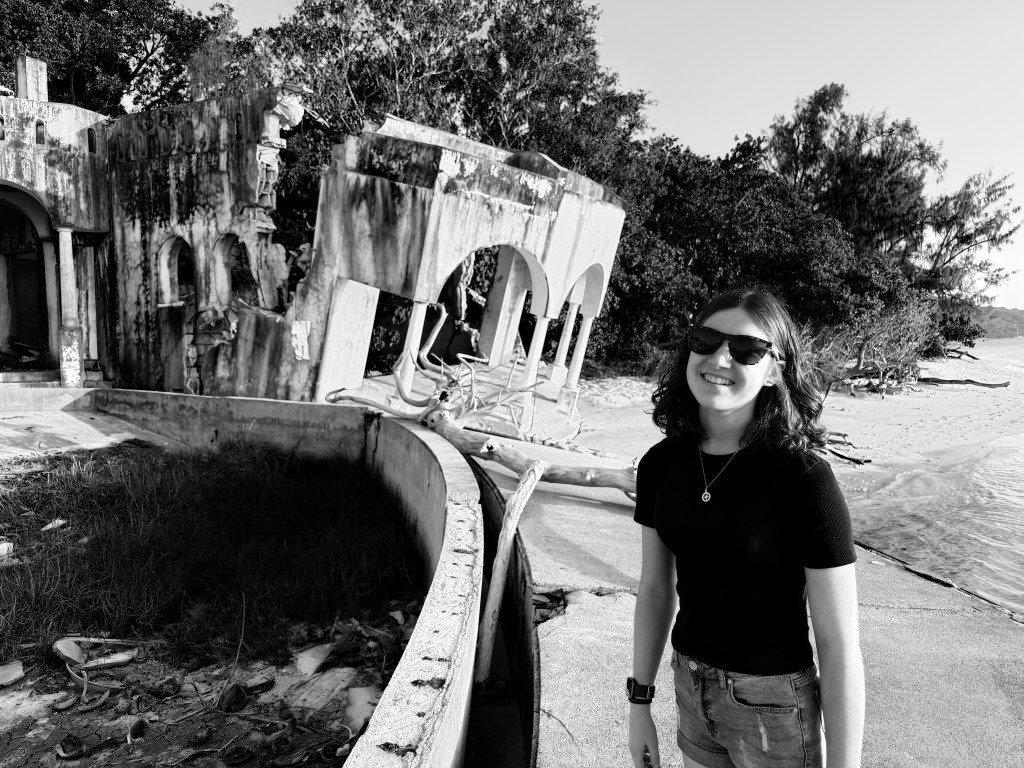
Over to explore the remains of a luxury hotel on the shore at sunset, closed in 2006 and abandoned, ravaged by cyclones with the entire beach foundation washing out from under it.
After a delicious dinner of yellowfin tuna steaks and games, to bed early for (another) pre-sunrise passage morning to head north, leaving Efate to explore the middle islands of Vanuatu over the next couple of weeks.
 SV Terikah Adventures
One response to “Vanuatu: Efate Island”
Just the smiles on everyone’s faces tells the whole story.
Thank you again for sharing. It’s terrific to be able to see the places of the world that you’ve visited.
Be safe in your travels. I’m waiting for the next post.
Take care!
James Reece 9075184460
LikeLike