Waking up at anchor in Port Resolution, Tanna Island in Vanuatu, my senses were filled with the sounds and sights of this jungle landscape. I heard children’s laughter, a cow mooing, roosters crowing. The shorelines were bustling with the activity of the morning. Around our boat, the local fishermen in their handmade dugout outrigger canoes were busy catching mackerel. They had all paddled from various shores in the bay to meet in a central location, standing up to see the schools of fish underwater. Their light laughter and conversation would come to a more urgent crescendo and the nets would go in, circling the fish.
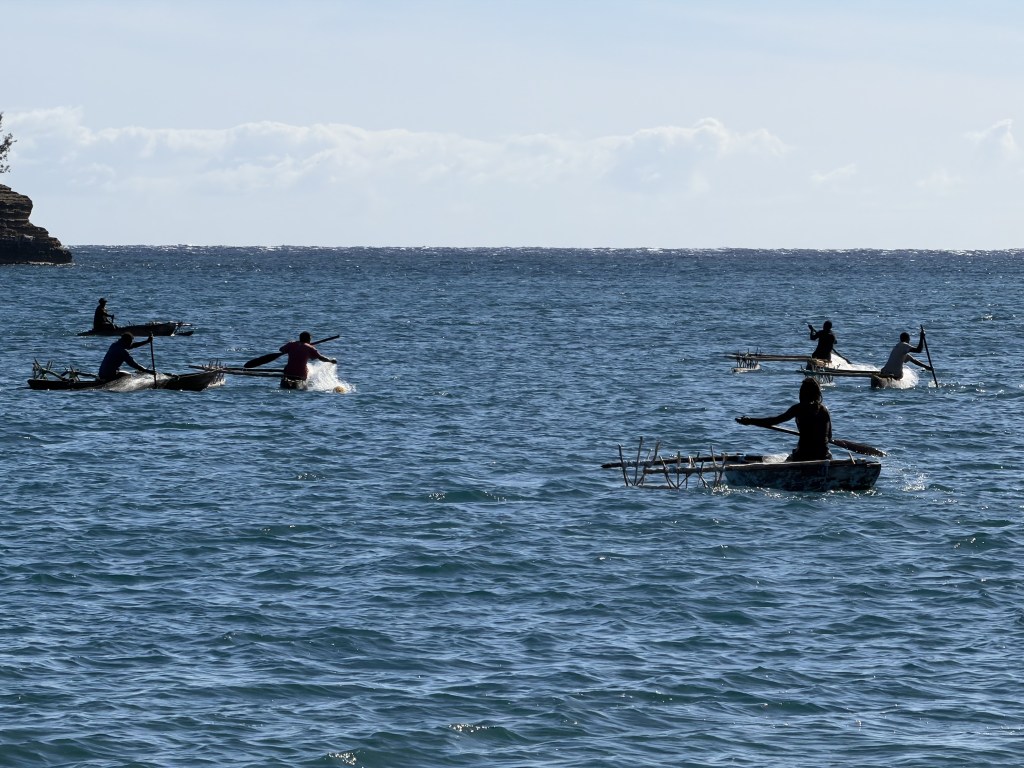
Orders were given, the outriggers were paddled fiercely trying to run the fish into the nets, people even jumped off their boats splashing, others smacking the water with their paddles. (It was similar to our subsistence gillnetting in Alaska in many ways, though I’m going to have to challenge Chris and Calder to up their commitment by jumping into the water and splashing to corral the fish!) There would be hoots and hollers as their nets went underwater, then they would haul in their mackerel and fill their boats. This was all done with the backdrop of a hillside with rolling geothermal vents. I would say hello and make light conversation as they came by Terikah, clarifying that we were not in their way. Werry, from a nearby village, showed me the mackerel that he had caught, stating that the clouds overhead made it more challenging to fish. Their boats are made from breadfruit trees. Werry talked to me about our route home to Alaska, very clearly understanding the geography of our route, as well as the political situations in the world. They do have internet here and will communicate with me via WhatsApp, all while maintaining their subsistence living. Werry also commented that a USA company is working on geothermal energy for the island, hoping to avoid fossil fuels as much as possible. There are many rainsqualls coming through, which helps clean the salt off the boat from the passage. A large rainbow arced across the villages at the head of the bay.
The country of Vanuatu is an archipelago of 83 islands in the South Pacific with a population of about 340,000 people, known for its remarkable cultural diversity with about 138 distinct Indigenous languages, giving it the highest density of languages per capita anywhere in the world. Located on the Pacific Ring of Fire, Vanuatu is home to several active volcanoes and is one of the most geologically active countries in the world. Ni-Vanuatu (“of Vanuatu” in Bislama) are the people of Vanuatu. Tanna Island is home to about 30,000 people living in hundreds of small villages, speaking five Indigenous languages (with many local dialects). In Port Resolution, there are 5 villages each defined by its own nakemel, the traditional gathering place that serves as the social and cultural heart of the village. The ni-Vanuatu living here work together to share resources amongst them. When one garden is covered by ash from the nearby volcano and dies, the other villages provide food.
Our week in Tanna has been richly overwhelming to the senses and I find it difficult to fully describe.
We feel blessed to connect with Jocelyn and her husband Sam, the chief of the supreme nakemel, of the village Yakupen. Our time with them unfolded over a series of visits. They do have cell service here and share phones and data with each other, and I had reached out to Jocelyn by WhatsApp at the encouragement of other sailors who had met her. The ni-Vanuatu of the area see the “yachties” (as they call us) in a favorable light, wanting us to understand their culture and seeing us as a source of difficult to find supplies in their remote location. They are always gracious when asking, never demanding, and will offer specific requests only if we inquire. We have had requests such as “rope because our cows are getting loose” or “utensils and plates for a family who’s home burned down” or “baby clothes for the 8 pregnant women here” or “batteries for our flashlights for night fishing.”
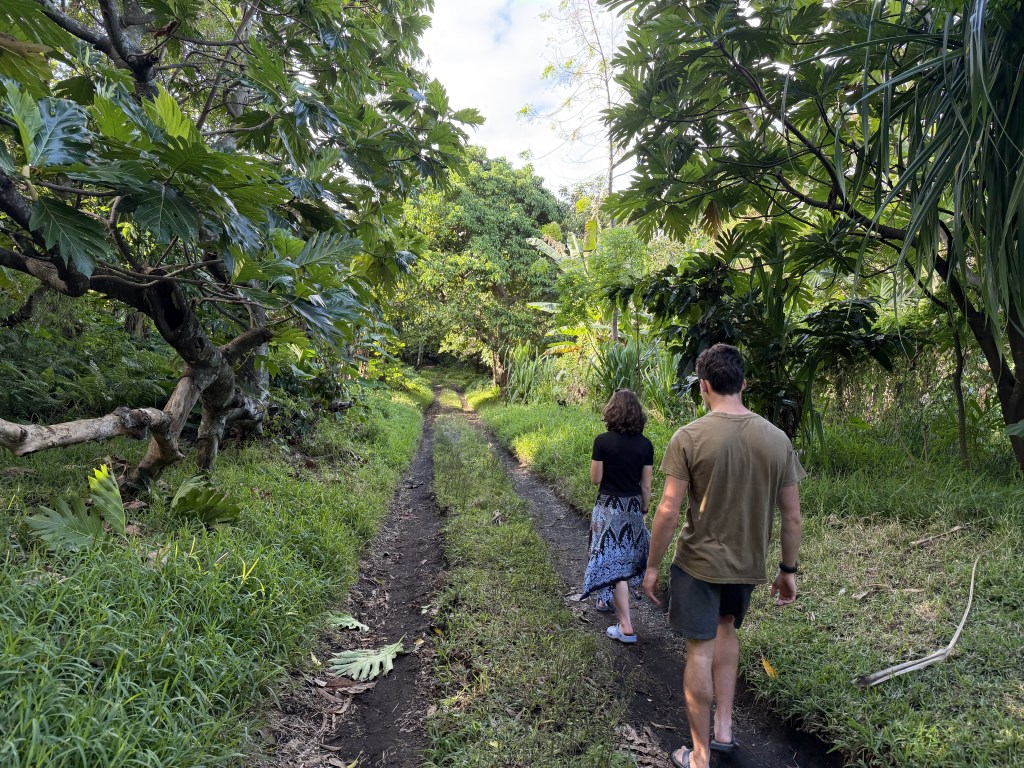
When we first go to land in these remote settings, we never know what to expect, how long we will be there, who we’ll meet, what we’ll do. Calder and Cora are used to me saying, “I don’t know. It will evolve.” Village visits do just that, evolve. We beached our dinghy and wandered up to two men with a fire and asked where Jocelyn’s village was. They smiled but shrugged their shoulders; clearly we were not connecting. I smiled and walked over to a bigger group of men on the beach where one offered to walk us part of the way to their village. It always feels a little uncertain entering a village the first time, trying to find our place and make connections. The people here make it easier with their extreme hospitality. Another person walked us through another village to Sam and Joselyn’s house, where Joselyn came out with arms open wide and embraced us. We spent the next couple of hours with her, as she taught us about ni-Vanuatu kastom, the living traditional culture and customary way of life that shapes community life throughout Vanuatu. She showed us significant banyon trees, a taboo rock that would protect again cannibalism, and invited us into their home that they were re-roofing with overlapping woven palm fronds.
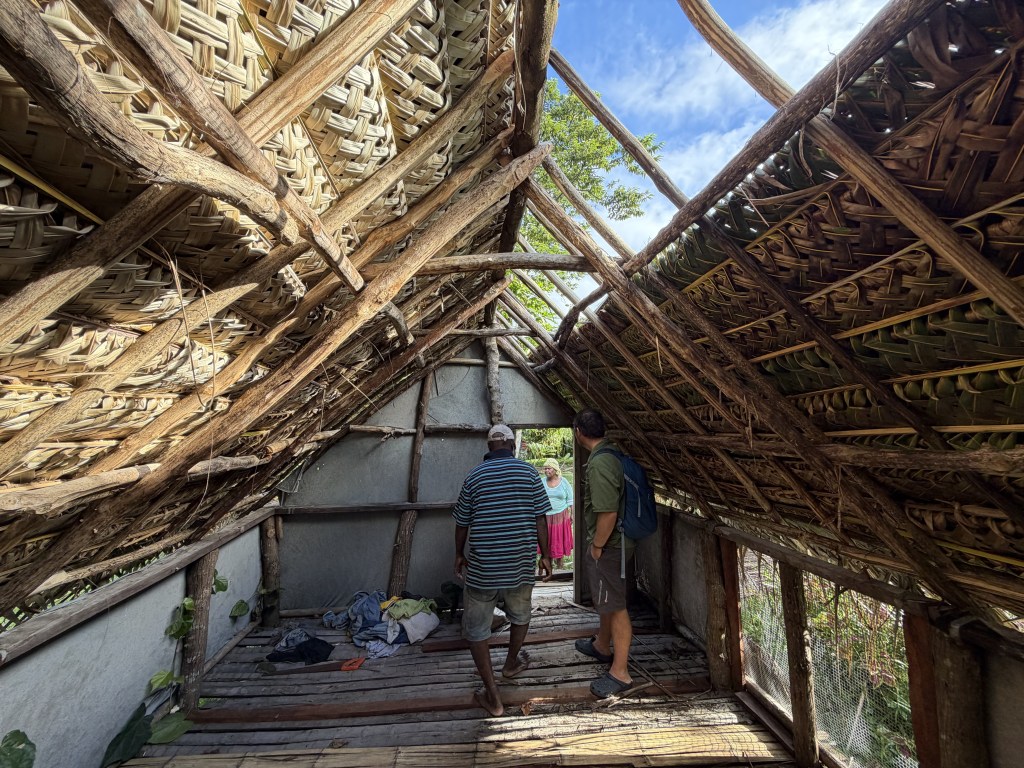
She was genuinely inviting and willing to openly share her culture and answer any question we might have. She spoke of community and how all the local villages helped each other. She is a leader in the community, involved with both women’s rights and land rights. Her husband Sam, the chief, is a quiet humble leader with kind eyes that smile, as he played with his grandbaby and built their home.
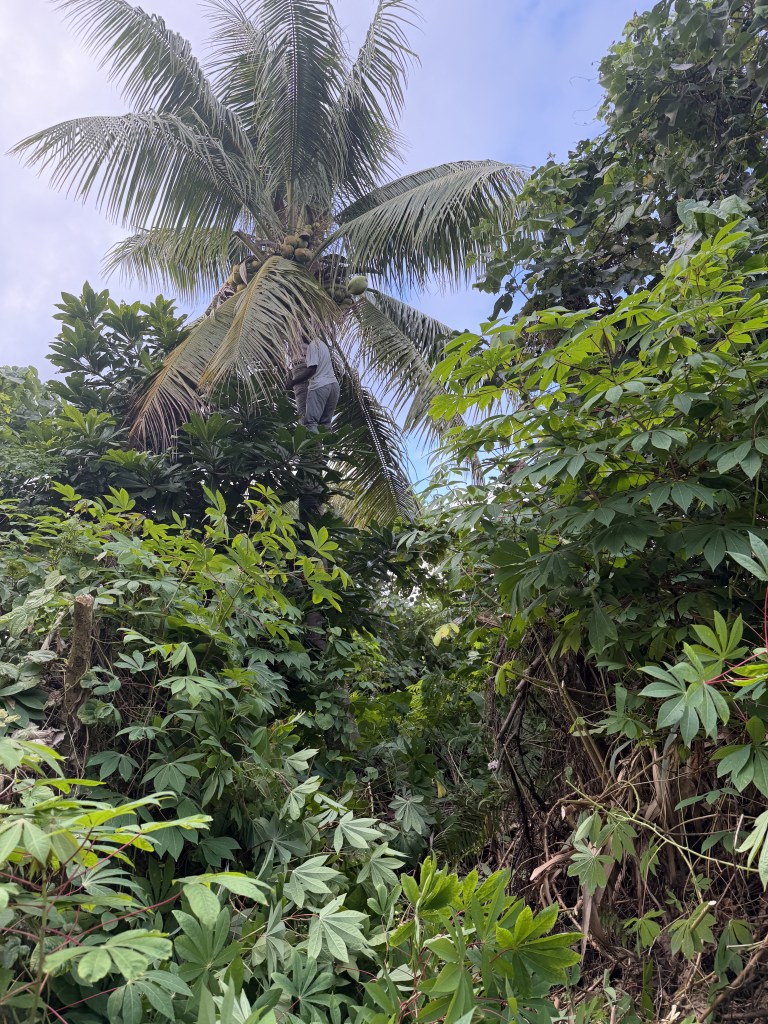
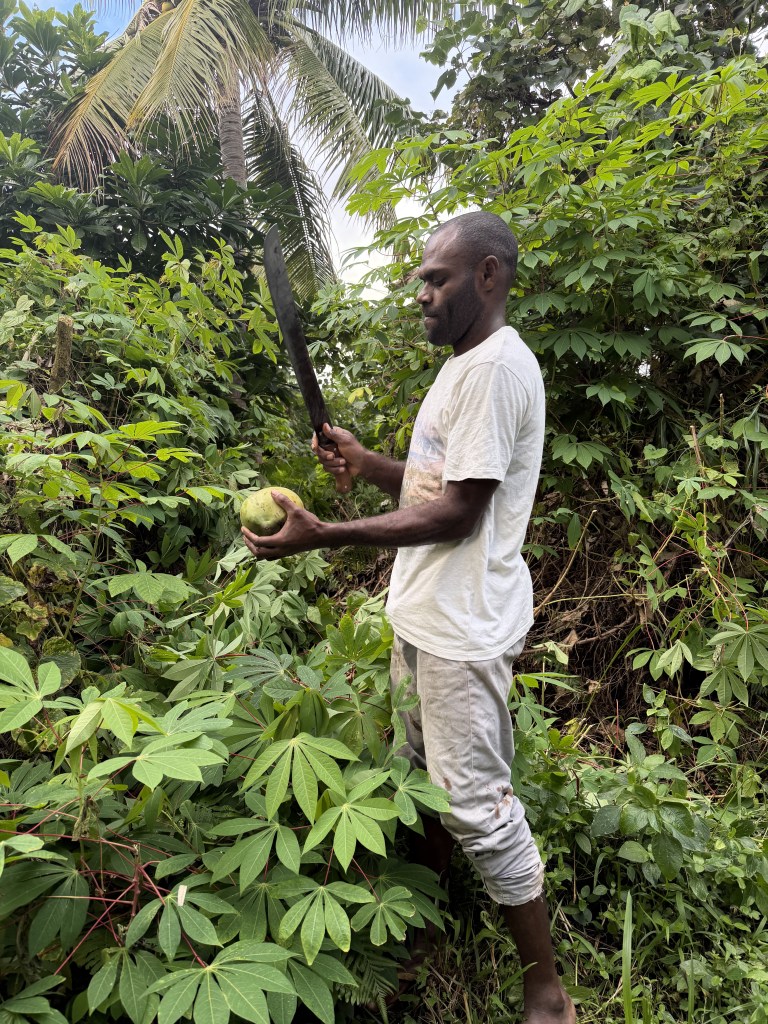
Two mornings later we had the opportunity to prepare traditional foods with Jocelyn and some of the others from her village. After welcoming hugs, she immediately sent Calder on his way with a group of young men with machetes to get coconuts. Thankfully, the times of cannibalism are over or I would have thought he might be taken away to be a part of the feast! Ritual cannibalism was practiced by some communities in Vanuatu until the late 19th century, with a few reports suggesting isolated cases into the early 20th century. It disappeared as Christianity spread and traditional warfare declined. But none today, and Calder returned with stories of extremely tall coconut palms and piles of coconuts.
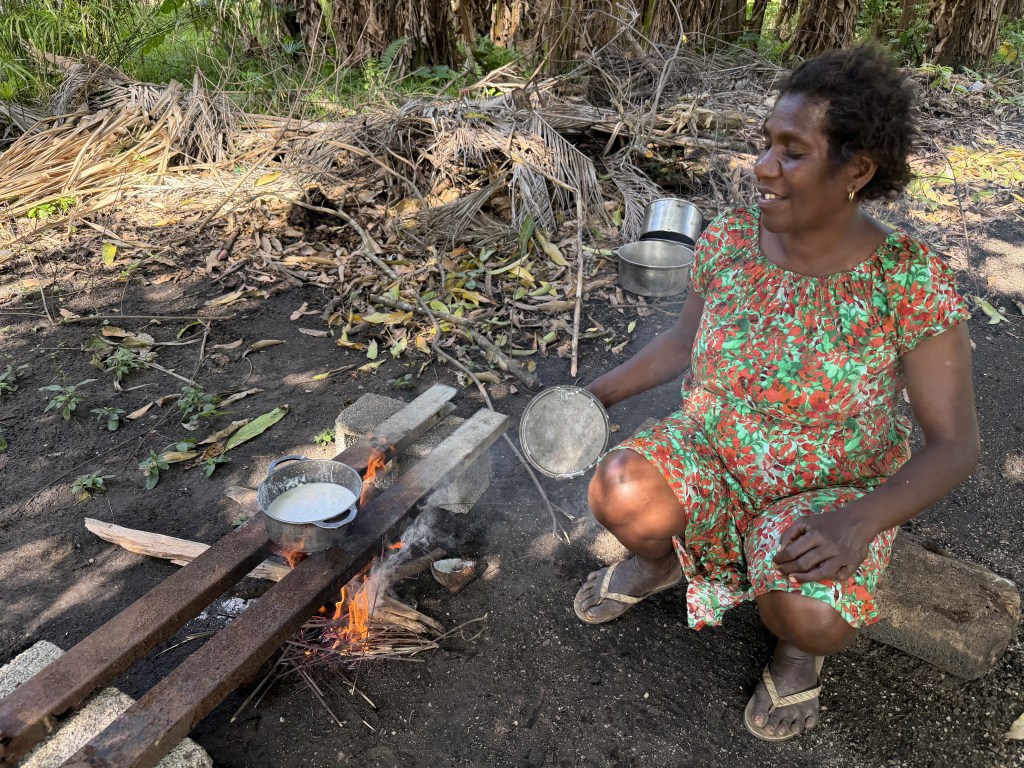
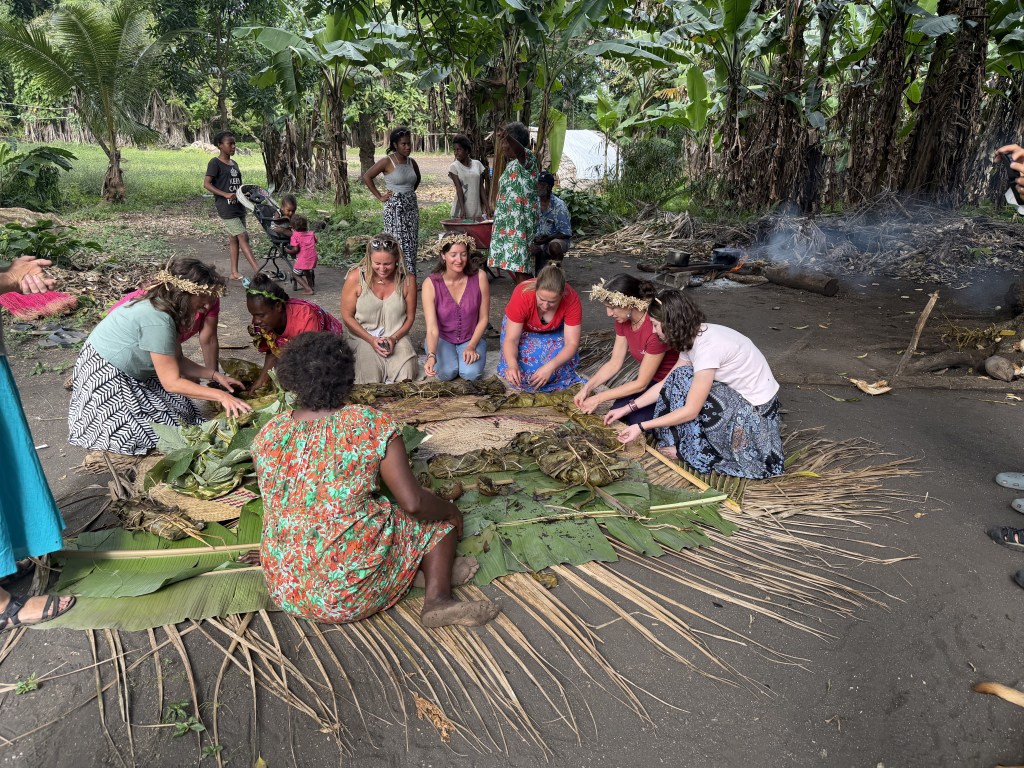
Chris worked with Sam on getting the fire going with layers of wood and volcanic rock, to heat for the earth oven to cook the laplap, Vanuatu’s national dish. Cora and I sat on the mat with two other women and we got to work making laplap.
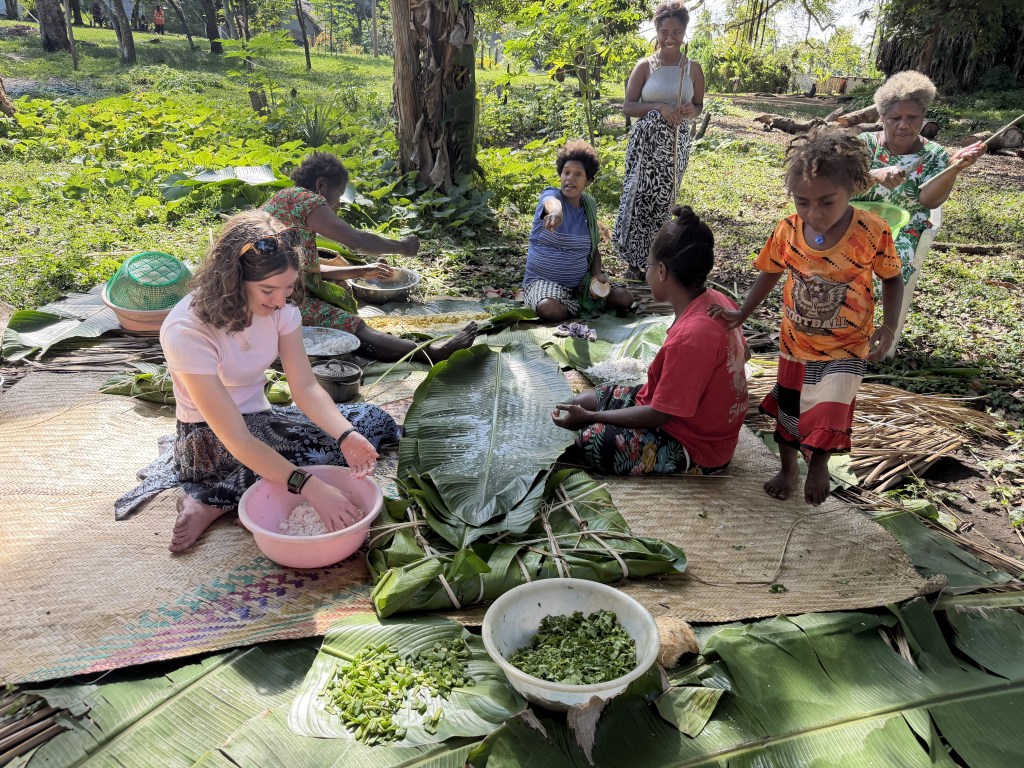
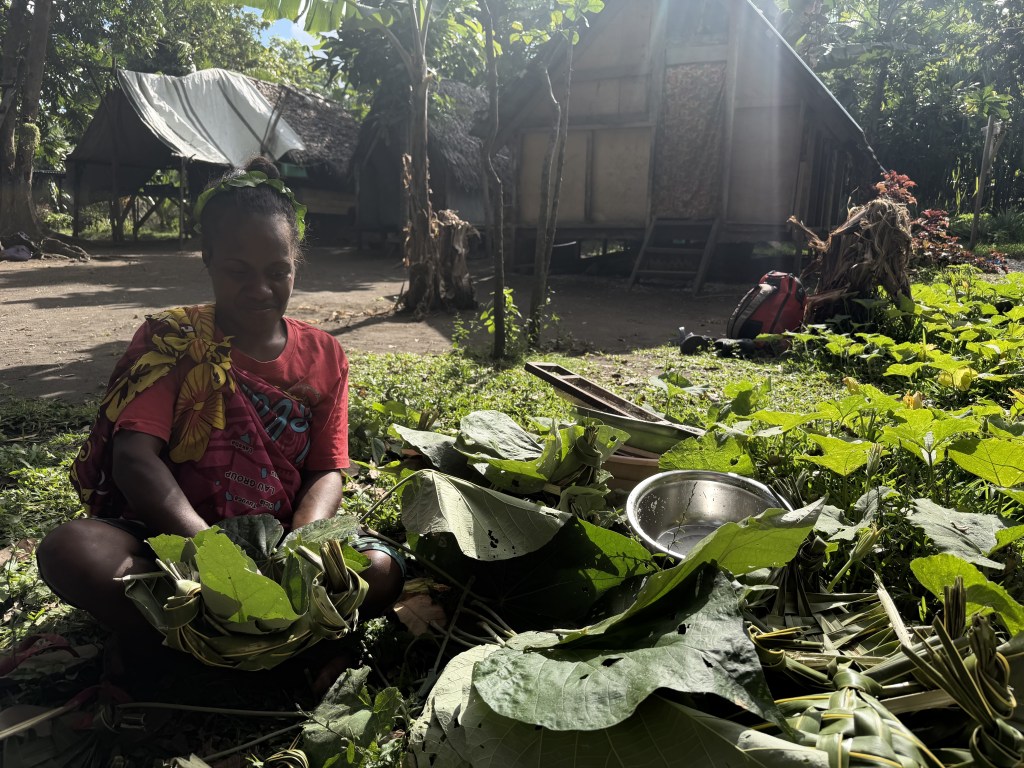
We laid the banana leaves down, then spread with our hands the grated root vegetables (taro, yam, manioc/cassava), squeezing coconut milk by hand. As I tried to get the liquid out of the coconut, we would laugh together at my inadequacy in fully milking that coconut, though I finally got the hang of it.
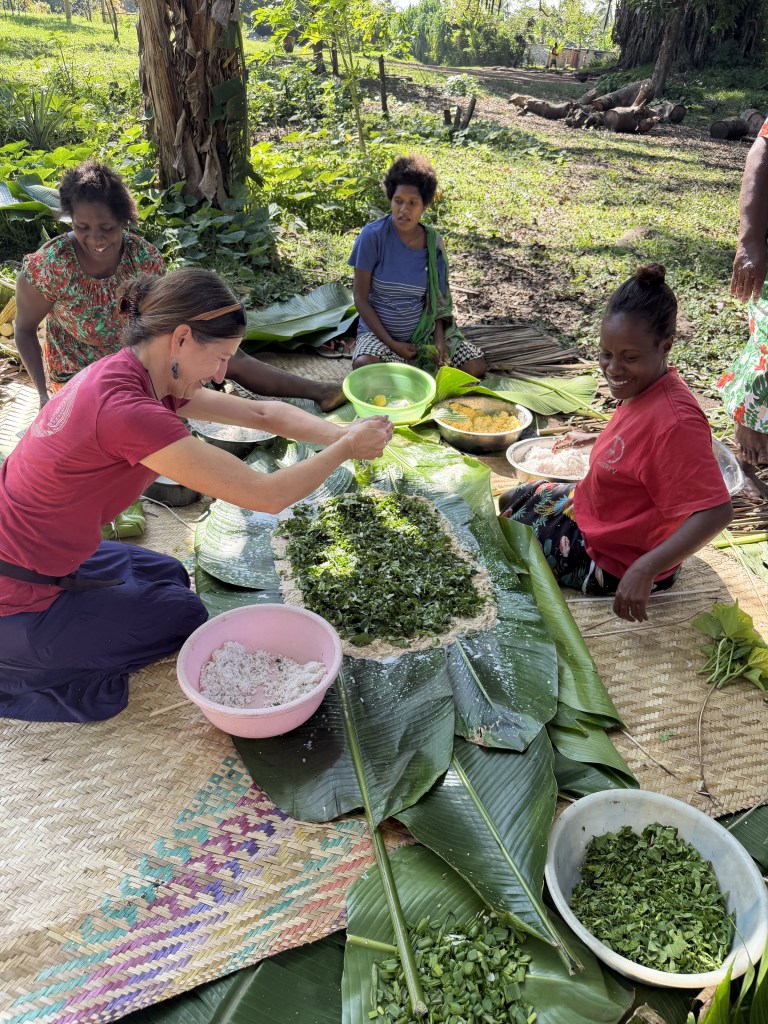
Then we’d fold it and shape it carefully, tying each banana leaf bundle closed before stacking them on the now hot lava rocks. These were then covered with large leaves, then more rocks on top, more laplap bundles, more rocks, more leaves. This pile was then topped with a few woven mats, then a standard plastic tarp and the whole thing covered with dirt… voila- earth oven complete!
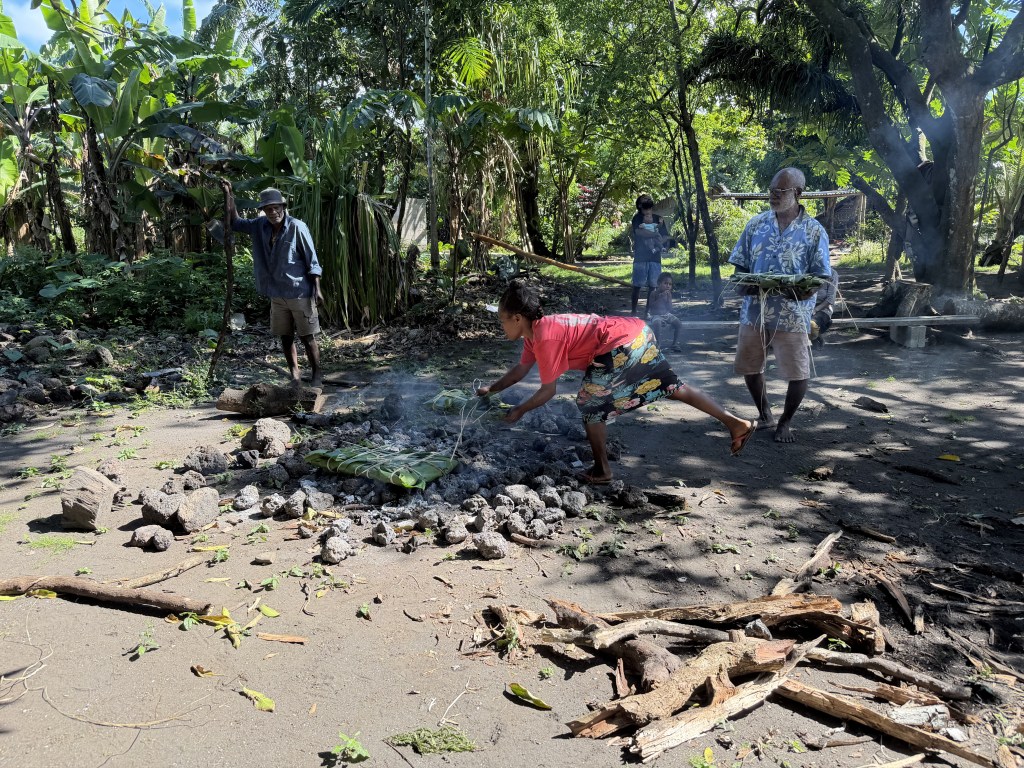
Chris and Calder both got a turn at grating coconut, though Calder was fired almost immediately due to slow production, everyone laughing.
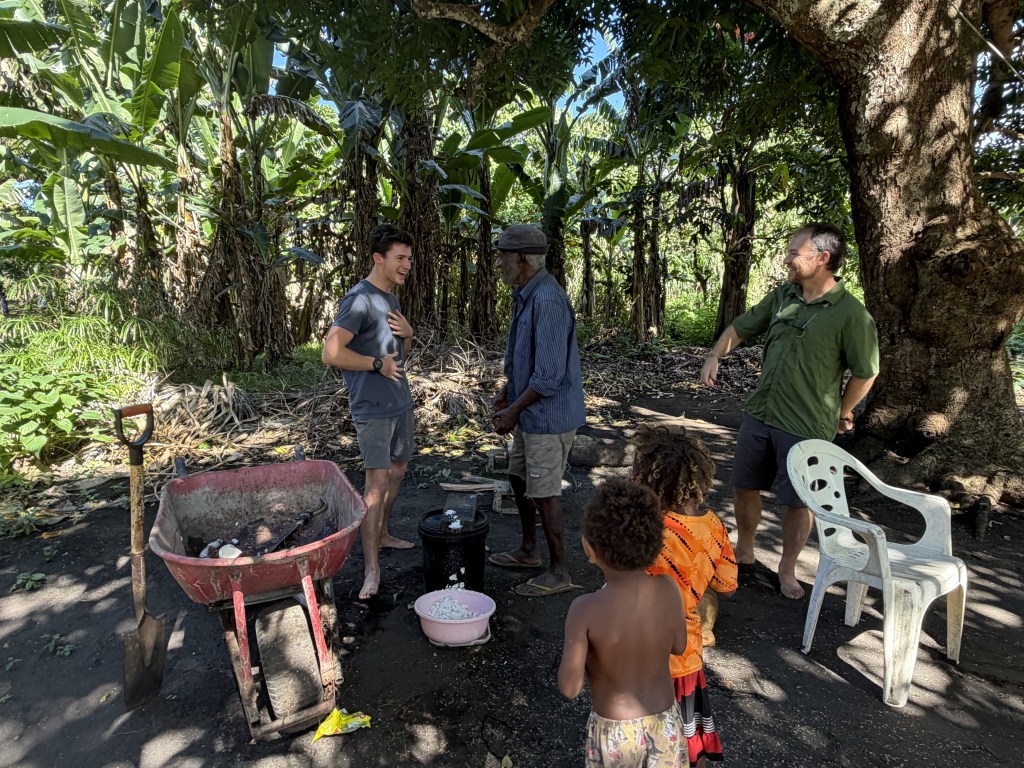
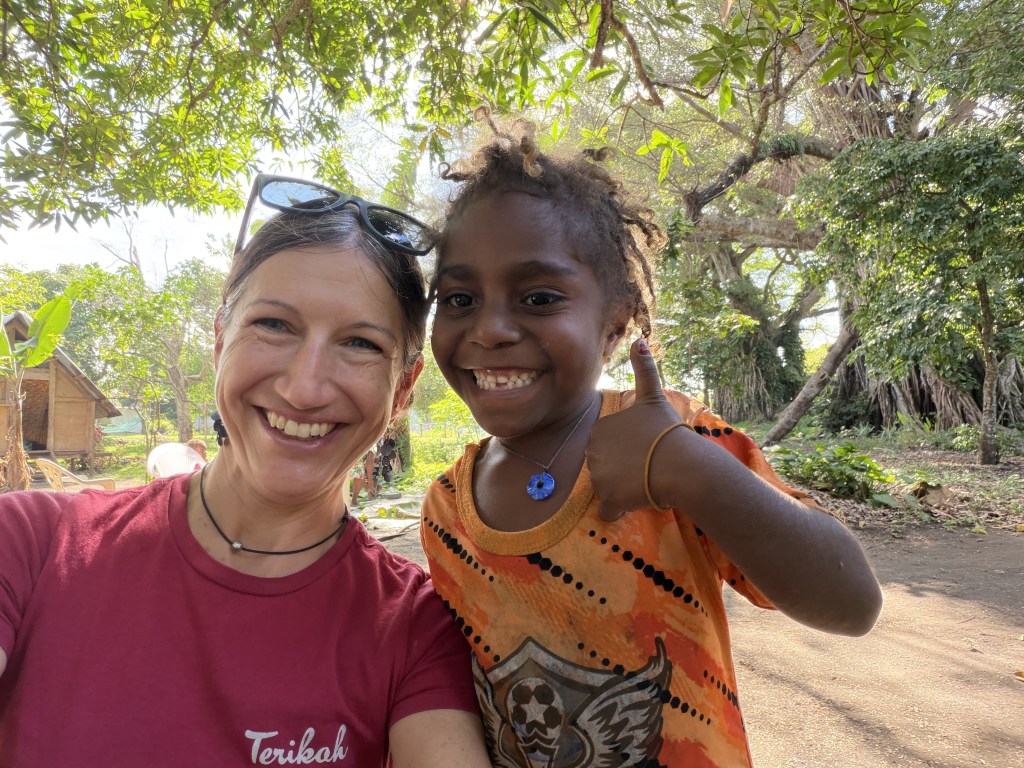
I made friends with two of the little kids and we laughed, held hands, twirled about, and drew pictures in the dirt.
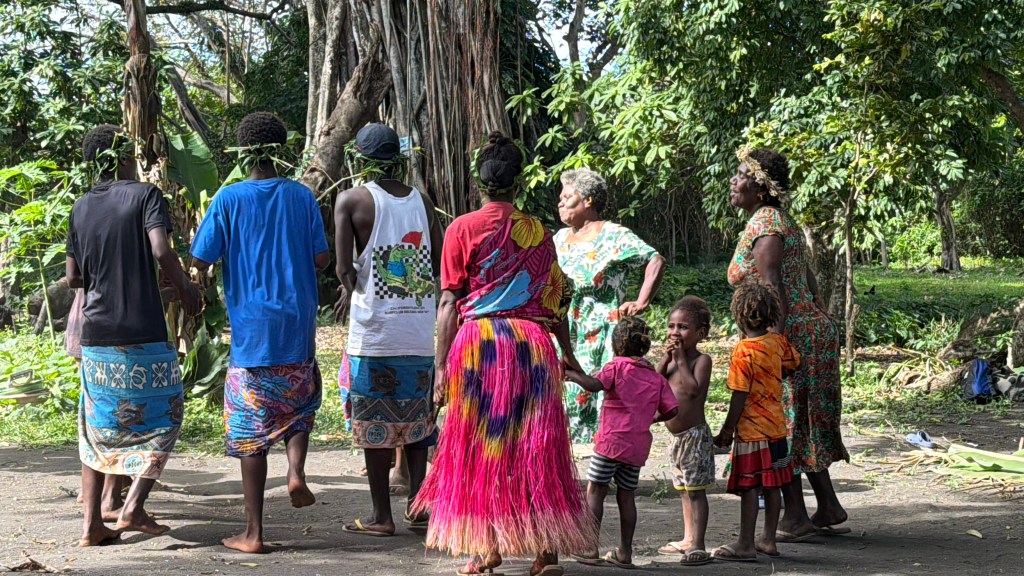
Some of the older boys came over to chant and dance, inviting Calder into the mix as one of them. Then we all were invited to jump around and dance with them.
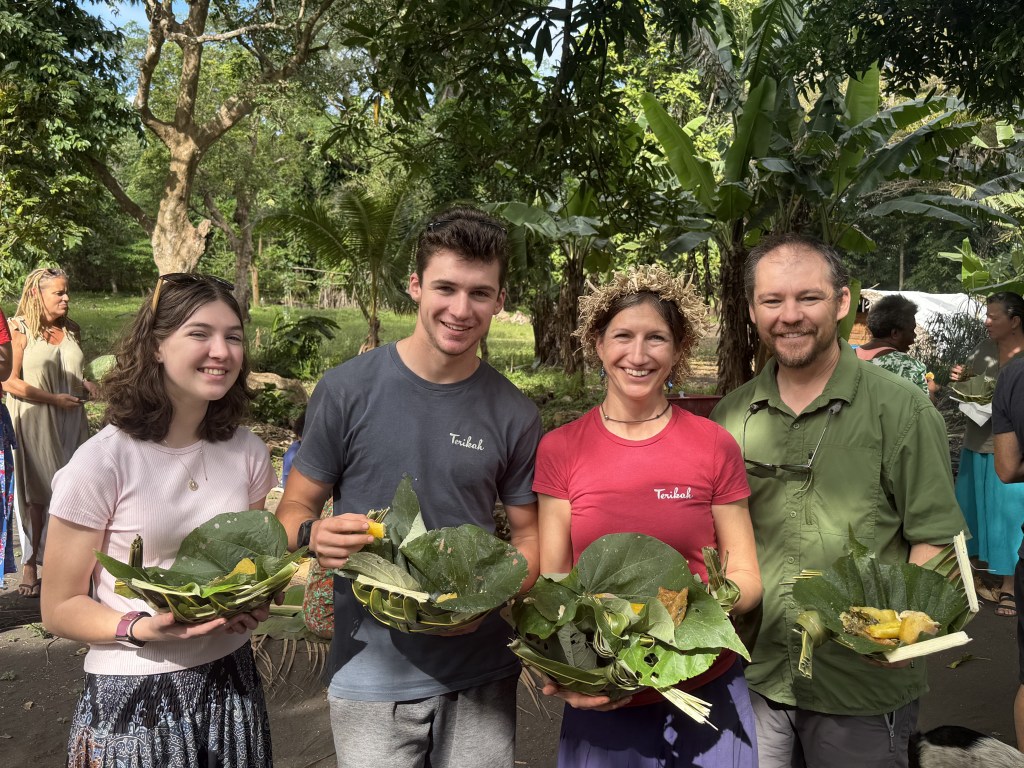
We noshed on corn cobs, then they placed a crown of dried corn cob weavings on my head. When the food came out of the earth oven, us women unwrapped the bundles, cut the laplap, placed the food into beautiful handwoven plates freshly made from palm fronds, and presented it to the men.
I actually quite liked the laplap with green onions inside, but struggled to clean my plate. The food was highly filling and starchy and our family had mixed reviews of it. Throughout the time, Jocelyn shared openly about her culture with no topic out of bounds. She spoke of the very important ceremony of circumcision at age 12 using bamboo (though they get to bite on a stick), inviting us to come to the ceremony if we were still around in a week. She spoke seriously about lining up the teens and telling them which people were not to be touched in a romantic way, which ones were relatives. She openly pointed out one young teen girl not assisting in food prep and explained that she was menstruating so could not prepare food. Such open sharing was a gift in understanding, if not somewhat cringeworthy at times. By the end of our afternoon, we were tired, full of food and had another amazing cultural experience.
Our next adventure found us staring into the active bowels of our planet at night in awe. The night before we were signed up to hike to the top of Mount Yasur, I couldn’t sleep. I had visions of lava bombs exploding around us. In the morning, I read more information, trying to ease my fears. I found that the volcano remained at Level 2, meaning the volcano is in “Major Unrest.” It is more active than normal, with stronger explosions possible, and volcanic bombs, ash, and gas may fall in or around the crater, so access is restricted to designated safe viewing areas outside the permanent exclusion zone. It is one of the world’s most closely monitored active volcanoes, with its activity tracked continuously by the Vanuatu Meteorology and Geo-Hazards Department and documented internationally by the Smithsonian Institution Global Volcanism Program. The most recent fatalities at Mount Yasur occurred in 2017, when two tourists were killed after a sudden explosion hurled volcanic bombs (large rocks) into a viewing area near the crater rim, highlighting the unpredictable danger of even routine activity.
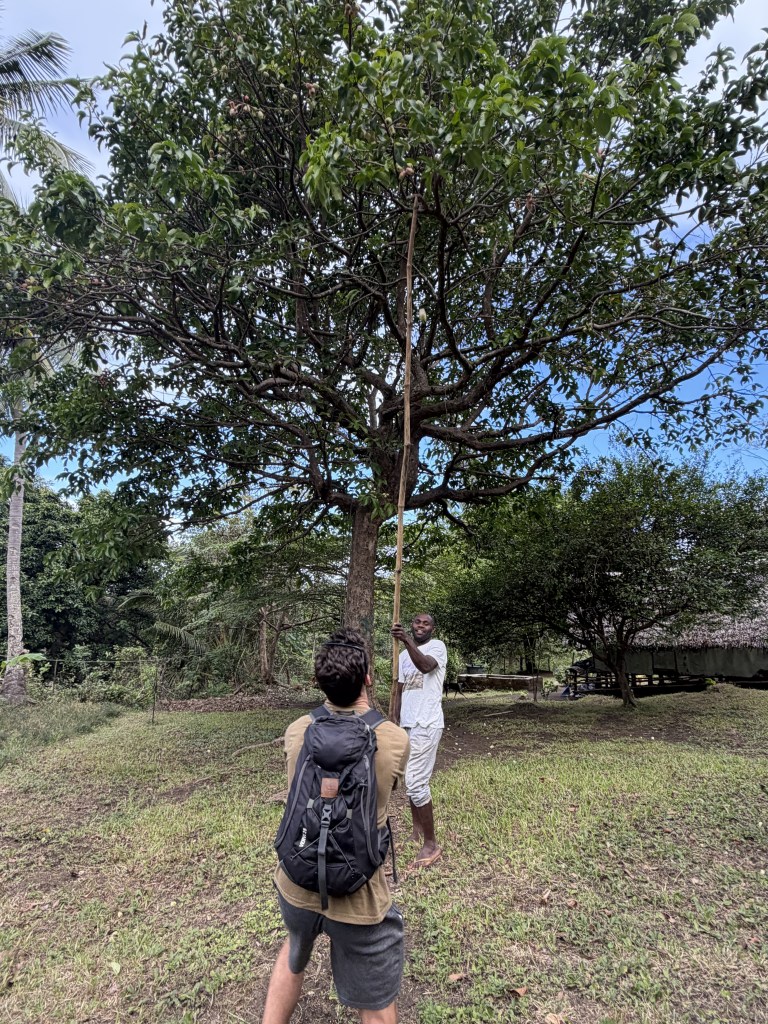
However, after talking more to our local guide Donovan, we decided to go for it, knowing that we didn’t have to continue at anytime if we felt too uncomfortable. He met our family and another crew of 3 from another yacht at the beach and we set off through the jungle toward his home. He explained how he has had to fight in court for the right to take tours up through his peoples’ land (rather than through the park service), having gone to jail three times during the process. He was successful in obtaining an official permit as a volcano guide and the money goes back to his community. Stopping near his house, he plucked wax apples off the tree for us and introduced us to his mother and his wife.
A group of teenage girls came along to practice their English and I enjoyed chatting and laughing with them as we crossed through the jungle past massive banyan trees.
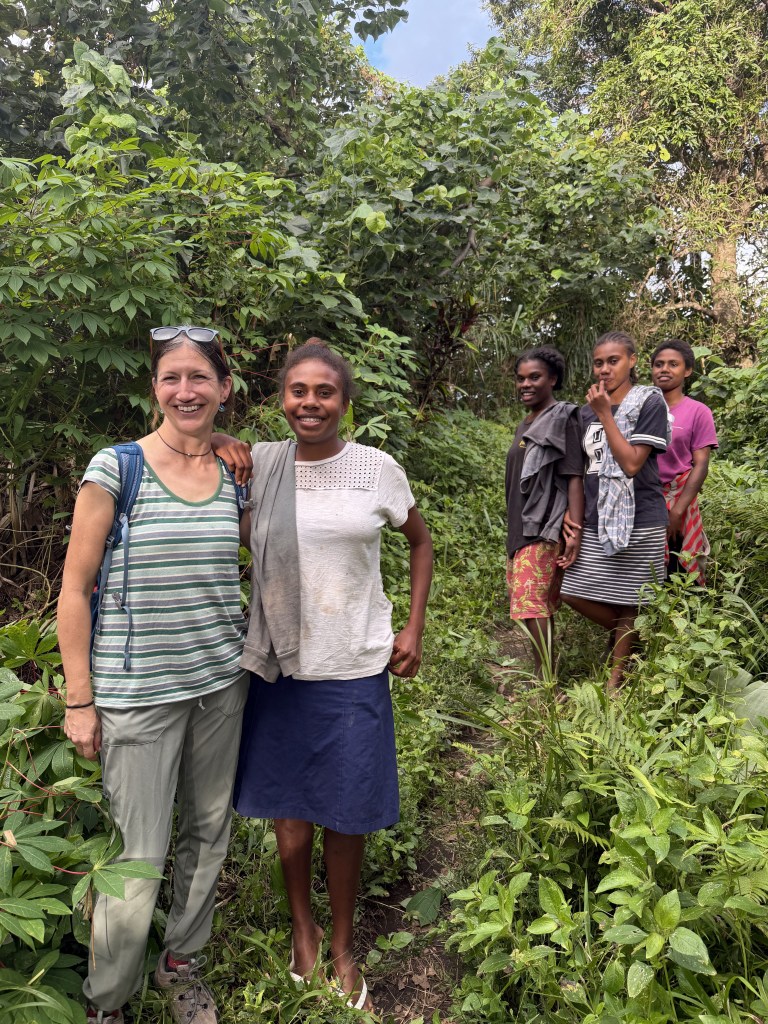
After a while, Donovan stopped and climbed a tree to get us each a coconut for some refreshment; the total hike was 14 km roundtrip in the end.
As we moved on the trail, we started to hear the loud booms and feel the earth resonate…we were getting closer. Coming up out of the jungle, we found ourselves in a transition zone of ash, pumice, lava bombs, and stunted trees.
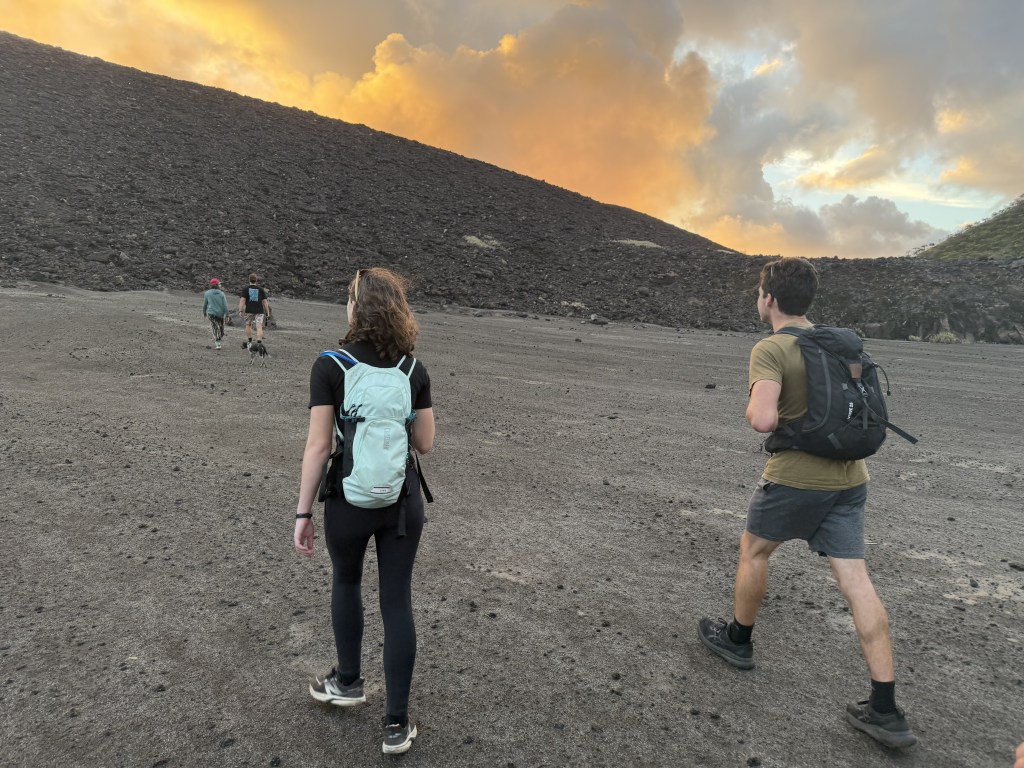
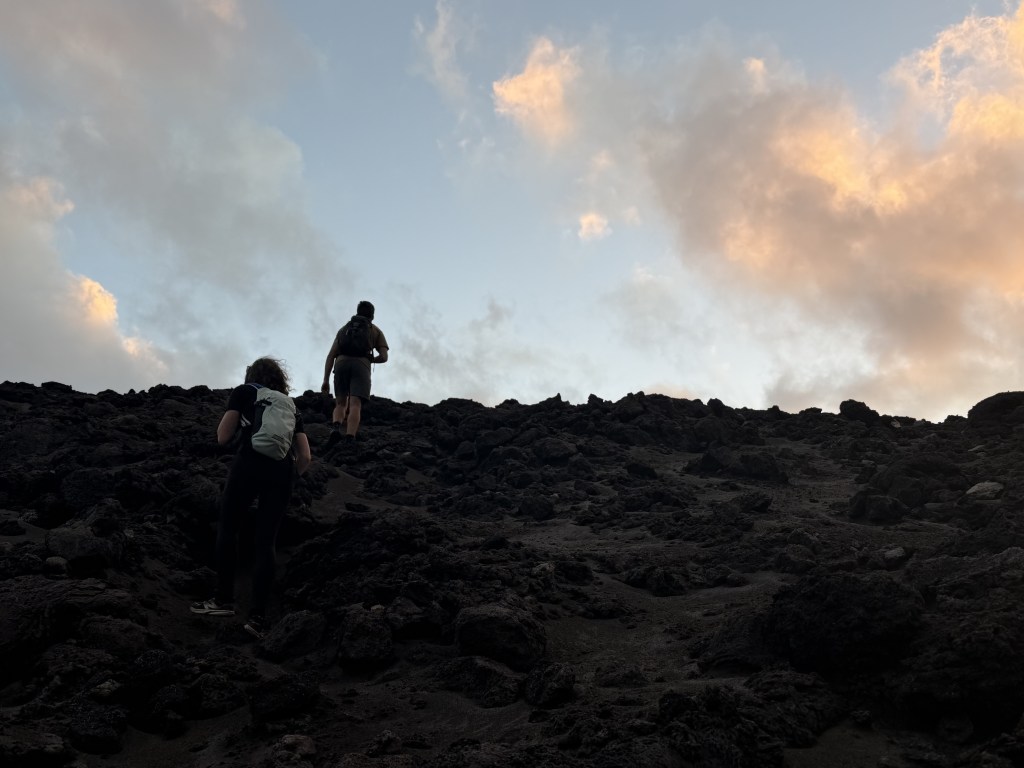
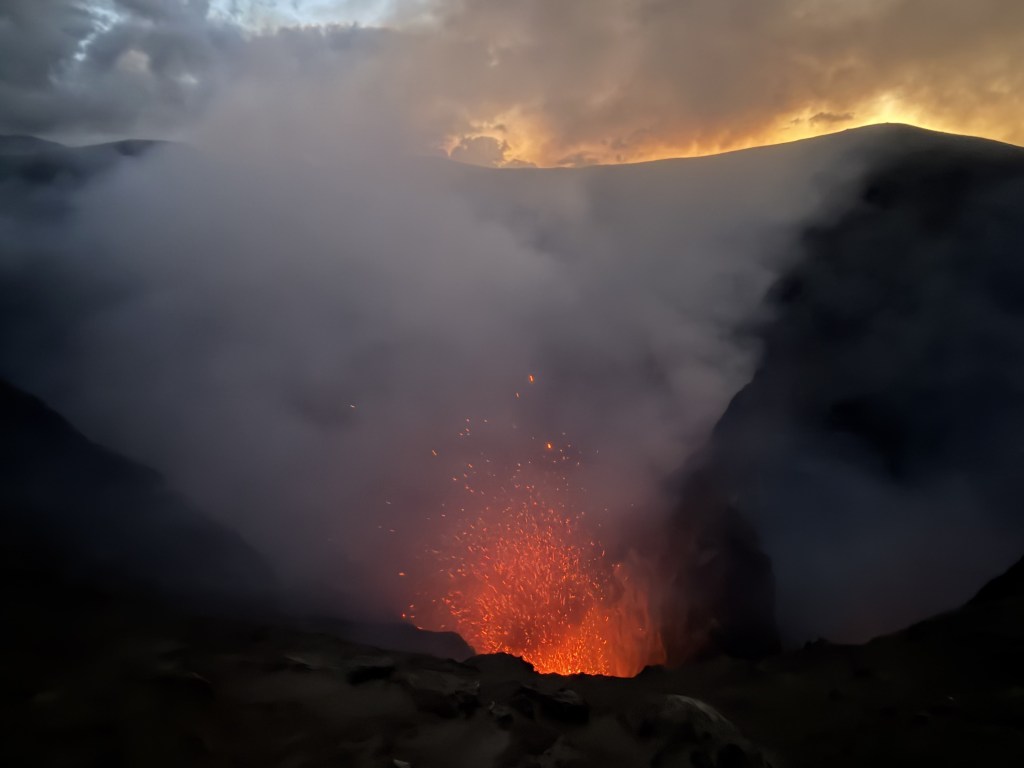
We crossed the ash plains, the sounds increasing, then straight up the side, climbing up and over large pumice boulders. It was completely surreal. Then we were there, standing on the crater rim where a scant plywood fence stood separating us from the sheer drop down to the depths of the earth, where glowing vents constantly spewed gas and steam, a larger explosion about every 5 minutes.
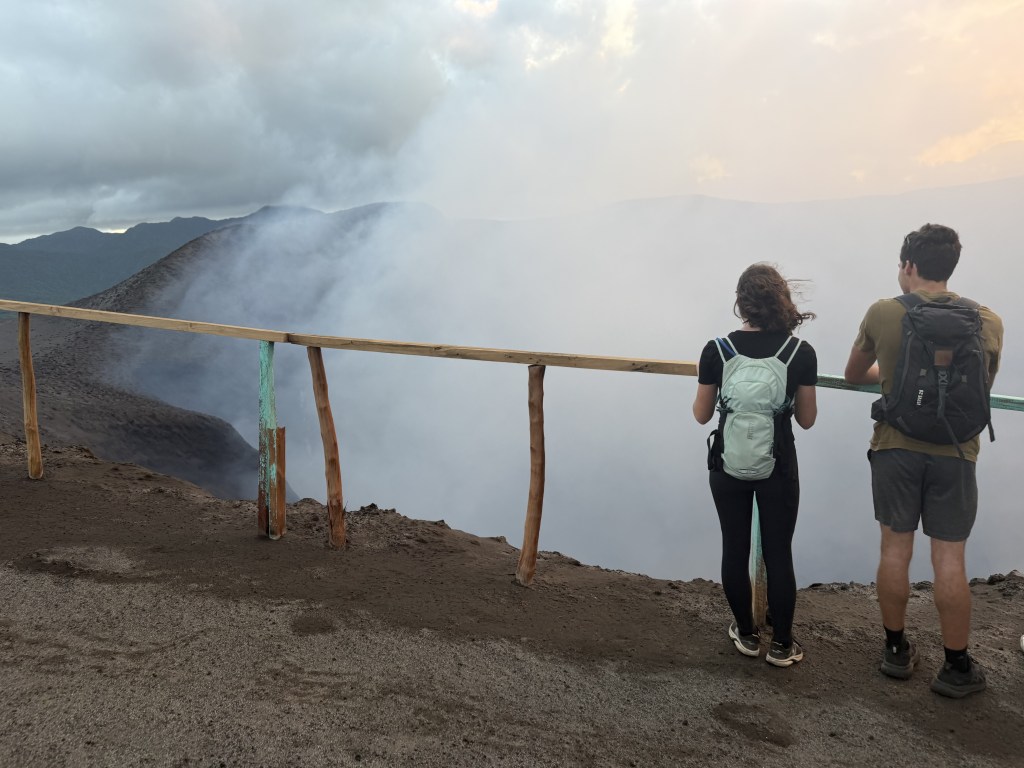
We were all quite literally on edge, seemed unbelievable that we were allowed to be so close to such an active volcano. Donovan assured us that the winds were blowing the right way for us to stand there, that the ancestors came up when the winds blew this way. I felt like I was staring into Mordor, as the sun set. As it grew darker, the explosions also grew in intensity, shooting up streaks of orange lava. I couldn’t look away, watching to ensure nothing was coming at us, but also looking behind to ensure the earth wasn’t cracking under us. The explosions could be felt through our entire bodies.
The power of this planet, it’s creative and destructive force, was awe-inspiring and terrifying. After about an hour, we put on headlamps and glissaded down the ash to the bottom, where we walked the rest of the way to the beach on the jungle trail.
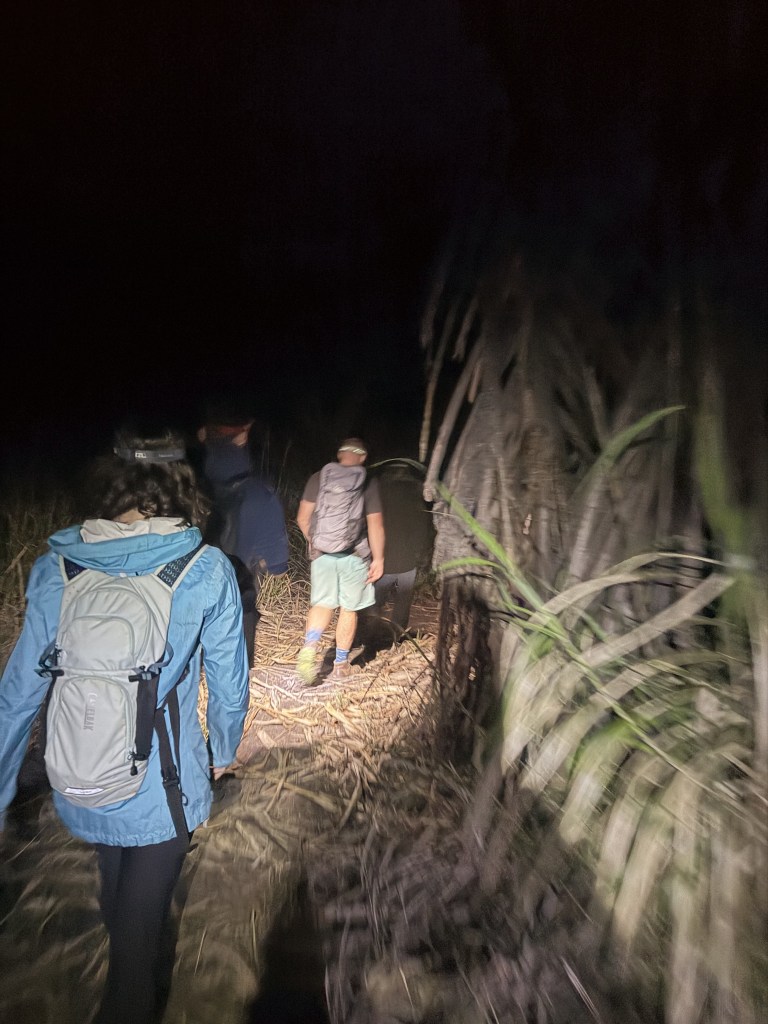
Our family agreed that it was one of the most amazing experiences of our world cruise thus far.
A couple mornings later we experienced a Bride Price ceremony. Over to shore by 6:30am, feeling as if we could use another coffee, we were humbled by the fishermen that had already caught piles of fish by the time we landed our dinghy. Walking into one small village, a smiling man informed us that the ceremony would take place twice today, first at the larger village nearby where the groom lived, then again at this smaller village where the bride lived. We were invited to walk along the road to the larger village, as trucks passed by filled to the brim with traditional gifts. Once there, Lea introduced herself and welcomed us warmly, then stayed with us and explained all that was happening. Walking into the open space of the village, the groom was surrounded by family, wearing traditional brightly painted chicken feather headwear and grass skirts with painted faces. Then, from across the village, the chief marched across with the bride and her family in similar traditional attire.
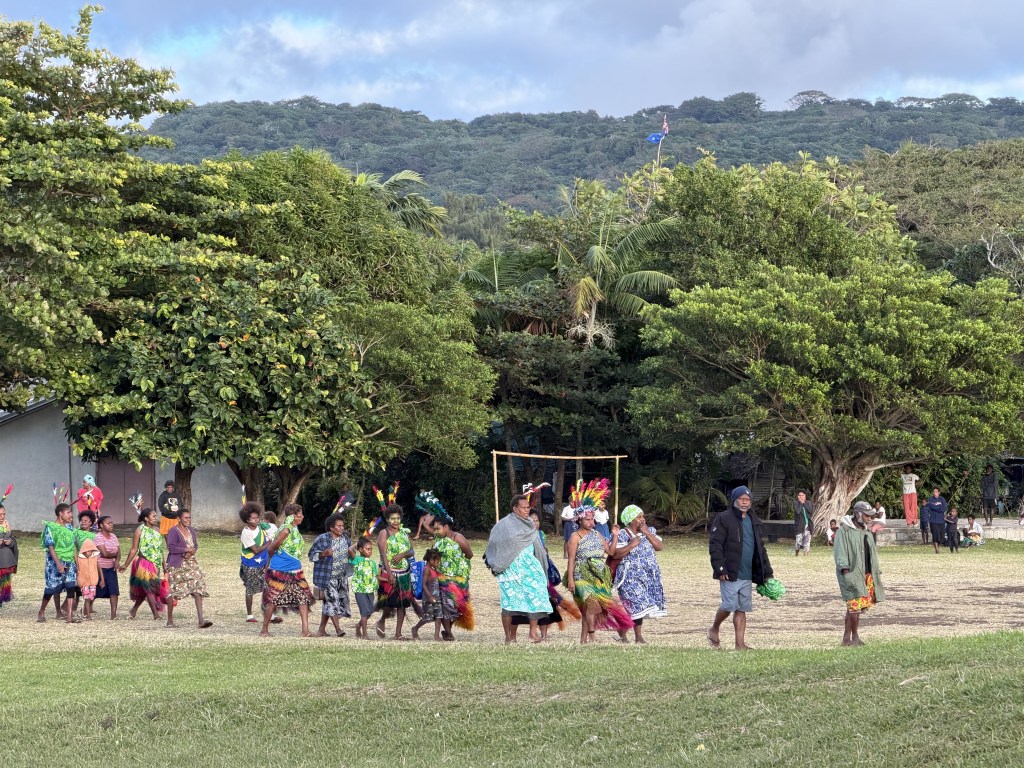
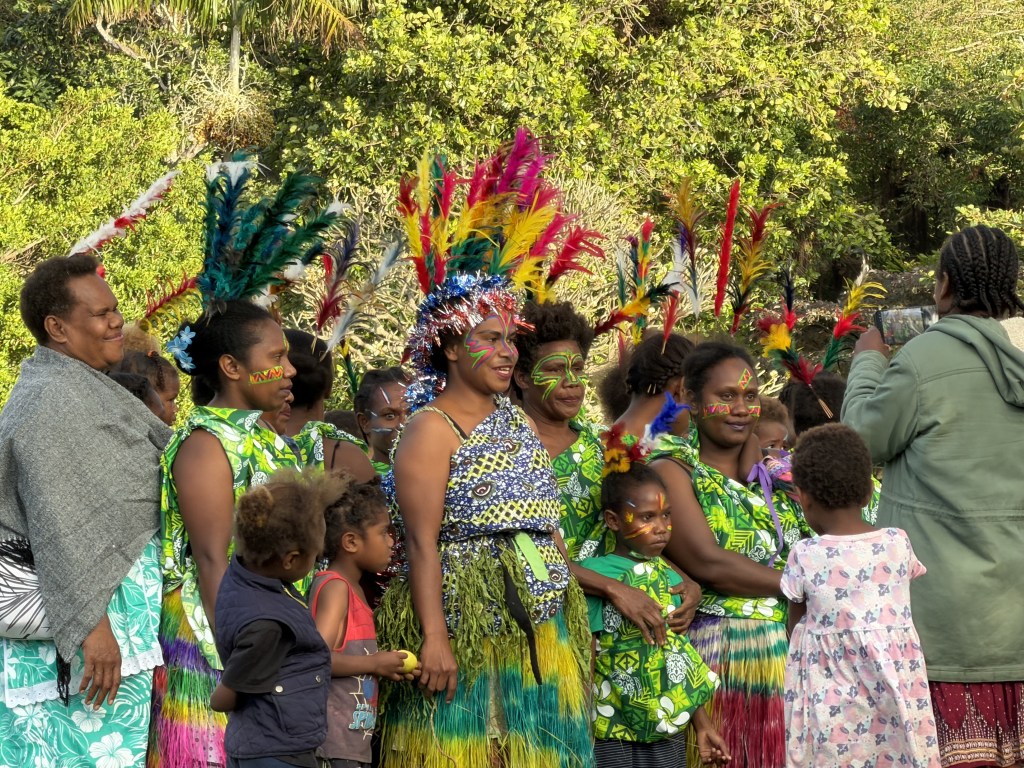
They stood across a divide, as their families got to work each erecting a massive pile of offerings, the pile from the man’s family in payment for the bride appropriately much larger. Neat piles of bananas and cassava and yams formed the base, with handwoven mats and baskets laid along the outside in neat rows, sugar cane topping the pile. Then out came the men carrying massive kava plants which they piled up.
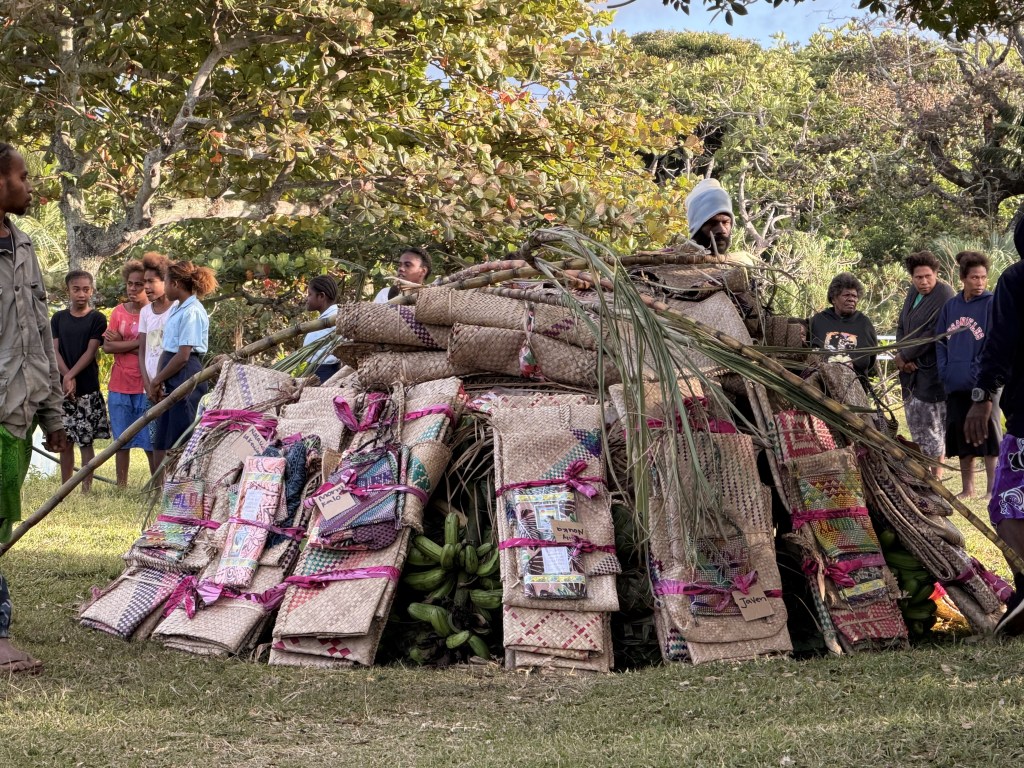
Then they carried a live pig trussed to a pole, laying this down, then using a massive wooden club whacked it repeatedly, the sounds of frantic squeals felt to the core. We saw later that the pig was not yet dead, but rather only temporarily knocked unconscious, so it could be killed at the next village, squealing again as it was carted off. Even as hunters, it was well outside our comfort zone. The next pig was fully dispatched quickly, the stray dogs licking up the blood. Then an entire cow was added to one pile, and another hacked off midsection of ribs and hide added to the other pile. Finally, the bride went to join the groom’s family and village, where she would live permanently. The chief came out and spoke, then a small child, about one-year-old was brought forward from the groom’s family. It was the first-born daughter of the groom’s brother. She was beautifully dressed up in traditional garb and presented to the bride’s family in exchange for her. It was explained to me, “Some villages pay for brides in vatu (local currency), but we do it with children.” The small child would live with the bride’s village or origin in exchange for her.
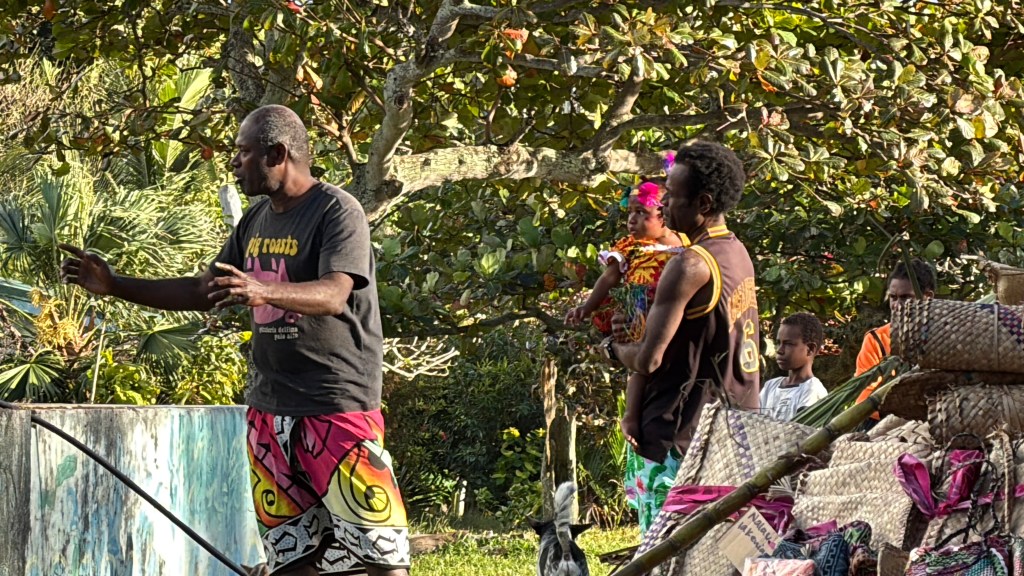
After the ceremony was complete, it was all packed up in trucks and driven to the bride’s village to be done again. It was not put on for us as a palatable tourist display, but rather the raw visceral unfiltered ceremony of their people of which we stood witness alongside them.
Another day we walked the trail along the bluff, meeting a very pregnant Lucy along the way with her machete strapped to her hip, who led us down the correct side trail to the hot steam cave. Walking the beach later, we commented on how kids play in the sand everywhere in the world. However, when we got closer, we found that the two six-year-olds were digging in the sand with 10-inch butcher knives…so maybe just a bit different from the plastic toys most kids use at home. Everyone smiled, waved, and a local sought our confirmation that we were finding Vanuatu the “Namba-one friendliest place in the world.” Yes, we could definitely stay here longer, weeks even, but there’s some good wind to sail north.
The night before departure from Tanna, we walked over to White Sands Beach on the windward side of the island where we were impressed by the size of the waves and winds. We’ll be battening down the hatches for tomorrow’s passage.
Up early and underway, two days to Port Vila, Efate Island broke up into 2 full days (71 and 79 nm) to maximize daylight fishing time rather than doing one overnight. Winds 18-28 with seas 2-2.5 meters on the quarter stern throughout the day. Had double take-down on the fishing lines, landing a nice yellow fin tuna and losing the other after a 25-minute fight. Into the lee of Erromonga Island, the seas and winds died down and we motor-sailed to keep up our pace to anchor before dark, joined by pod of dolphins playing in our bow wake! Anchor set in Ponamlas Bay just before dark and enjoyed fresh tuna poke. We saw lights converging on the beach and people set a bonfire shortly after we arrived. Reportedly, Ponamlas has scattered family homes, gardens, and bush tracks inland that aren’t obvious from the water. The bonfire we saw was most likely a signal to family that a yacht had arrived or a “welcome, here is where to land if you want to visit in day light.” It made us wish we could stay and wander to shore the next day, but we were awake with anchor up in the dark at 4:30am under a full moon. We set our Code Zero and were flying, remiss to give it up as the winds built, but were definitely overpowering the boat and decreased sail to our Genoa, still making good time in the 20-30 knot winds. Fishing line whirred and Cora reeled in a wahoo, what a gift!
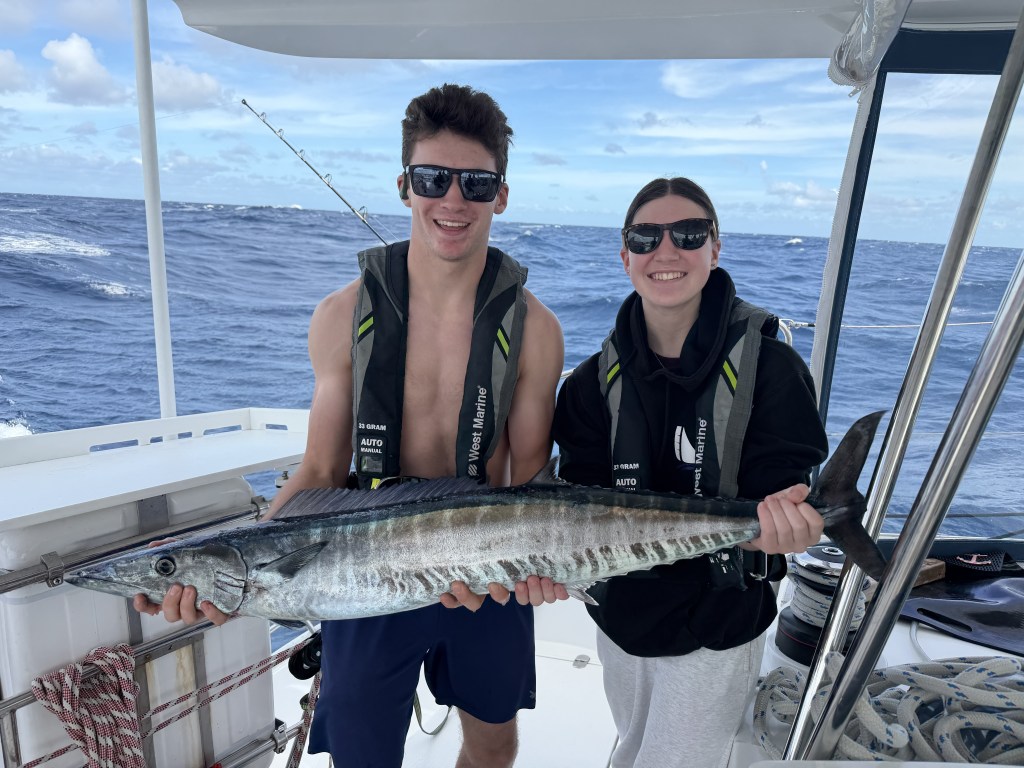
As Calder was cleaning it on his table, there was one massive wave that we think may have been the largest wave we have seen, far above the height of the hardtop of our boat. Terikah lifted and surfed down quickly. Overall, the day was a wild ride with large waves close together, happy it was the daytime so we could anticipate the surfing. We rounded the point into Mele Bay, Efate Island, our next Vanuatu island to explore.


One response to “Tanna Island, Vanuatu”
Wow guys it’s fascinating to keep reading your adventures, thanks!And yes the volcano experience I think is the most impressive one!!Last month we’re
LikeLike