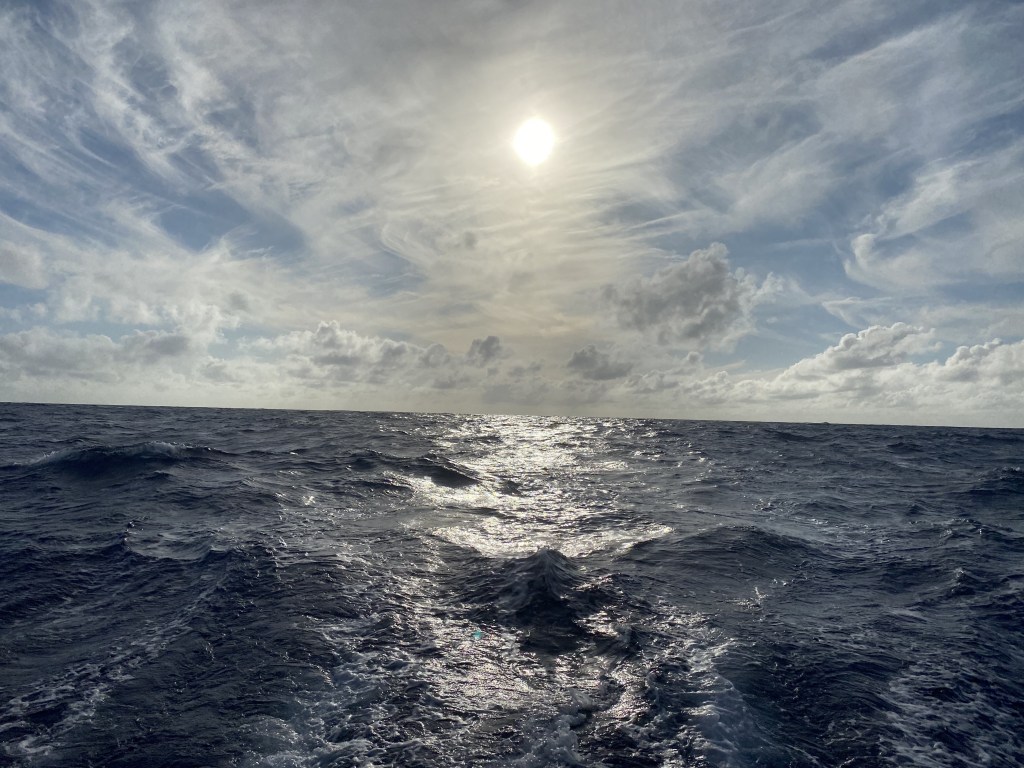
Day 5: Decided to go wing-on-wing (butterfly sailing) through the night with some modifications, overall uneventful watch.

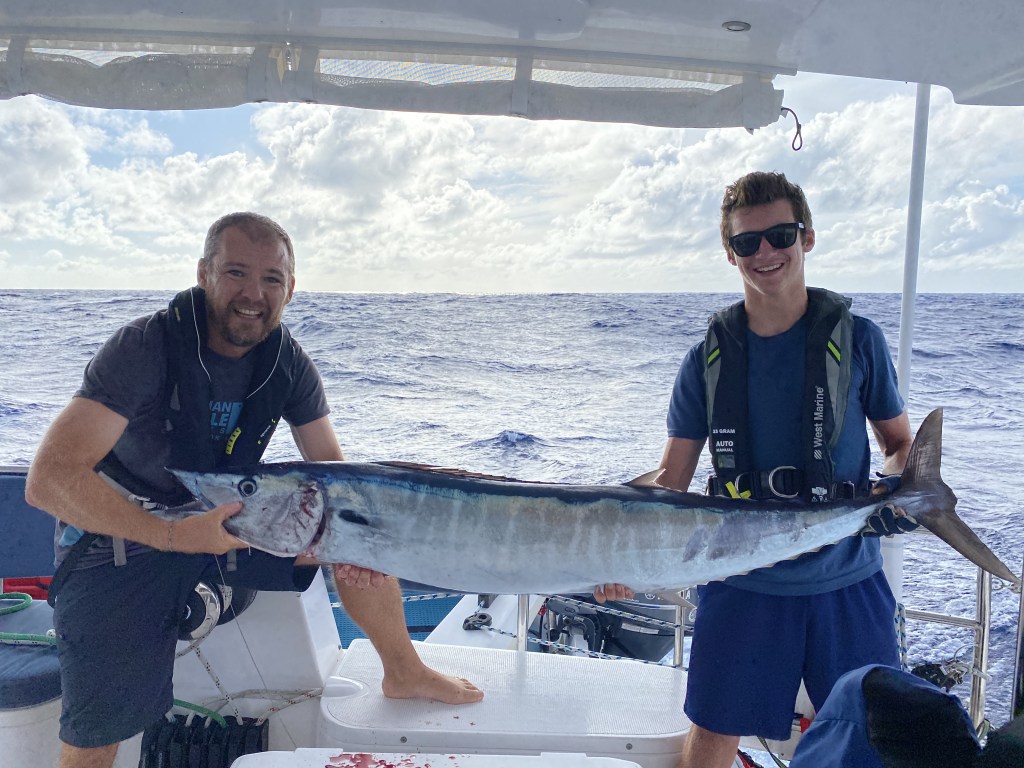
Morning started out great, as sleepy-eyed, not yet fully awake Calder joined us in the cockpit and immediately heard the whir of his fishing rod. Something hit and hit hard, almost spooled him, arms shaking as he brought in the largest wahoo he’s ever caught (51 pounds). (The video only works on the website)
What a gift. We spent the morning cleaning and processing the fish, vacuum-packing fillets and filling the freezer.
We are approaching the SPCZ (South Pacific Convergence Zone), an area of volatility and hard-to-predict winds/seas that oftentimes has thunderstorms. We’ve started to head a bit south with building beam-on seas.

Our anemometer has not been working correctly, namely the TWA (True Wind Angle) which we rely on for our sailing; we are now straining our necks to look up at the arrow at the top of the mast more often.
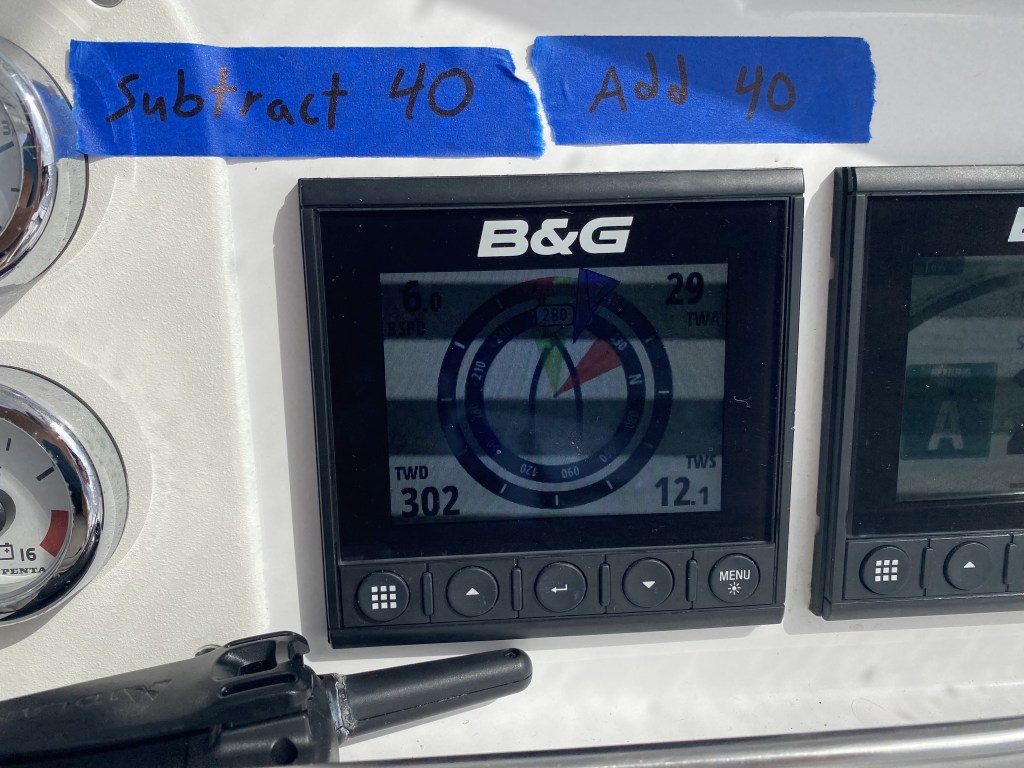
Initially the wind speed was also not working, but this seems to have evened out. The fix for the TWA is to adjust the anemometer at the top of the mast, which none of us is crazy enough to do underway. The group of 7 kids boats (all with different boat speeds) connected online the last two days for trivia. Kids came up with 5 questions each and did trivia over WhatsApp video, a nice break in the middle of the day. We just had an orca surface right behind the boat, beautiful and a bit eerie at the same time, as we watched him surf on the wave behind us underwater. We’ve adjusted our course to avoid the center of a massive system of squalls with thunderstorm potential and, overnight, only had a few smaller rainstorms with some wind but no thunderstorms. (the video below of rain only works on our blog webpage)
Our water tanks are now full (we have a rain catchment system on board). And squalls bring squall-bows that stretch their spectrum across the ocean, both sides visible at the horizon.

Day 6: Very thankful about minimal squalls in the night. Seas building to 3-4 meters, gentle towering swells spaced out and rolling, winds ranging from 10-20 today with some great sailing. Middle of the morning, Calder’s fishing line whirs; a short time later we have a beautiful, colorful mahi on board.

We feel so blessed to have a tuna, wahoo, and mahi from this passage. After rocking out to music as a family as we sailed along, we had a fresh mahi dinner. It was a very good day.
Day 7: Changed to Niue time, one more hour difference from Alaska (we are now 3 hours behind Alaska time); getting quite tired. Sailed most of night, now motor-sailing in minimal winds. Made some yummy Italian herb bread underway. Filled out Niue paperwork. Calder caught one of the biggest tuna of his life, going to be marinating in poke sauce soon for dinner.

We read, take turns on watch, listen to audible, visit, fish, look at the ocean, look at the clouds, count the length of flying fish flights, nap, shower, cook, and eat; just life stuff underway. The days go by both so slow and so fast.

Hopeful arrival tomorrow night to Niue. We posed the question, when can we actually say that we’ve crossed the Pacific Ocean? The conclusion is that it requires a boat go from the edge on one side (for us, Mexico) to the edge of the other (will be Australia or Asia for us). We have covered 5,100 miles since leaving Mexico! Double mahi on the two fishing lines, Fishing Team Hyer worked together to get them both on board; wow!
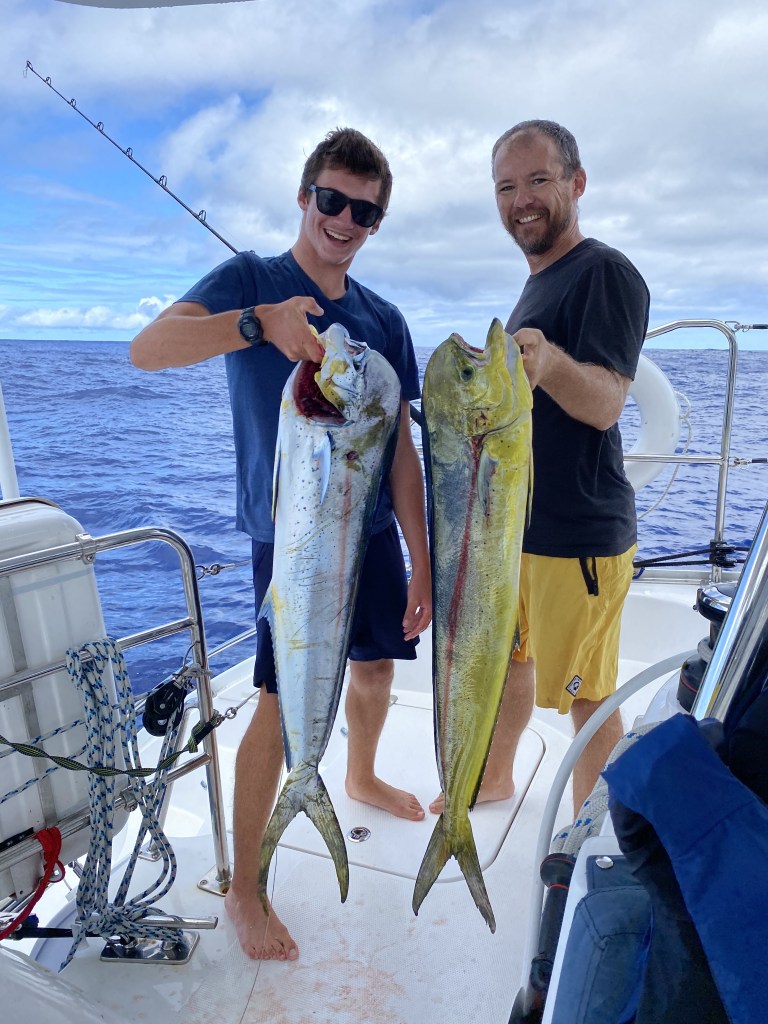
Okay, our freezer is full. Total count for this 8-day passage: 3 tuna, 3 mahi, and 1 wahoo.
Day 8: Overnight seas and winds building, but not to the extent that we thought – we found that our anemometer is not reading correctly. It started out at the beginning of the passage reading about 5 knots lower and now is reading about 5-7 knots higher than actual wind speed; it depends on which tack we are on. It makes it very challenging regarding sail plans and we’ve gone back to the basics – looking at the water and figuring out the Beaufort scale. We’ve been Force 4-5 all night and today, ranging from 11-21, directly on the beam. Once we realized that our winds were lighter than our sail plan, we got out more sail and are flying! We are going to have our fastest (ever) 12-hour boat average. Looking back, our new anemometer worked excellently all through Mexico and the first part of our Pacific trip. Chris started to notice a possible discrepancy at the end of our Pacific crossing and it has been off through French Polynesia. He will need to go up the mast to re-orient the unit, as well as connect it to software to ensure it works correctly.
The transition from a monohull to a catamaran has been a challenge sailing-wise, as we are used to the feedback a monohull provides us. We would over-sail our monohull, rarely reefing, as monohulls “spill wind.” With a catamaran, they do not spill wind and it is dangerous to over-sail them, as they do not heel; they over stress the rig and can tip over. With this in mind, we have been under-sailing Terikah, relying on a very conservative chart of wind angle/speed and reefing early. This was at a baseline. Now, with our anemometer slowly going wonky, we’ve been under-sailing even more, making for slower passages. Today, as we try to ignore our instruments telling us an inflated speed, we are sailing by the look of the waves and the help of our buddy-boat providing wind speed info; and Terikah is flying! We look forward to seeing what she can do as we continue this journey as a family.
Land ho – 3pm – Niue!!!
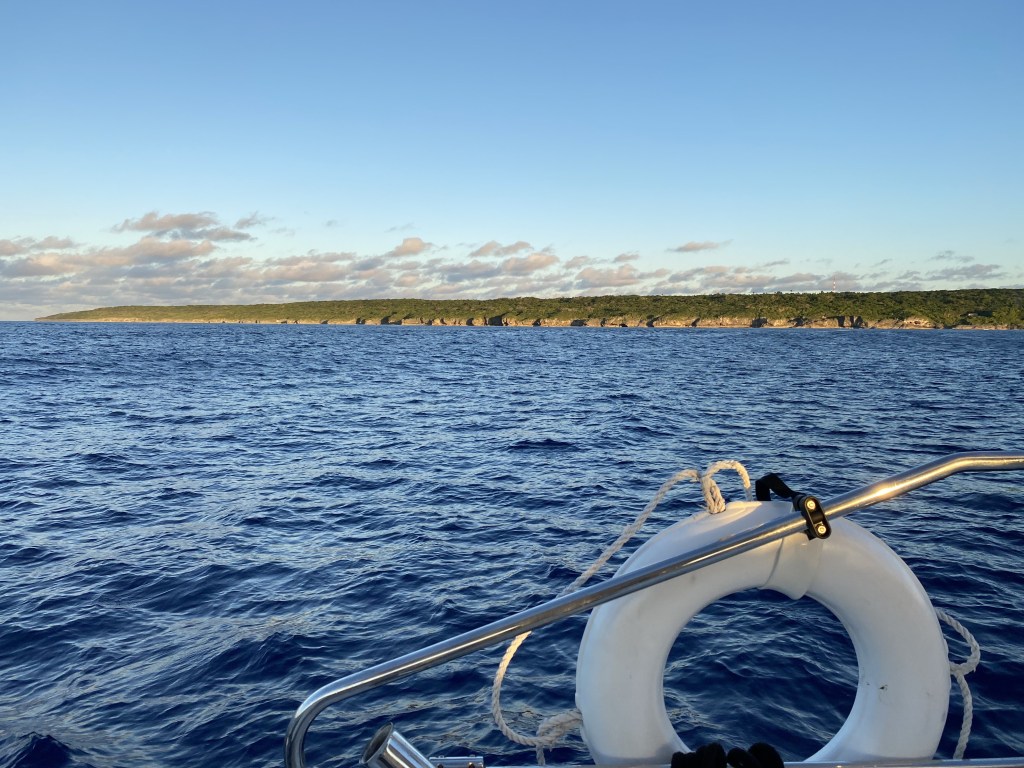

Requested permission to proceed into Niue waters to our mooring ball on the VHF. It’s nice to hear English again; it’s been 9 months since we were in an English-speaking country. Beautiful sunset as we rounded the island, but didn’t make it quite in time before dark.
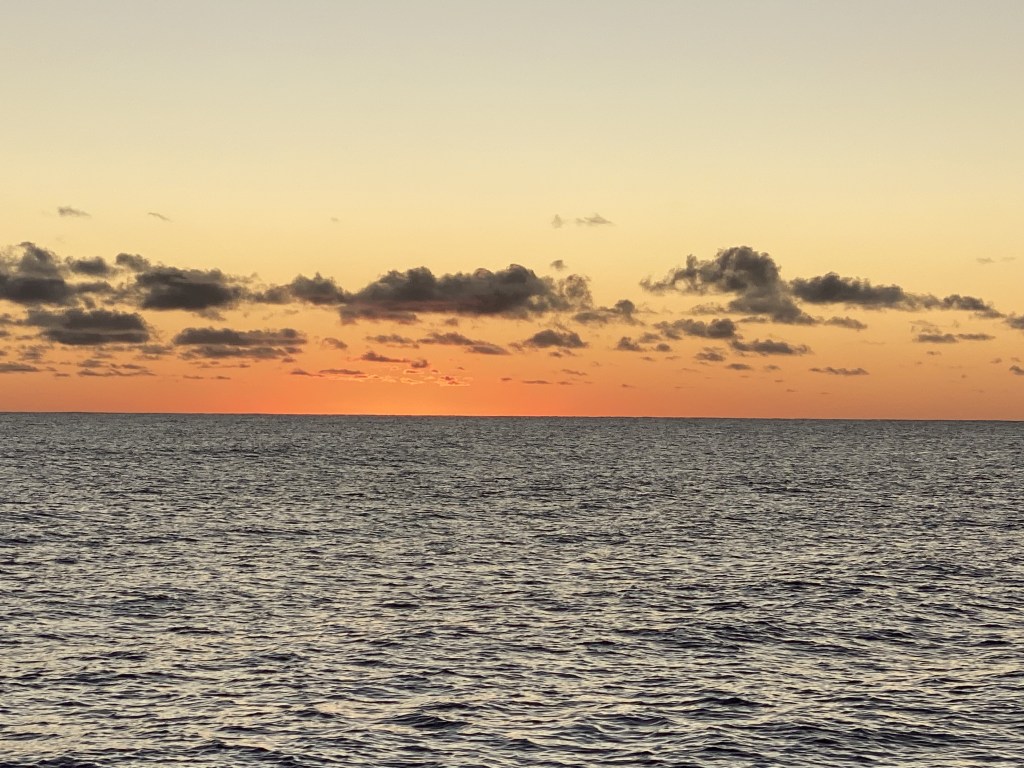
We heard humpback whales trumpeting in the distance. So thankful to friends who launched their dinghy and lit up our mooring ball, assisting us with getting attached in the darkness. Arrival at 7pm: NIUE! Humpback whales amongst the moored boats, with their breaths loudly over the waters.
Total passage of 1,048 nm with average speed of 6 knots. Overall, a great passage with a few squalls and some spicy sailing. Now, off to bed for a full night’s sleep with no watch!
 SV Terikah Adventures
2 responses to “Ocean Passage to… Niue!”
It’s terrific to be able to watch the videos! I sure hope you make more and more. We’re getting to see this part of the world through your lens. Be safe and take care.
LikeLiked by 1 person
This is Jennifer Slager from CHM. Such cool adventures! Love the pictures!
LikeLike