
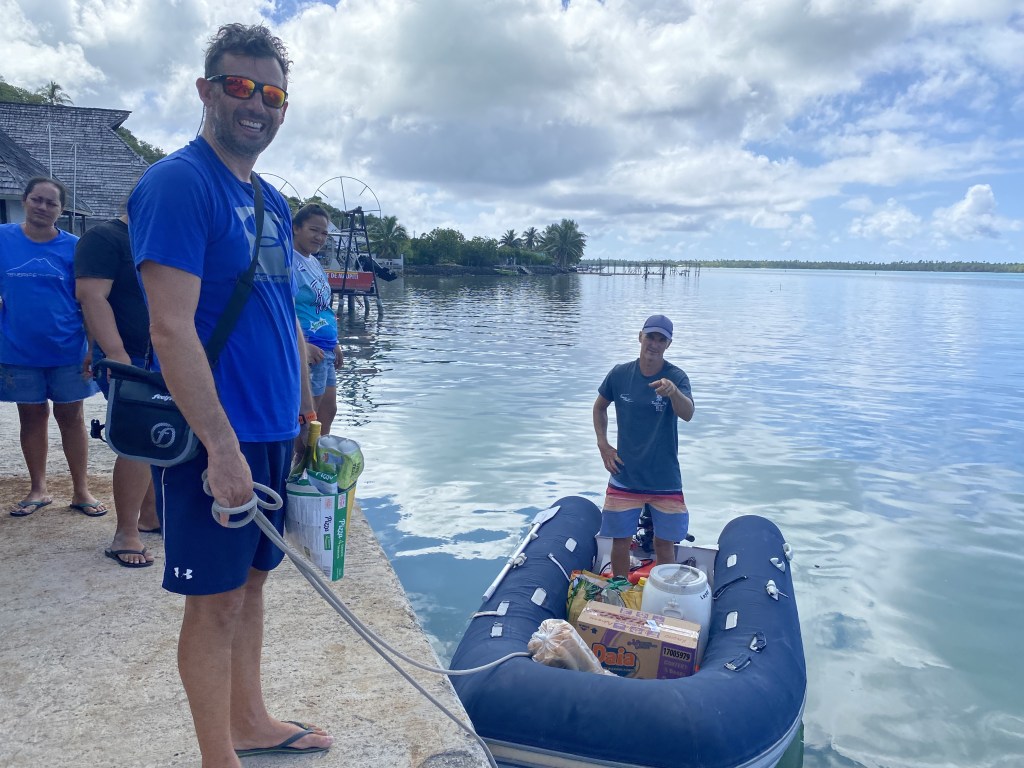
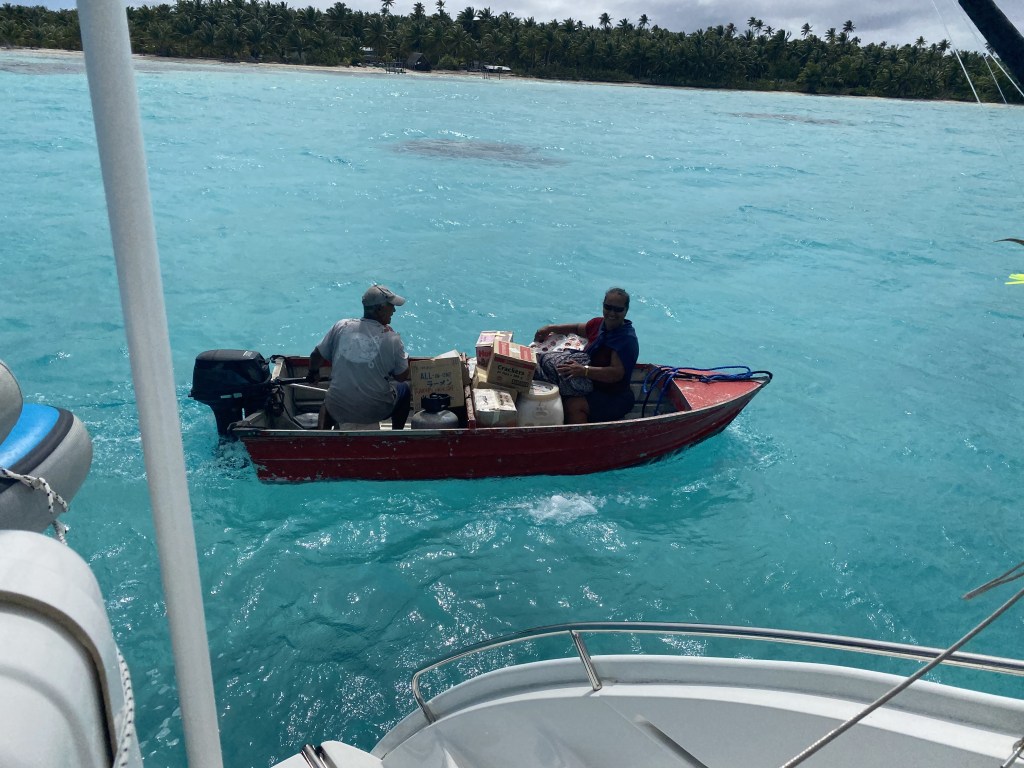
How did we end up on a 100nm overnight voyage from Maupiti to Maupihaa with a local grandmother and a pile of supplies and food for the locals? While we were in Maupiti, another cruising boat reached out to us from Maupihaa, providing us contacts to organize the passage of a woman named Norma back to her home, along with supplies for the 10 residents. Norma had been in Maupiti for the Heiva for 3 months and her husband was looking forward to having her back home again. We scheduled a time (using online translating apps) and, between four cruising boats, loaded up supplies into our dinghies that were then secured onto our boats.
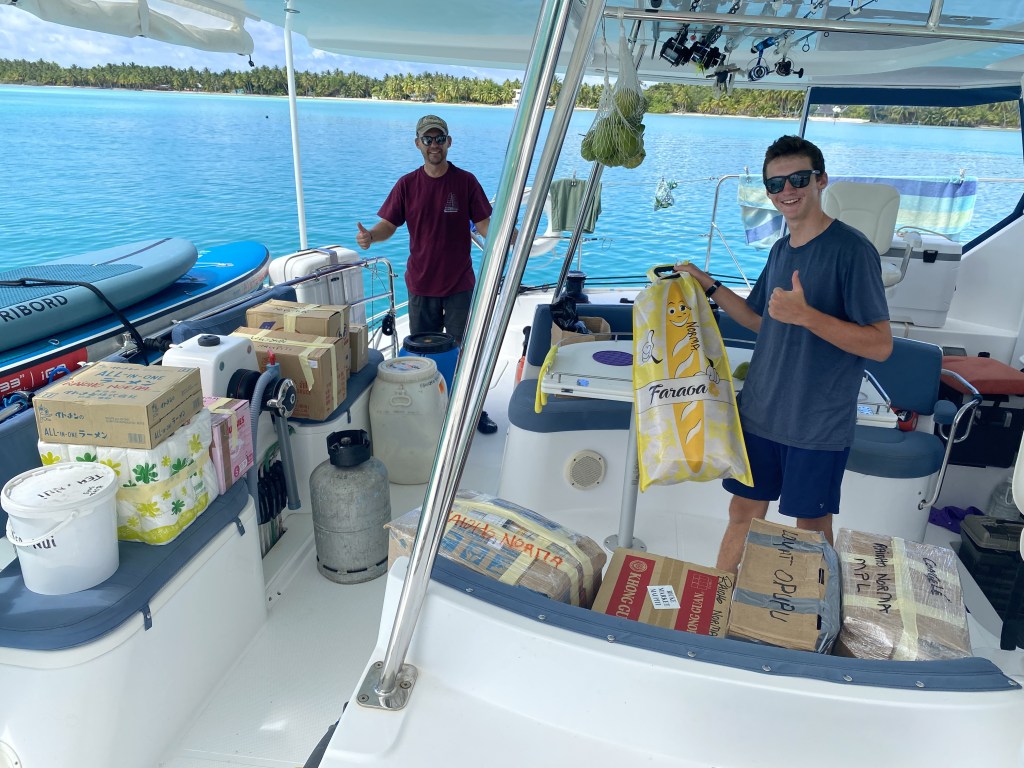
Norma joined us just before departure, French-speaking only, locals waving to her as we departed the Maupiti lagoon, our on-board celebrity.
The exit out the pass was more exciting than our entrance, with waves building up and the local ferry passing us on our way through.
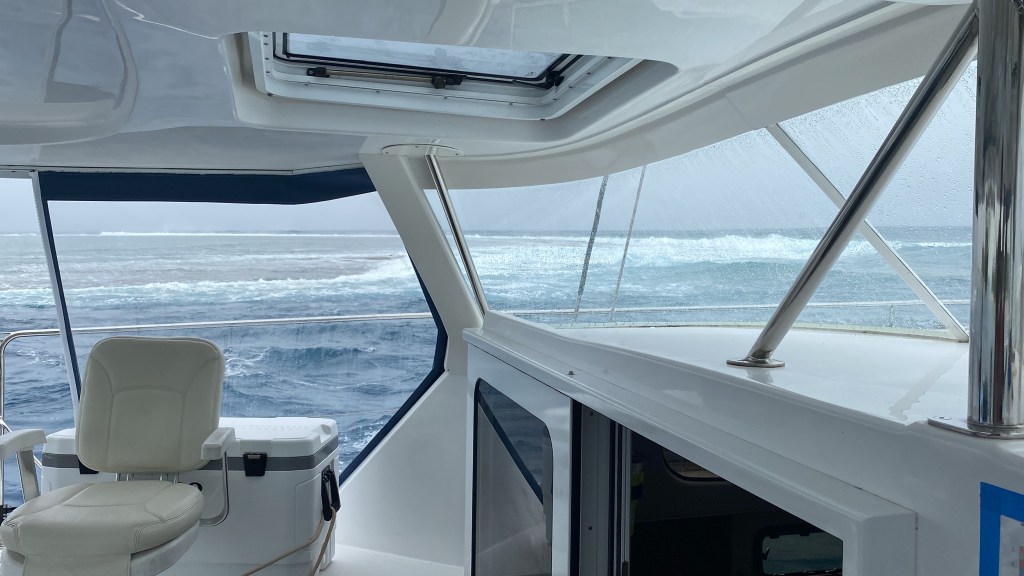
The overnight passage was not pleasant, Norma and Cora both curled up on their respective benches feeling ill, unfortunate large beam seas. We sailed with only a whiff of sail, still moving along at a good speed to get us to our destination in late morning for the pass into Maupihaa.
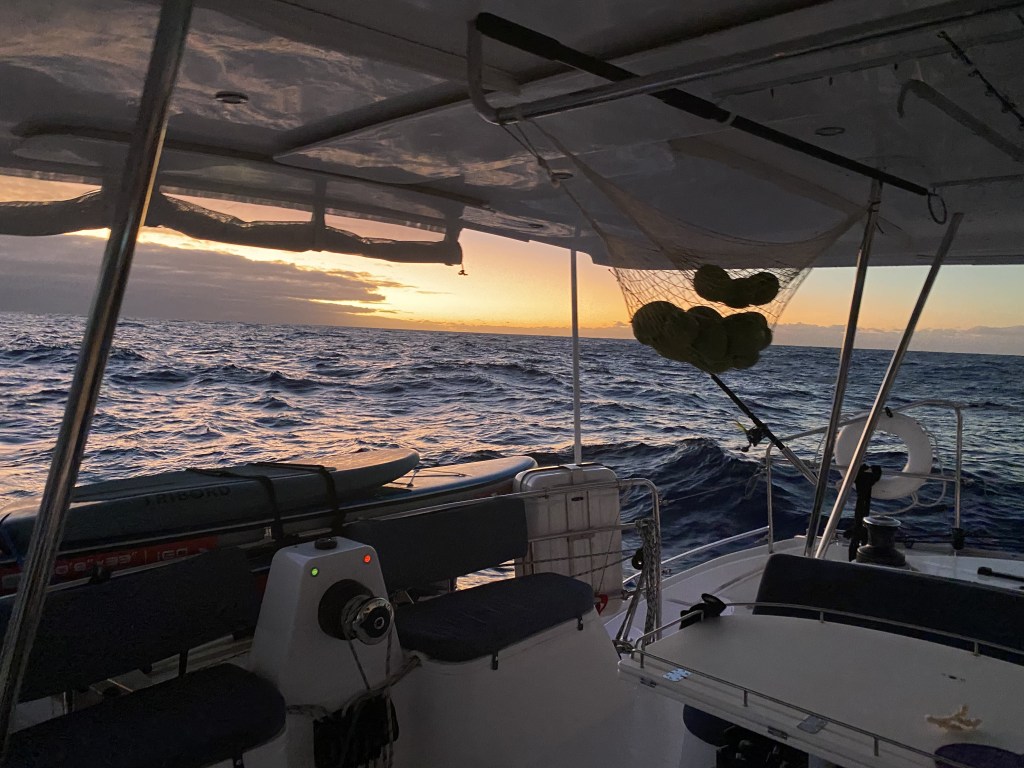
We were on a front, quite literally the edge of a low/trough that was moving north and creating a convergence zone, an area of instability. However, we felt we needed to leave Maupiti, which we could only exit when south swell was less than 2 meters (and this was our brief window to do that). As much as we loved Maupiti, we didn’t want to spend another 2 weeks or more there.
The pass into the atoll of Maupihaa is VERY narrow with only 2 remaining channel markers.

On the bow, Norma and Calder were pointing in opposite directions; the language barrier made it unclear if Norma was pointing the direction to go or at coral heads to avoid. At one point, we started to go backwards in the 3 knots of current, as we slowed down to get clarification about the clear route. Safely anchored, Norma’s husband Harry was soon there to collect his wife and supplies.
Invited to dinner that night, we showed up on shore to find Norma, Harry, and Norma’s brother Steven dressed up in nice clothes, greeting us with tiare flowers to tuck behind our ears.

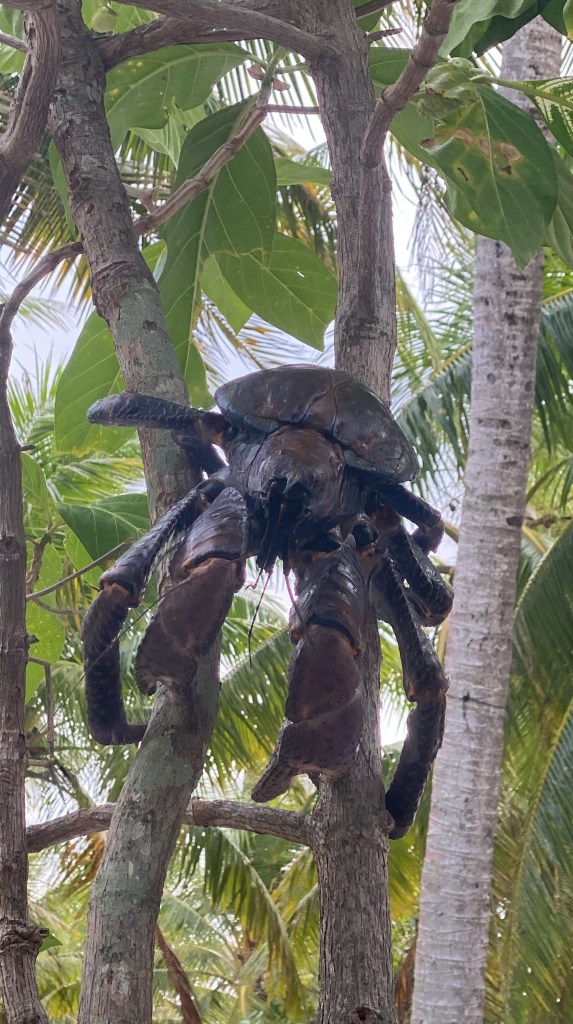
A table was laid out with freshly caught and cooked snapper and coconut crab, which we enjoyed after they offered up a prayer. What a feast!

We gifted them with some lemon cake and the cedar bowl made in Petersburg by our friend Emil, who wanted us to find a good home for it. They sent us back to our boat with left-overs, fresh mangos, and coconuts. The inhabitants here are copra (coconut) farmers and live in simple open-air homes with water catchment and subsistence living off coconuts, fish, coconut crab, and various seasonal fruits. They only get a ship here every 1-2 years, once they have processed enough copra to have it picked up. This is remote living to an extreme.

Our interactions with the locals have been a highlight here. The next night, all the cruising boat crews were invited to another local family’s home for a feast of tuna and black jack on the grill, a coconut sitting upright at each person’s place to drink. Before we ate, they thanked us for bringing the supplies they needed.
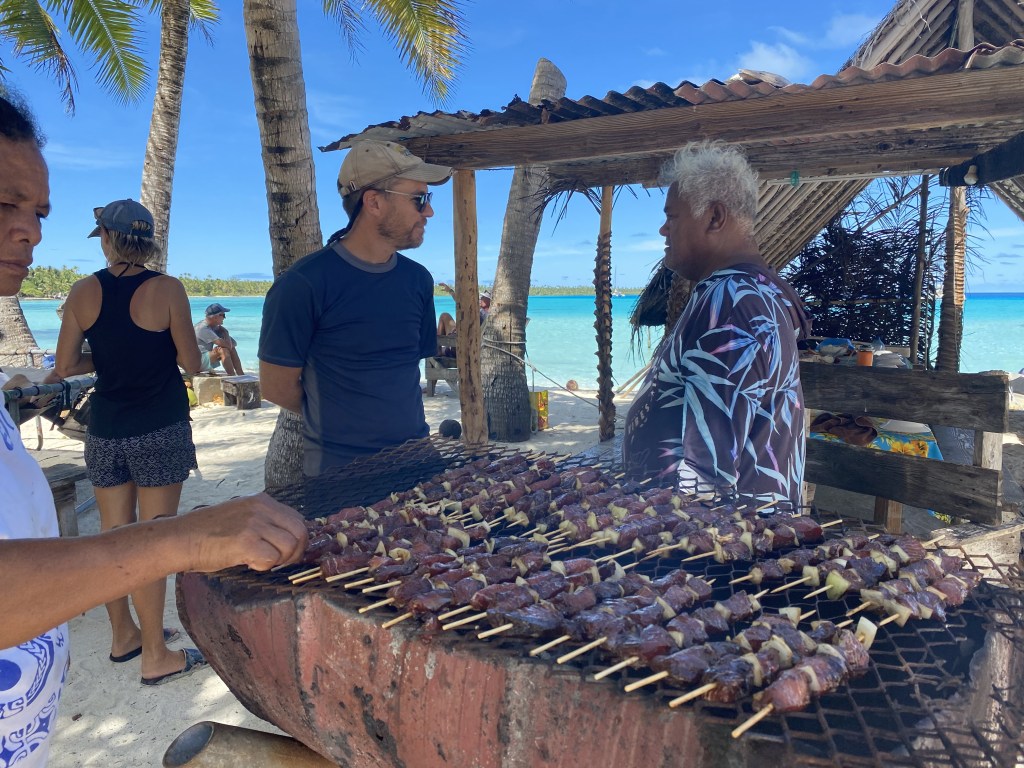
They taught us to pick up a massive coconut crab correctly, its pincers so powerful they could remove a finger. One early morning at 4am, a local woman gathered 23 lobster off the reef which she put into a plastic tub backpack, bringing them to shore to share with all of us. Later that morning, our boat crews joined the family to raise the roof on their copra shed, a task that requires more than their family of 3.
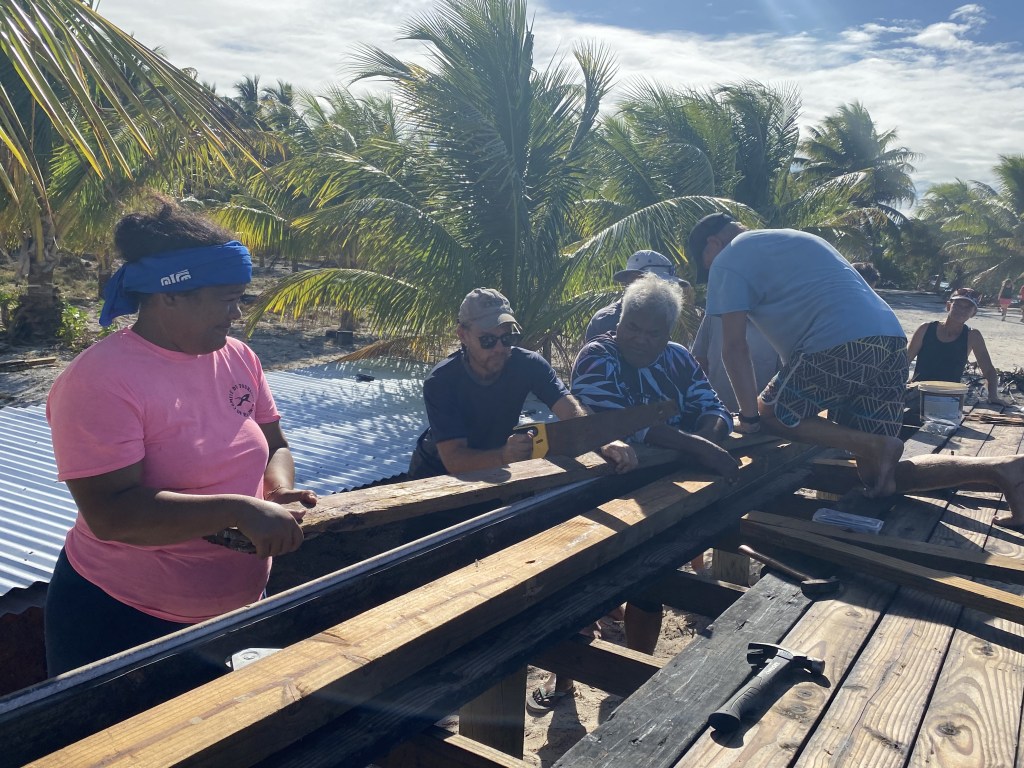

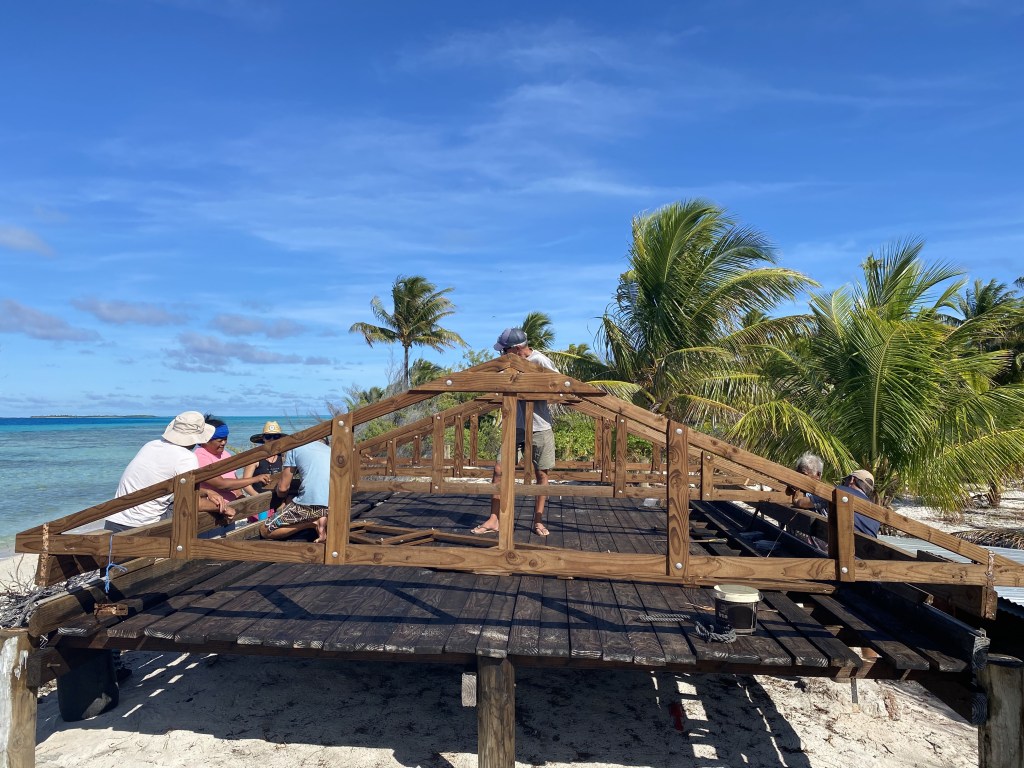

We nailed and lifted and fit the roof over a few hours and were thanked with a lunch of fresh lobster.


At these feasts, we have brought various dishes, finding that they really love noodles and sweets. It has felt so wonderful to finally be able to give something back to this amazingly generous people. Their laughter and sense of humor is contagious and breaks through language barriers.
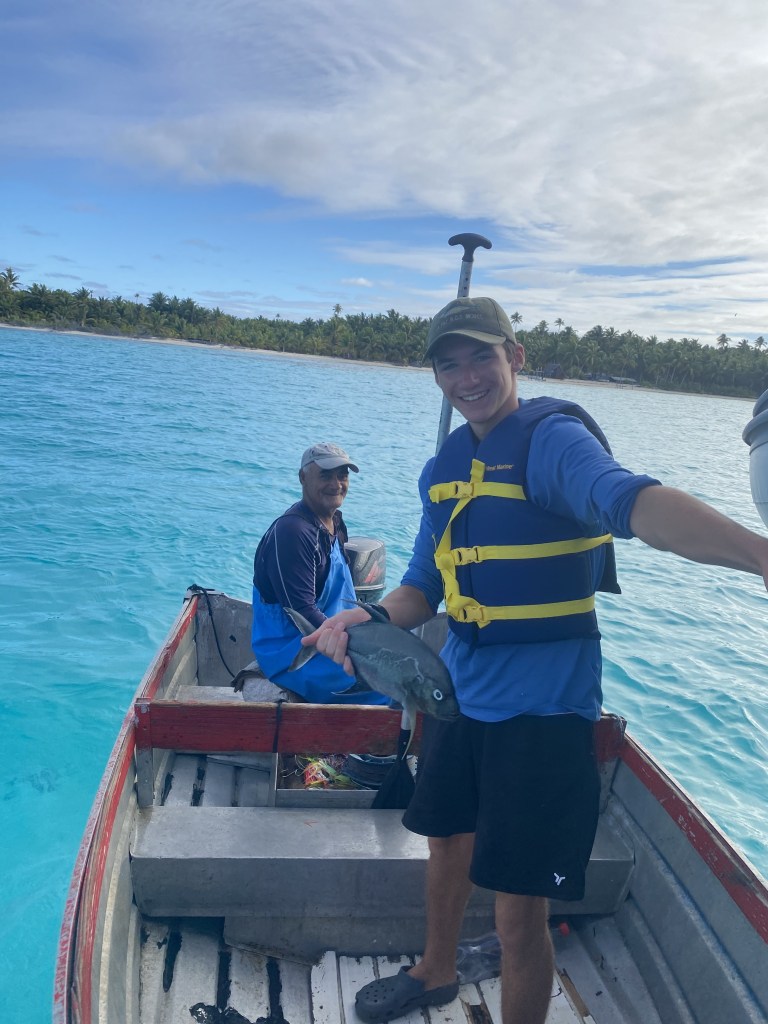
Chris began his birthday celebration with a fishing trip with Calder and Harry.
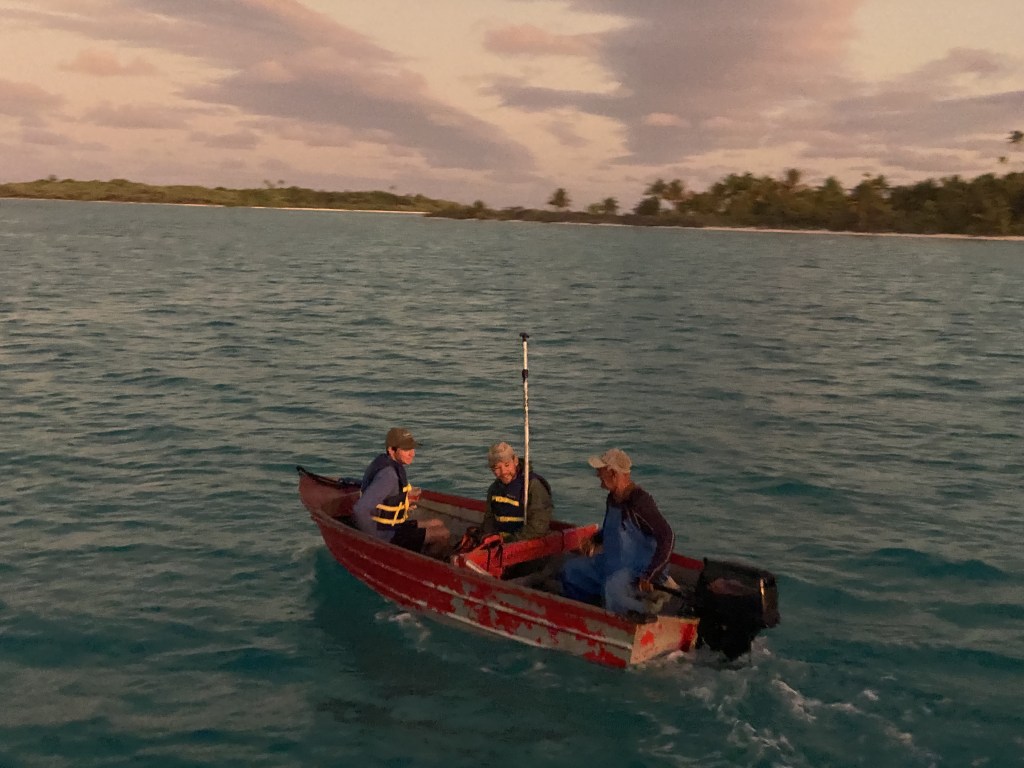
Here’s Calder’s story: After having dinner with the local family, they offered to take us fishing in the morning at five. We woke up at four, got ready, and were ready to go by five. At six he showed up and, with the language barrier, we were not able to tell the reason. We hopped in his 14-foot skiff, and off we went. We offered to take our dingy but he told us, “No. Shark pop.” Not wanting a shark to bite our “car,” we went with his tippy, and very leaky, skiff that flexed with every wave. After getting out of the pass, which was alright going with the current, we tossed two handlines out and trolled along the edge of the reef. His method was to ride the area where the wave broke so we would ride up the huge swell and then over the other side, just as the wave curled over behind us. It was terrifying in the beginning, knowing that if his beat up 18 hp engine died, then so would we. But it didn’t! We caught two fish, a Blackjack and an unidentified fish. A shark jumped clear out of the water, almost snatching Dadu’s fish right off the hook. Then it was time to head back, and the current had really started to run out the pass. We surfed a wave into the pass, then on full power, were barely able to go at more than around 3 knots. But, yet again, the beat-up engine pulled through and we made it back to the boat with fish for birthday breakfast!

The remoteness of this location gave us quite the scare when we thought Cora might have appendicitis. She developed a fever of 103 for three days, complaining of abdominal pain that was migrating to the right lower side, worse when she coughed or jumped; all signs of potential appendicitis. The good news was that she maintained an appetite, not a sign of appendicitis. What to do? Even though we have medivac insurance, we are 100 nm from the nearest airstrip against the prevailing winds and seas. The locals showed us a cleared dirt area near their house that they called their “helicopter pad,” having used it two years ago for a medical emergency. I reached out to friend doctors in Alaska and got her started on antibiotics that would cover early appendicitis, as well as bacterial gastroenteritis; her fever went away within 24 hours and she continued to improve. She remains symptom free, so I am suspecting it was bacterial gastroenteritis. However, we continue to watch her closely before we take off on our 1,000+ mile passage to Tonga. It is a very vulnerable feeling to have one’s child ill in such a remote location.
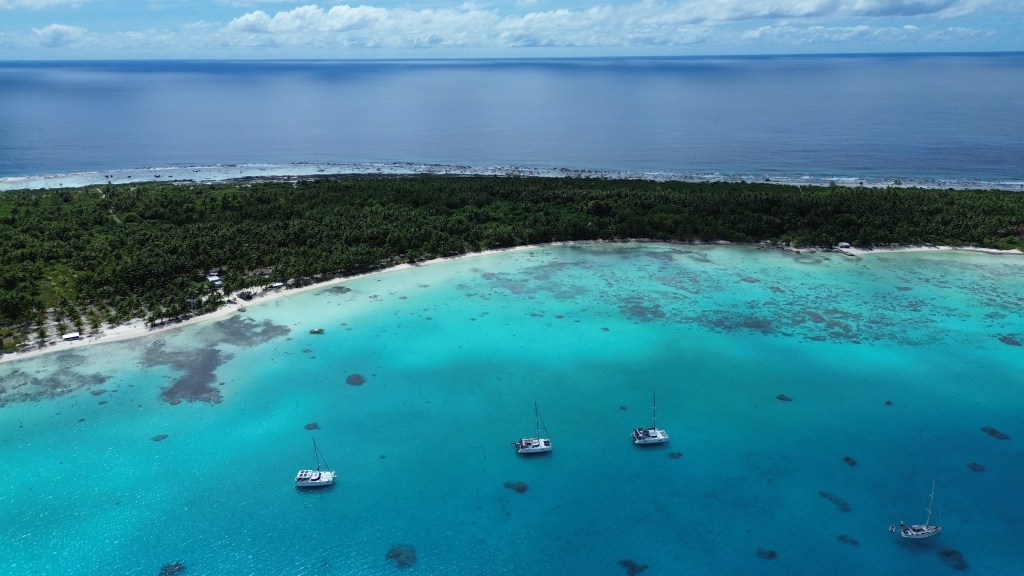
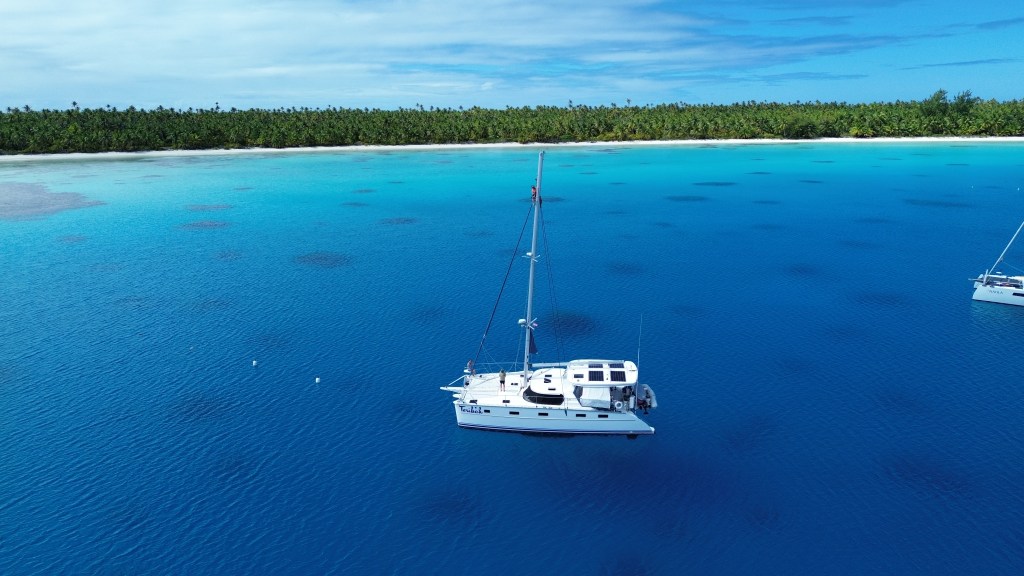
We started in the northern anchorage near two local families, but wind direction prompted us to the southern anchorage where we anchored amidst bommies, floating our chain again. Here, we spent time with Hina and Opupu. Hina has lived alone here for about 25 years. She took a group out spearfishing, then we had a feast for dinner of reef fish.
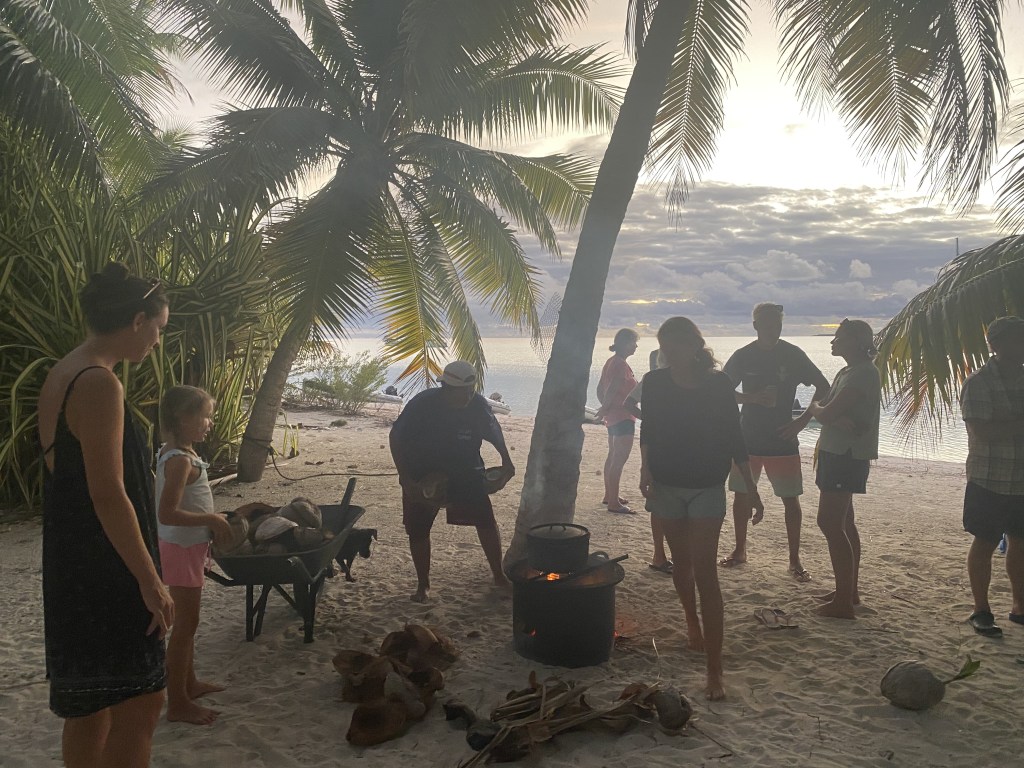
She makes her own beer, which she kept wanting to share with me, “Here doctor Jennifer, it good for you” as she laughed. She taught us to open coconuts and make coconut milk.

We would sing and dance together, as she loved the music we’d play on our Bluetooth speakers. Opupu caught us tuna and taught us about coconut crabs.
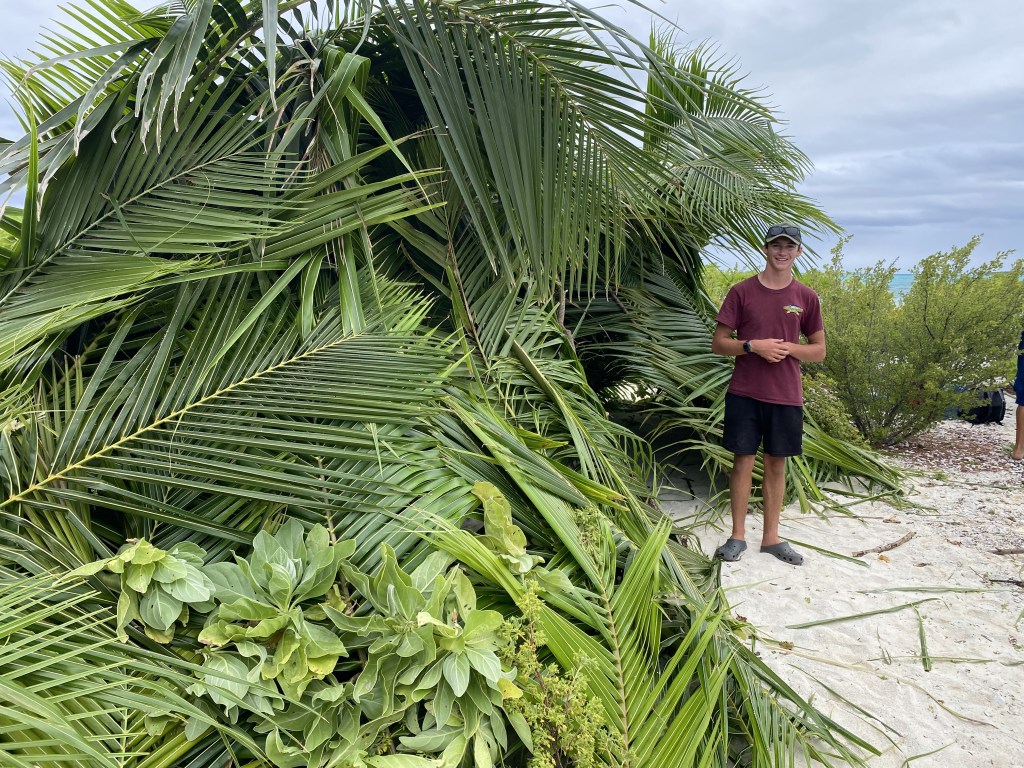
We are anchored here with many other kid boats, which has made for a happy, busy time. The kids have had two overnight camping experiences with their friends, sleeping out in hammocks and palm structures, fishing the reef for a hopeful dinner.

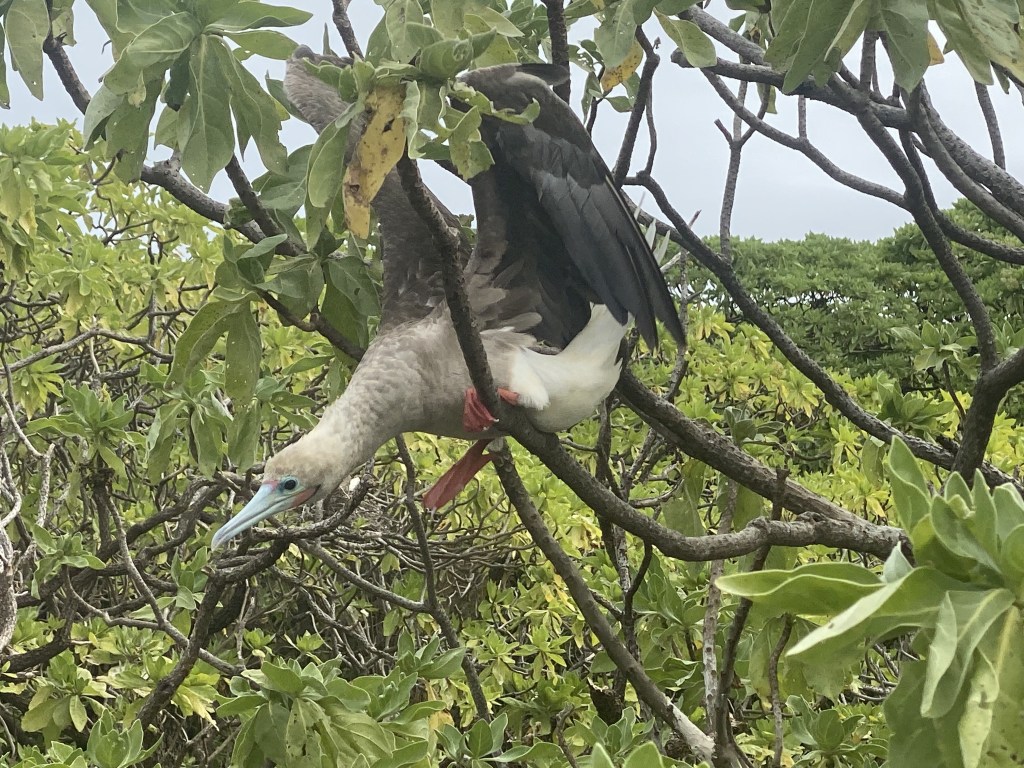
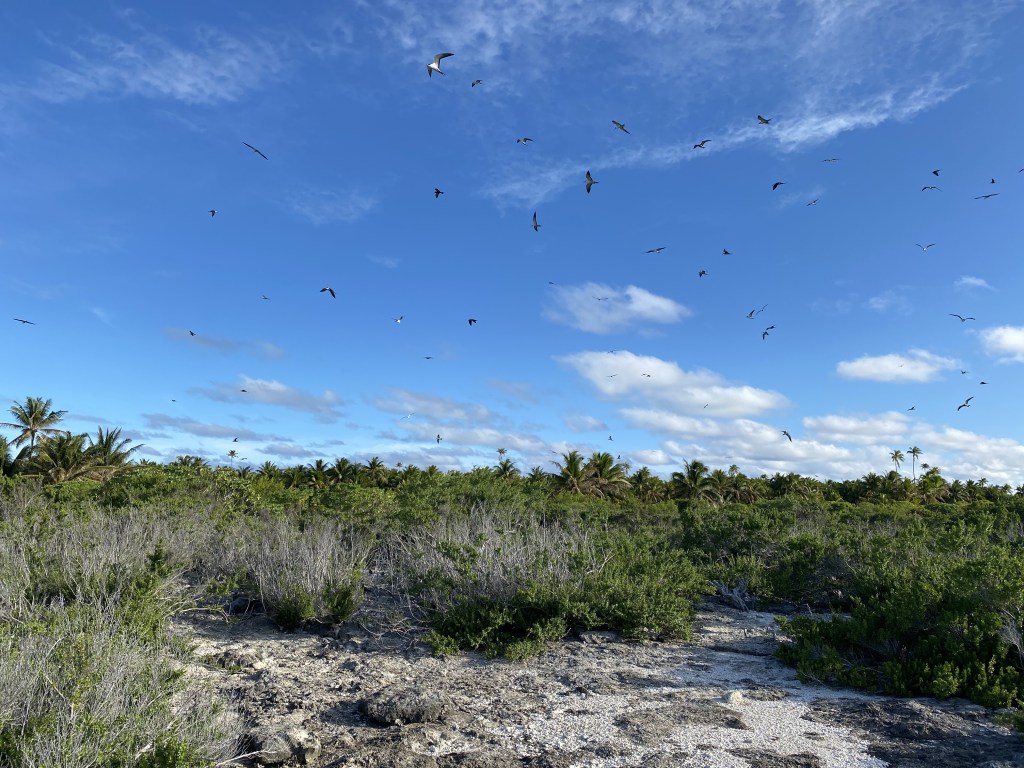
We’ve had numerous walks on the beach and along the reef. Being so remote and untouched, this is a bird nesting area for boobies and terns. Thankfully we only were charged by one angry mama bird.
Humpbacks can be seen swimming outside the reef, while the inside waters team with colorful fish life. The hermit crabs here are the predominant species, coming out in night in the thousands and clinging to trees like Christmas ornaments during the day. Calder has practiced wing-foiling. The adults have gathered for happy hours, while the kids play games.
Chris also has continued work on the boat, some planned and some not planned. On the planned side, he oiled and greased the bearings on the genoa furling drum. On a calm day, he went up the mast to do a full inspection and cleaning, finding the Code Zero attachment not ideal. He respliced it, then went up the next day to reattach it.


The big project we didn’t anticipate was our anchor windlass not working….One morning, I woke up to a calm, beautiful sunrise…

…as the winds came in, we realized that our anchor bridle was tangled around a coral bommie, as well as the floating balls. We missed our helpful kids who were camped out on shore, as Chris had to launch the dinghy to untangle the mess and I had to drive the boat forward to avoid the reef behind us. At some point during this process, our anchor windlass stopped working, which means that we could not haul up our anchor, a very vulnerable feeling to be in building winds without a way to move quickly if needed. Chris dove into our windlass and found the motor burned up completely, a melted ball of soot and oil.

He started cleaning it but, thankfully, another boater saved us with an extra motor that fit; so fortuitous! We now have a working windlass and another motor on its way to us in Tonga.
We are tucked in for a few days of rain, starting the new school year, Cora in 7th grade and Calder in 9th grade. Homeschooling a high schooler is a whole new challenge, as I try to ensure he is meeting all standards needed to pursue college and beyond. It involves making sure he masters certain knowledge for some courses (Biology, World History, Geometry, Composition, Health), or logs adequate time for other courses (Spanish, Guitar, and Computer Aided Design). Both of them have more independence this year, with me serving as a coordinator and consultant to their learning.
It is proving challenging to find a weather window to get to Tonga. Low after low pressure system is marching across the South Pacific, bringing large winds and seas that we would like to avoid. It also is not straightforward about which way to get to Tonga with paths leading through Suwarrow, Niue, Samoa, or direct. We sit here anchored with numerous family boats, all with a goal of a safe, semi-comfortable passage. But we aren’t seeing any weather window in the near future. We’ve met with our weather router and continue to monitor for an opportunity to leave without taking too much of a beating. Boats are getting creative with food. Our beer is almost gone. If you don’t hear from us, we may have moved in with Hina, starting a diet of coconuts, crab, fish, and homebrew.
 SV Terikah Adventures
4 responses to “Maupihaa: Adventures in Atoll Living”
Your amazing adventures never cease! So fun to follow!! 😎
LikeLiked by 1 person
Dear Hyers,
We have been enjoying your adventures and so happy to hear Cora is feeling better and Calder—we enjoyed your description of fishing in not so comfortable/safe feeling circumstances. So many stories and experiences to remember!!!
Last weekend we had a UniBloc party here in Severson Subdivision and had a chance to see the Tuckers who enjoyed their rendezvous with you in French Polynesia and Emil must have been a great addition to your “crossing” crew. Must have been nice to have another ship mate to help make the voyage!
We have enjoyed lovely days here recently, but rain has thankfully returned—especially for the fish trying to return to the streams. Next adventure for us is to go and try to catch some coho!
Safe travels and enjoy the experiences! Your friends, Jim and Leslie
>
LikeLiked by 1 person
Am just about to dive into this blog – am so excited to hear about your journeys SV Terikah! Often feeling so much nostalgia and parts of my spirit that are still with our sailing adventures and life this past year.
Wren is so excited about and today is her first day as a middle schooler and 6th grader. She will be so happy as well when she gets home and I show her, to see this blog and SV Terikah’s adventures! Sending our greetings to SV Terikah family, from across the miles and from our little place in the mountains now, SV Amizade, Jen, Mike and Wren
LikeLike
Hi you guys! Great to hear from you! I hope Wren enjoyed her first day as a middle schooler. Much love to you guys in the mountains. We hope our paths cross again!
LikeLike