
What a wonderful night of much-needed sleep in this protected anchorage, the boat barely moving. Our time zone changed another 30 minutes, so we are now two hours behind Alaska. Expected clouds and winds moved in, thankful to be in this safe lagoon with excellent holding. I have been able to use my doctor skills, putting sutures in a cruising kid’s chin and taking care of Cora’s knee. Cora’s knee is still swollen and feels very unstable to her, so we continue to keep it protected. However, she wanted to step on land, as it has been a while! We went for a dinghy exploration, weaving between coral, to the beach where we walked a bit, watching the black-tip reef sharks (SO many here) and marveling at the various corals we floated over.

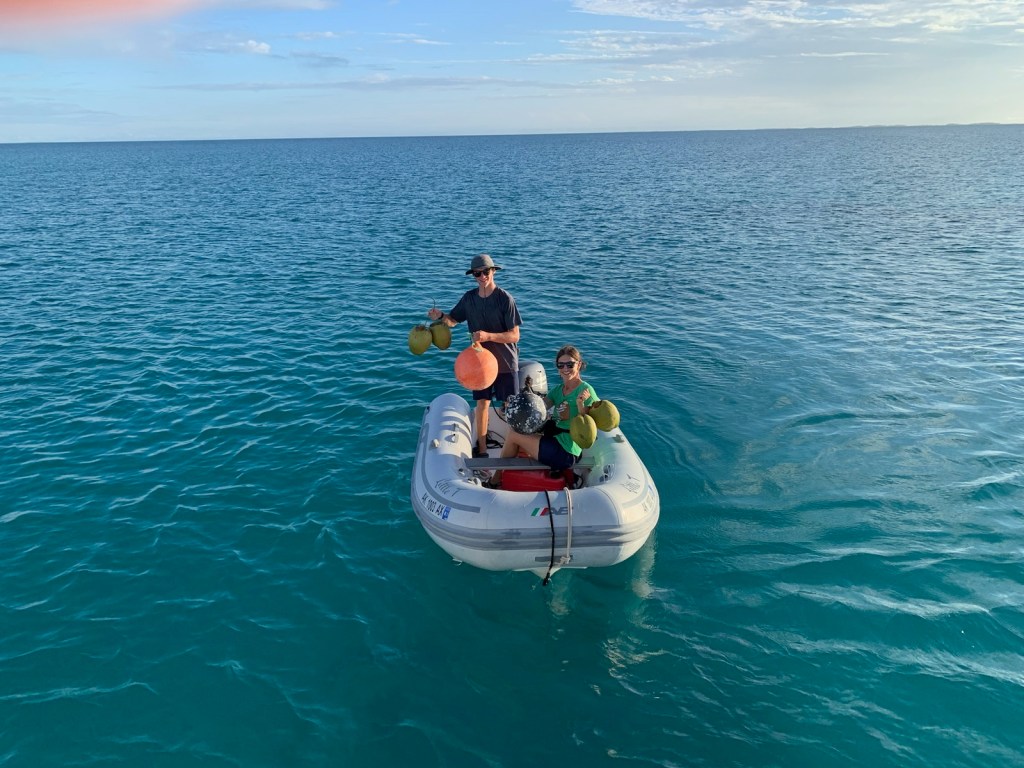
Then Calder and I went on an adventure – the task was to find heavy-duty hard oyster farm bouys to float our chain when anchoring; this protects the coral and keeps the chain from wrapping around and getting caught as well. The hard floats are nice, as they don’t collapse with the water pressure when the chain goes tight and pulls them underwater. Calder and I beached the dink then walked through the coconut palms to the outside of the atoll, where the waves crashed onto a fringing reef. We watched 5 moray eels devour a crab. And we found two hard bouys; score! To top it off, we harvested 4 yummy coconuts for as well. Our mission was a success!



The next day, Chris fixed a leaking overhead hatch and caulked an area in the galley. I started our post-passage cleaning, wiping salt spray off the walls… so much salt makes its way in! Cora started “physical therapy” that I found online, an incremental program of exercises that advance slowly as she heals. She still has so much swelling and is very cautious (and using support) with walking, but the pain is almost gone.

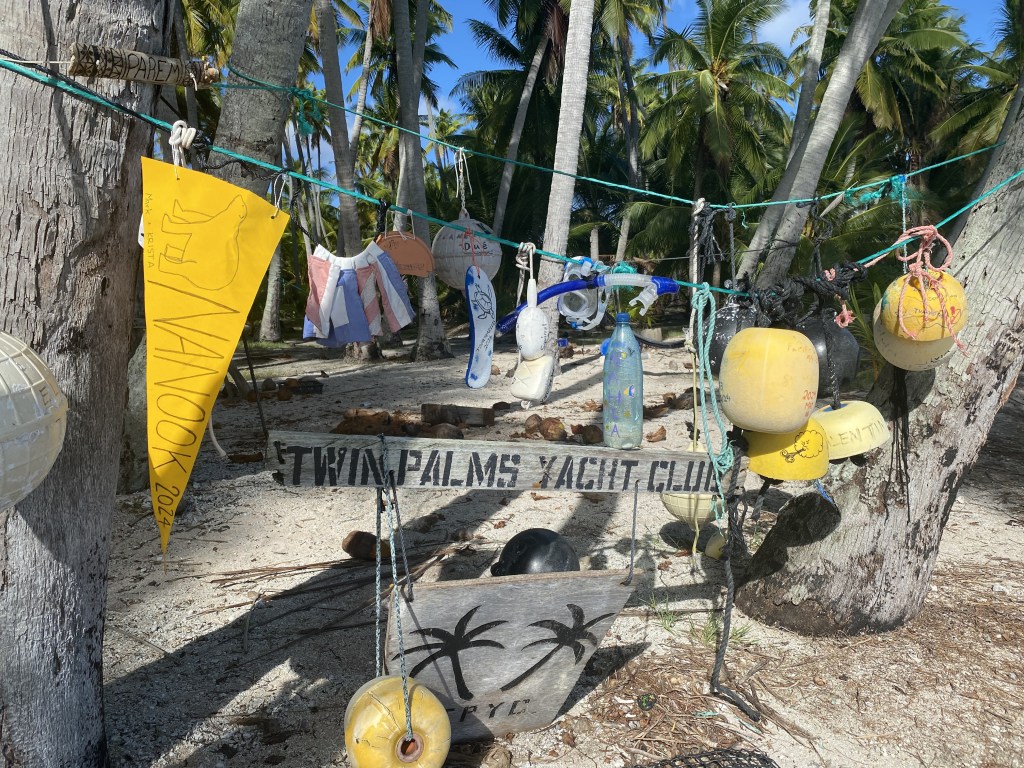
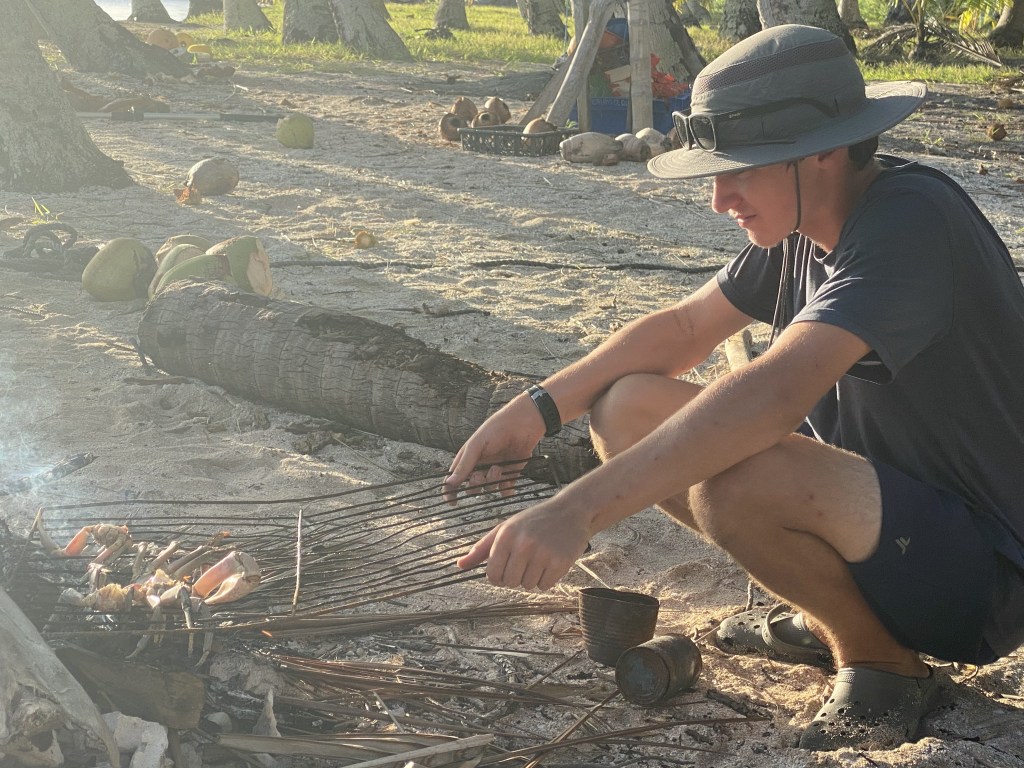
Over to the beach with four other kid boats to Twin Palms Yacht Club, a beach area where past cruisers have placed a comical “Yacht Club” sign and set up a fire pit to use. Calder and some of the other kids enjoyed harvesting and eating coconut meat and crabs they caught grilled over the fire. Tonight, the sweet smell of flowers wafted off the land with the trade winds.
Chris changed the oil in the generator and did some sleuthing on some other generator issues (small saltwater leak in the cooling system), as well as did two loads of laundry. Cora and Chris explored by dinghy in the atoll “hoas” (the small inlets that let water flow into and out of the lagoon). Calder and I explored by paddleboard and foot to the outside of the atoll, where we found another oyster farm bouy, a chunk of net for Calder’s coconut harvesting bag, and 3 delicious coconuts.

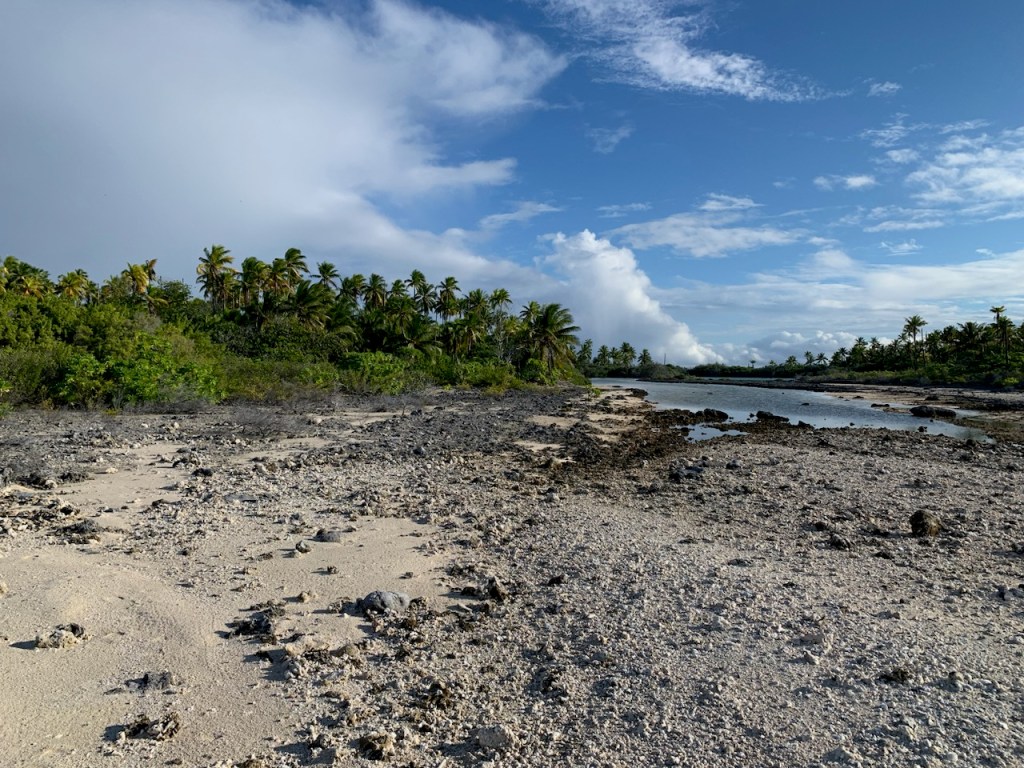
The land here is a mix of sand, rough volcanic rock, and coral chunks interspersed with coconut palms and shrubs. That night, I cooked dinner as I have been lately, not with my typical recipes, but rather starting with ingredients that I need to use up and looking for something creative to do with them. Tonight, I had eggplant and potatoes that were going south…so I made “Aloo Baingan,” a Pakistani style vegan curry.
On Thursday, we moved to another anchorage in the Raroia atoll about 9 nm away. We moved slowly, the kids and I up on the bow, Chris back in the cockpit with resources all around him including Google Earth and a track on Navionics from another cruiser friend. We communicated back and forth with walkie-talkie. The wind waves and clouds made visibility a bit more challenging, so we felt lucky to have so many tools. The only brief scare was an underwater rope with bouy, but we put the boat in neutral quick enough (to stop the props) and glided over it. Anchored in 50 feet, held well, and went to shore to explore.
This place feels “way out there,” as we’re anchored along many small motus (little low sand and palm islets) that form this part of the atoll ring. In between are the hoas, allowing water in/out from the ocean; the surf can be seen and heard from the lagoon. The waters are various shades of turquoise with sand specked with coral heads.
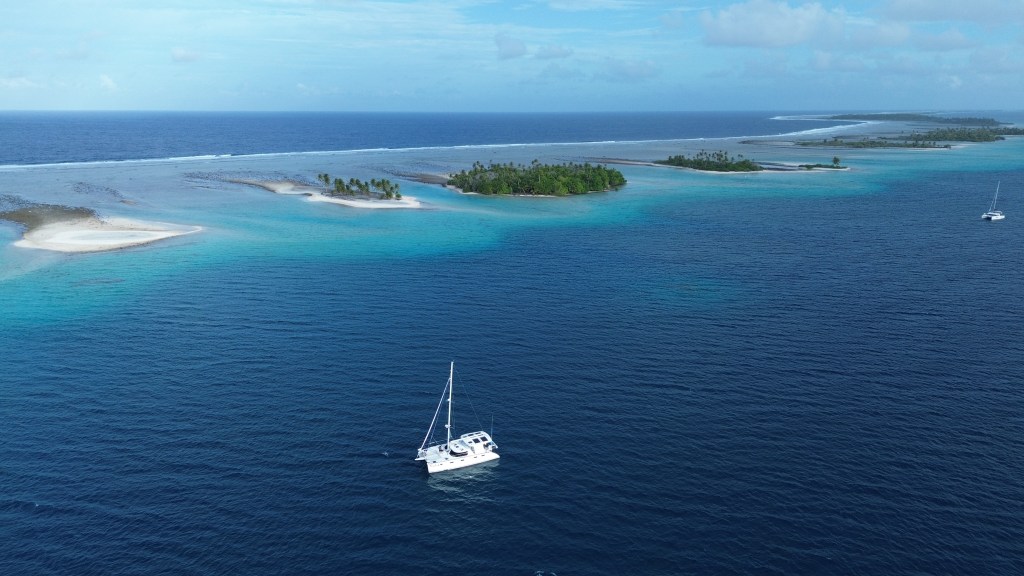
We explored a few tiny motu. Looking down, the beach started to move…tiny hermit crabs fingernail size and smaller were all over the beach. We would scoop up a handful of the tiny crabs, tickling our palms. At night, the skies north and west of us were lighting up with lightening; thankfully staying away.


I was able to connect with a friend orthopedist about Cora’s knee, who also is an Alaskan doc who cruised with his family in this same region; it was great to get some reassurance on my plan and guidance about next steps. She is doing an excellent job with her exercises and walking more every day, as swelling continues to slowly decrease. We plan to check in with a physician in Tahiti and get an xray to see if she has an osteochondral fracture of the patella and to ensure good alignment.
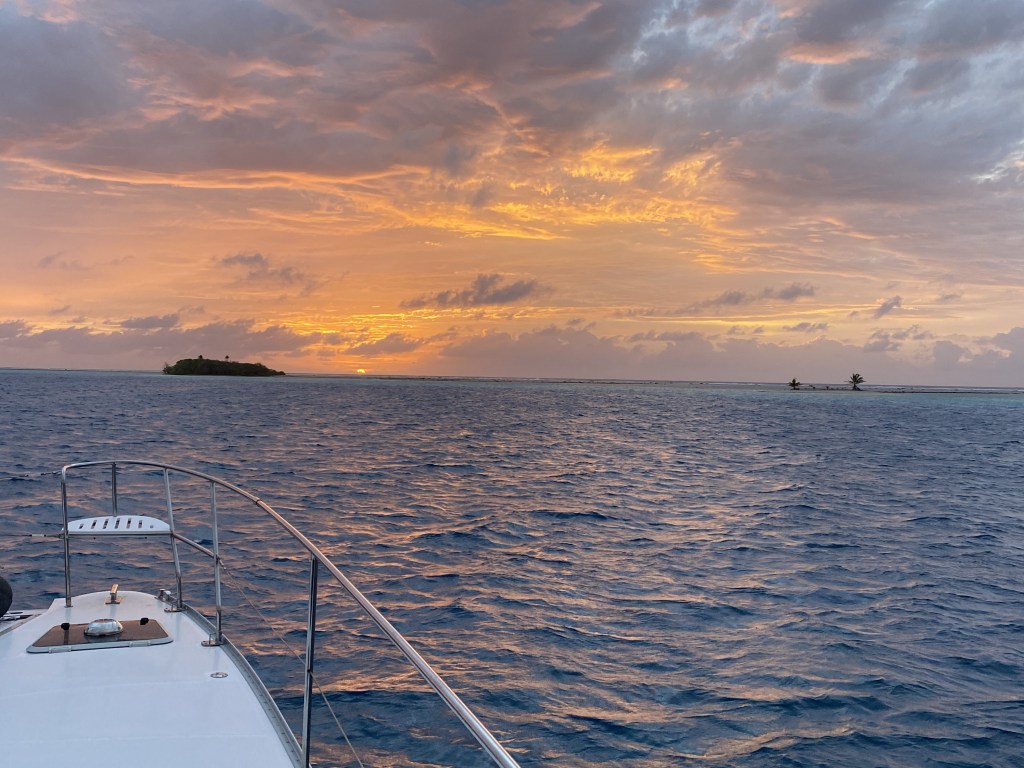
Friday, we declared a day off school for historical exploration. Raroia is the location that the raft Kon Tiki, captained by Thor Heyerdahl, landed in 1947 after its epic 4,300 mile, 3.5 month drift from Peru. We moved to this anchorage because the very reef the Kon Tiki crashed on, as well as the island they set up camp on, are right here. We had watched the original 1951 documentary (worth seeing if you haven’t) and set off to explore.
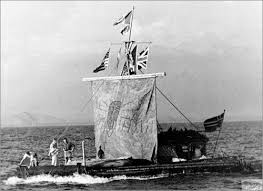


Birds roosted heavily on the Kon Tiki motu as we approached, soaring around us, one white tern chick peering down at us curiously. Walking the island to the Kon Tiki monument was surreal; even more surreal was looking out at the reef and imaging the experience of knowing you were about to crash your large balsa raft on there without any way of changing course.


Though the “drift theory” of how Polynesians got to these islands has been disproven, the spirit of adventure and the undertaking of the Kon Tiki voyage is still epic.
We explored two other motus, finding treasures from some line and stainless clips to the perfect palm branches for Calder to make a case for his new machete. A highlight was the Great Hermit Races. On one motu, there were so many large hermit crabs. We each picked one out and placed them in the middle of the race circle, cheering them on to victory. Chris always seemed to find the slowest crab.


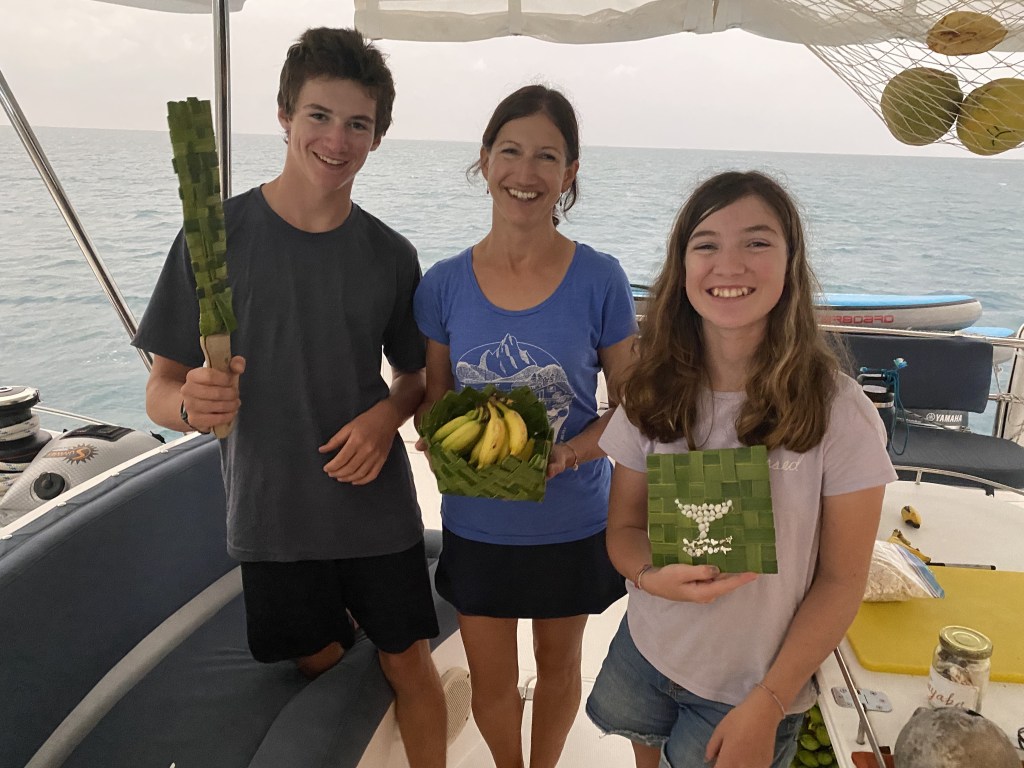
Cora did some cookie baking, as we are still learning the nuances of our convection oven now that I’ve given up on my propane oven (it’s dead to me and serves as a storage unit!). Calder did some weaving of coconut palms into a sheath for his machete. I remember him as a little kid, sitting on the beach in Alaska, weaving beach grasses; he’s always liked making mats and weaving in nature.
The winds are up today, along with some wind waves, and the weather around us is very “active.” We are contemplating our next move in the context of thunderstorms and low pressure systems in the south.
Today, the kids and I went to a nearby motu to gather up “art supplies,” consisting of more coconut palm fronds and small musical shells. The kids decided to “clean up” the motu, by nestling little baby coconuts just sprouting in holes and surrounding them with protective coral, as well as tidying up the dead palms and coconuts into a coconut mound.

The expected dark skies and rain shortened our shore exploration, and we spent time on the boat making palm frond crafts, from Calder’s machete case to Cora’s whale tail wall hanging to my bowl.
We received word from another boat that an impending thunderstorm tonight may have gusts up to 50, so we are tidying up and securing the boat in preparation. It should be through by tomorrow morning and we hope to be underway to our next atoll, Makemo, tomorrow.
We plan to work our way downwind, going west, along the Archipelago. As the distance to navigate from one atoll to another is usually over 8 hours, in order to leave one atoll with appropriate slack tide and lighting means an overnight passage to get to the next. As much as we’d like to see every atoll, this 2-day overnight transition from one atoll to another means that we’ll spend more time at fewer atolls during our month here.
 SV Terikah Adventures
6 responses to “Raroia: Our first Tuamotu Atoll & the Kon Tiki”
Absolutely stunning photos! You must have a drone to get some of these shots. Loved this blog – what a grand adventure, thanks so much for sharing!
LikeLiked by 1 person
Hi Tammy! We do have a drone that Calder operates; I don’t trust myself to do it! Which atolls did you and Dan visit? We think about you both so much on this voyage. Much love to you from us.
LikeLike
We visited Manihi and Rangiroa. Snorkeling just inside the pass at Rangiroa was the best snorkeling of the whole trip. So glad to be able to re-visit these places through your blog!
LikeLiked by 1 person
I tell everyone I visit with about your adventure and all of the stories that Calder and Cora will be able to tell their grandchildren for years to come. Words cannot express all of the thanks that mother and I have for your sharing this adventure with everyone.
We are both getting a much grander knowledge of the South Pacific as you show us all your pictures and tell us your stories. This is all just amazing!
Take care and hopefully one day we will get to see you all in Alaska, as we are finalizing everything here in Southern California and preparing for our move to Thorne Bay.
Looking forward to your next posting. Stay safe.
James and Camdin.
LikeLiked by 1 person
Hi – so glad you are enjoying following our adventure. Good luck on the move!
LikeLike
Hello to the Hyers!
This looked to be quite a varied experience exploring the motus, and subsistence foods. Wow!
<
div>It is nice to hear th
LikeLiked by 1 person