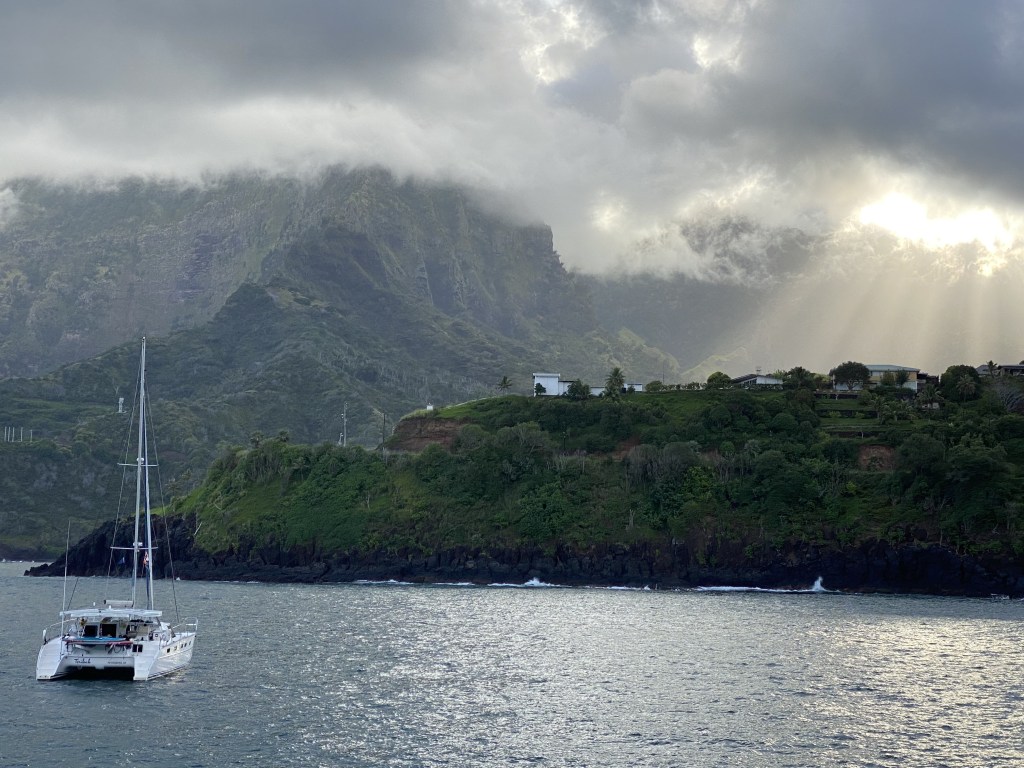
We continue to explore the Marquesas islands, planning to spend about 4 weeks here before our next passage to the Tuamotus, about 500 miles away. Our trip across the Pacific Ocean is only about 1/3 complete and the next 6 months will be passage-making between island groups, each passage with its own challenges. Thankfully, we get to “regroup” between each passage with island exploration, boat chores, and school.
Tekokuu Bay, Tahuata Island: Learning to swim with sharks
After picking up our laundry (this time we brought a huge plastic bag just in case a squall occurred) and our daily baguettes and some other last minute food items, off we went on a quick 8.5nm sail to nearby Tekokuu Bay on Tahuata Island. Our plan is to hang out on Tahuata Island and allow some weather to pass before heading further south (against the wind) to Fatu Hiva, which many report as their favorite anchorage in all of the Marquesas. Chris is not convinced yet due to having to go against the wind and waves, as well as some reports of a steep anchorage and boats dragging.
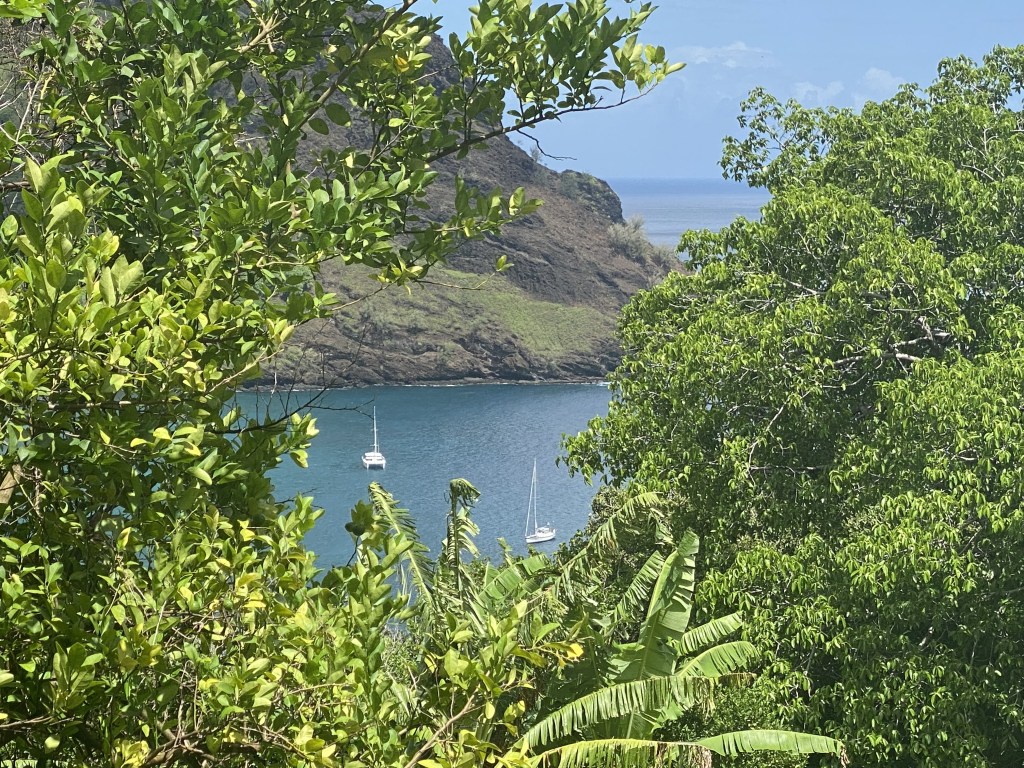
For the time being, we enjoyed this little indent of a cove with one other boat lined with volcanic rock and a small white sand pocket beach. The rocky shoreline right off our boat has a blowhole and the rumbling sound and rainbow spray is entertainment enough. We jumped into the water, Chris snorkeling out to check our anchor, something you do here to ensure your anchor is set in good sand and avoiding coral. He didn’t like our holding and we were on the edge of some coral, so we reset the anchor, and he was happier when he dove on it again.
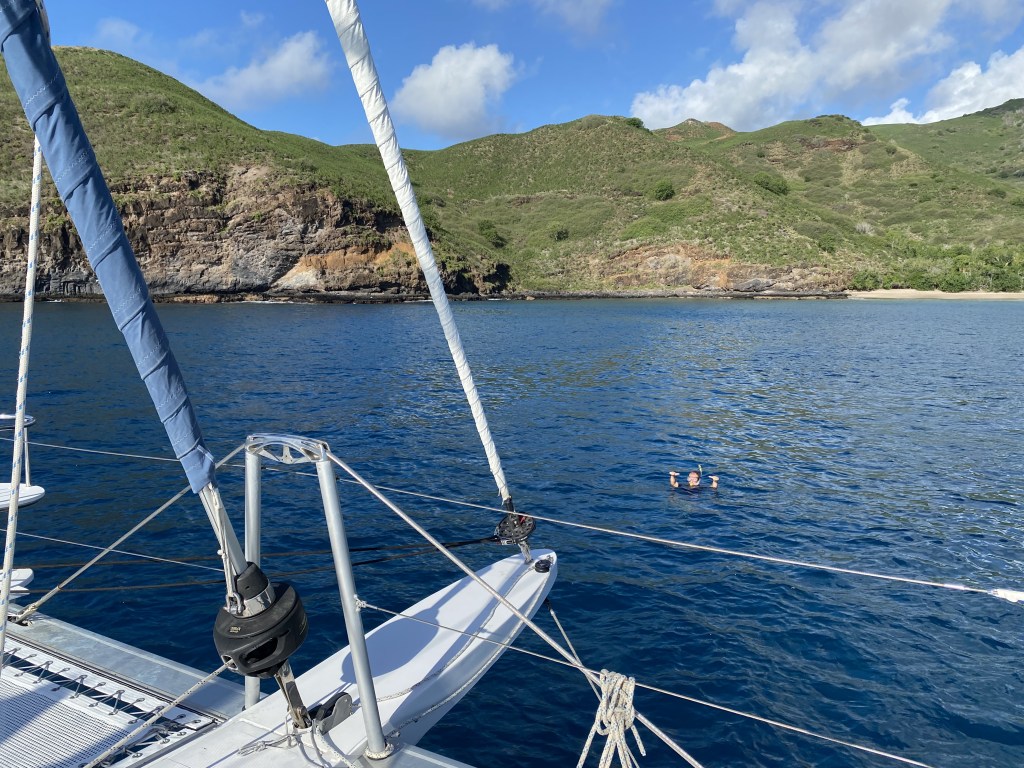
He saw a 3-foot shark in the process and we are having to get used to swimming with sharks, which feels quite unnatural to us. We took our dinghy closer to shore and anchored it beyond the surf break, then jumped in and swam to shore through the surf, trying to focus on swimming and not on sharks. Again, this is conditioning for us.
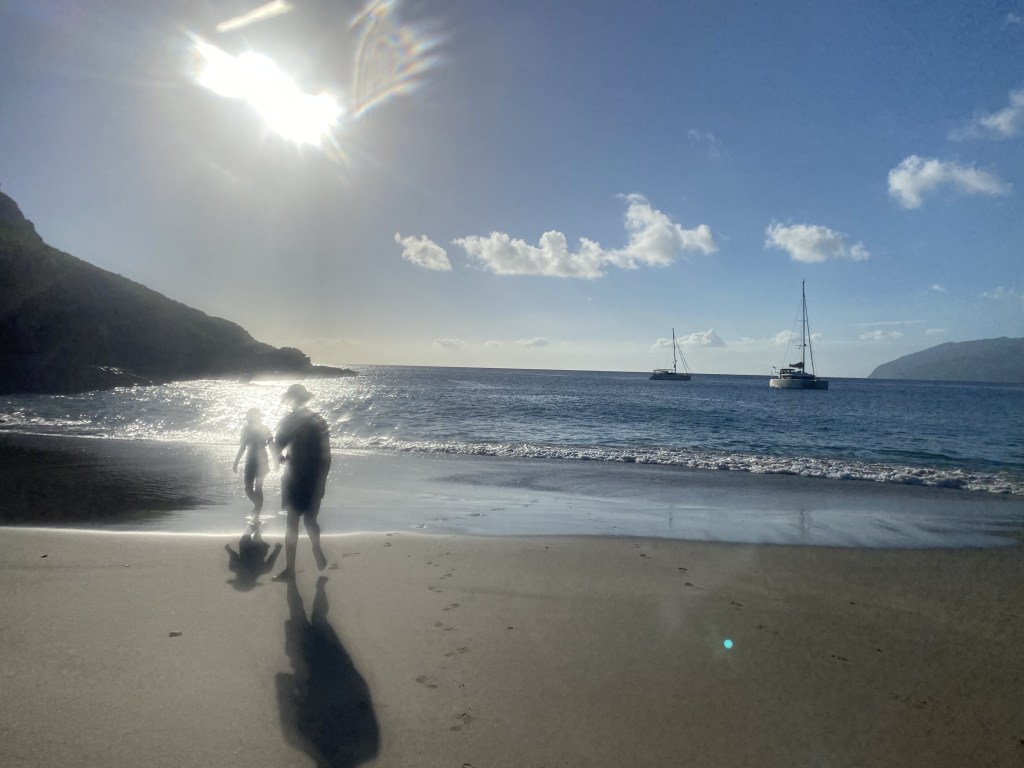
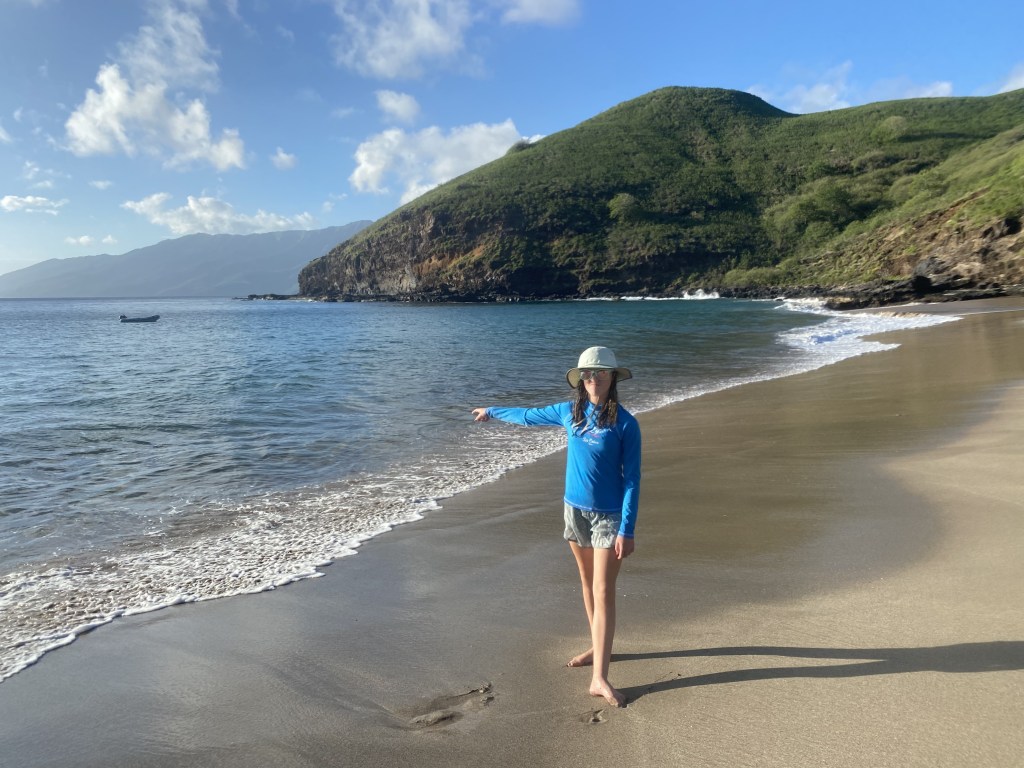
We laughed as we ran through the sand, little ghost crabs scattering and digging into the sand around us. After a bit, we jumped over the surf and swam back to the dinghy. Calder and I both saw a shark fin in the surf just before jumping in, but neither of us mentioned it for fear that Cora would set up permanent residence on the beach and never leave. We’d find her many years later surviving on coconuts and shore crabs.
Vaitahu, Tahuata: Friends, Fruit, and Anchor Nightwatch
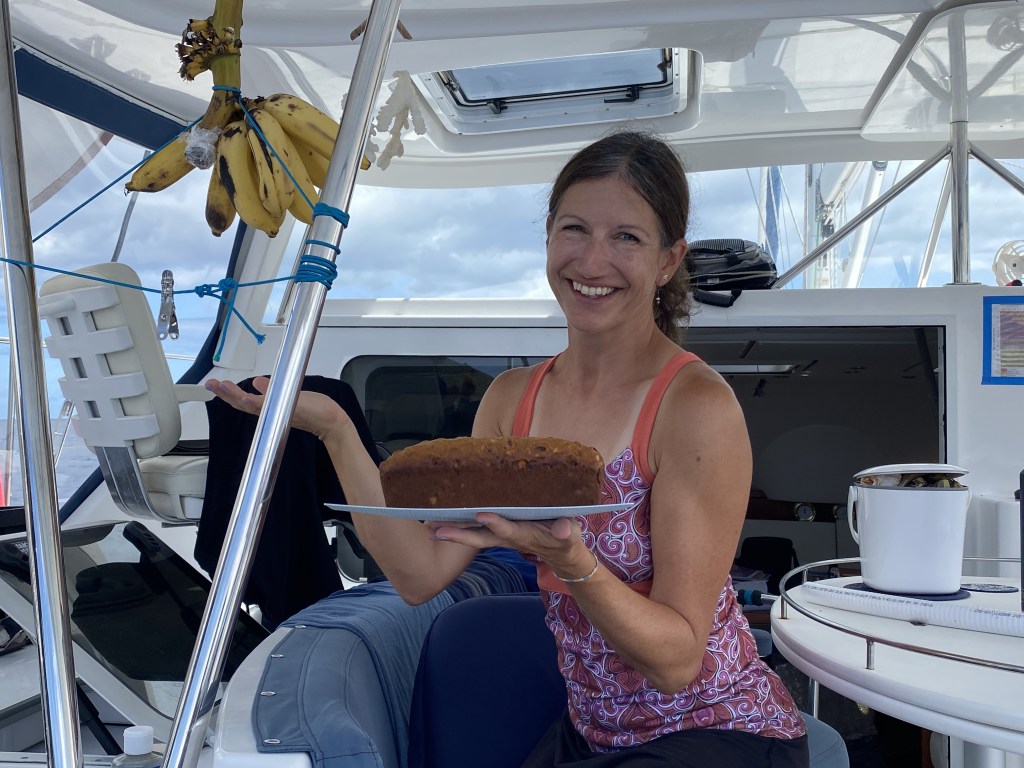
Woke happy to be on the leeward side of Tahuata, hiding out from the bigger winds this week. Spent the morning working on school and using the bananas that are falling from our bunch; banana pancakes for breakfast, banana bread with lunch.
Swell has started to increase and the blowhole is even more impressive. Made water (using our watermaker) and set out for an anchorage just a few miles south, Vaitahu, where our friends on SY Flora were anchored; we had met them on our passage down the outside coast of Mexico and have continued to follow each other’s journeys. Upon anchoring (even before our anchor was finally set) they were over to us in their dinghy, all of us excited to catch up! Besides simply enjoying their company, they have also served as mentors for our family with their extensive cruising experience and passion for learning and experiencing each place they visit. We simply adore them. After our anchor was finally down (second try, first set didn’t hold), we spent the afternoon eating homemade goodies, drinking coffee, and visiting with our friends.
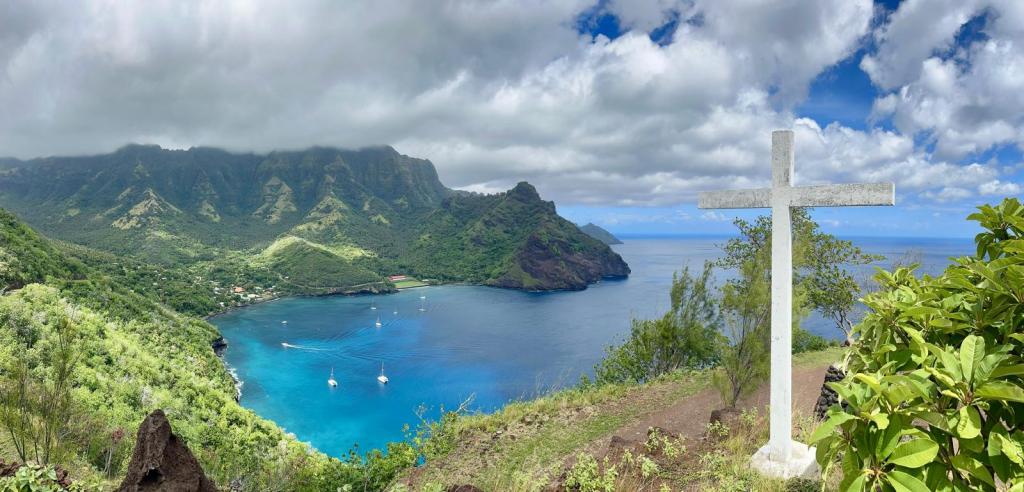
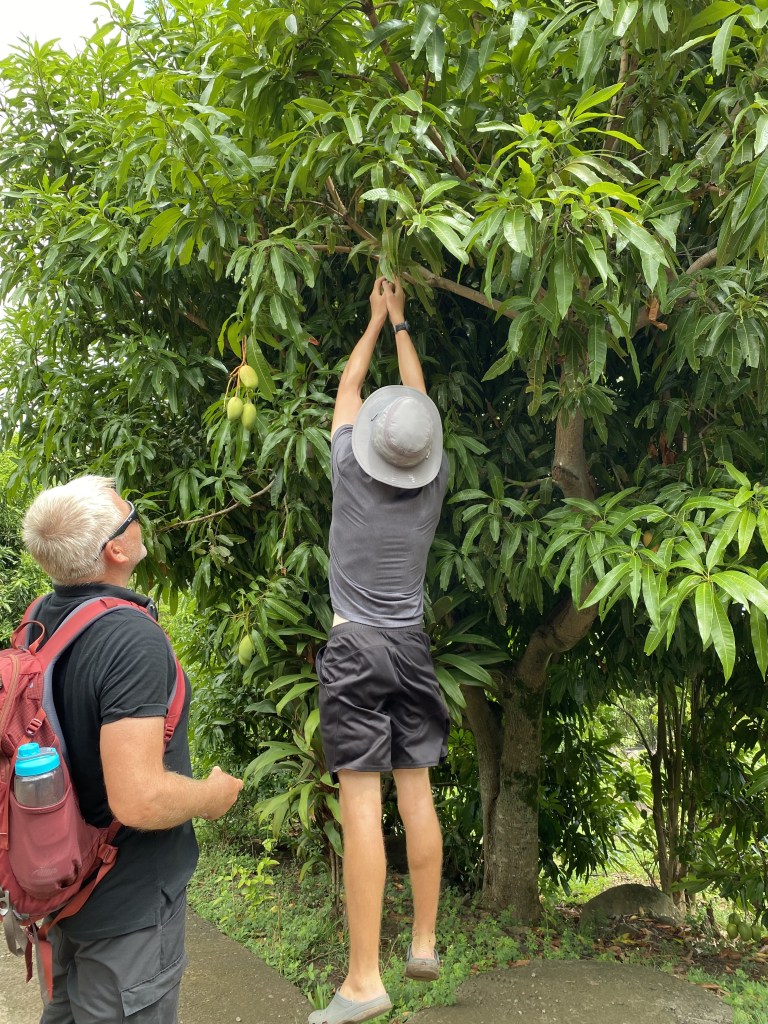
It’s been nice to change our daily schedule, going to bed earlier and waking up around 6:30 with the light, even Cora. It gives us the mornings to work on school with plenty of time in the afternoon to explore. Today, we went for a walk up the hill overlooking the bay with our friends, picking fruit along the way. Calder showed some awesome skill in harvesting mangoes, hitting one in a tree to make it fall with a rotten mango, then catching the good one as it fell from the tree in one smooth move. He also did some vertical jumps to harvest more. We picked a pile of limes that we hope to bake something yummy with.
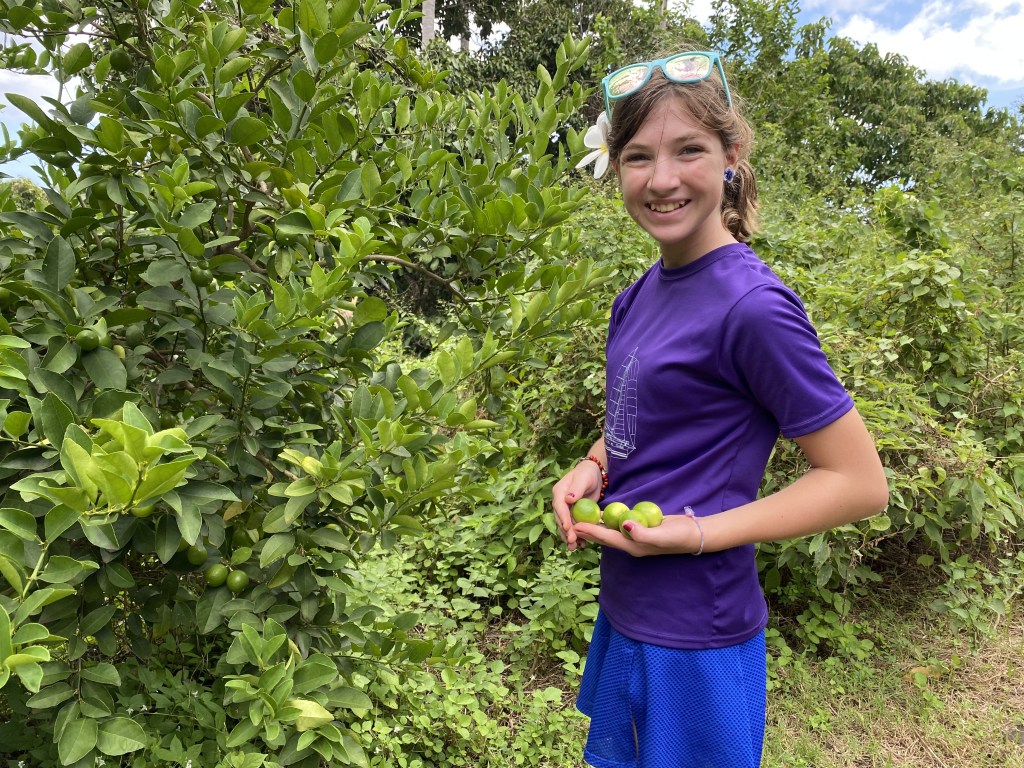
Fruit along the roads (and in churchyards) is considered everyone’s; there is a huge surplus of tropical fruits here. A local Marquesan woman, when passing her impressive yard that included starfruit, offered to sell fruit from her yard. Her husband came out with a small basket on a stick, quickly climbed the tree, and loaded us up with starfruit, pamplemousse, mangoes, and papaya. A massive grocery bag full of tropical fruit cost the equivalent of about $17 USD. Our cockpit fruit nets are again full. Next, off to Chez Jimmy’s Restaurant for lunch of poisson cru, steak frites, sweet and sour, and grilled fish along with fresh lemonade and Hinano beer; we left very full, though not full enough to miss out on ice cream at the Magasin (store).
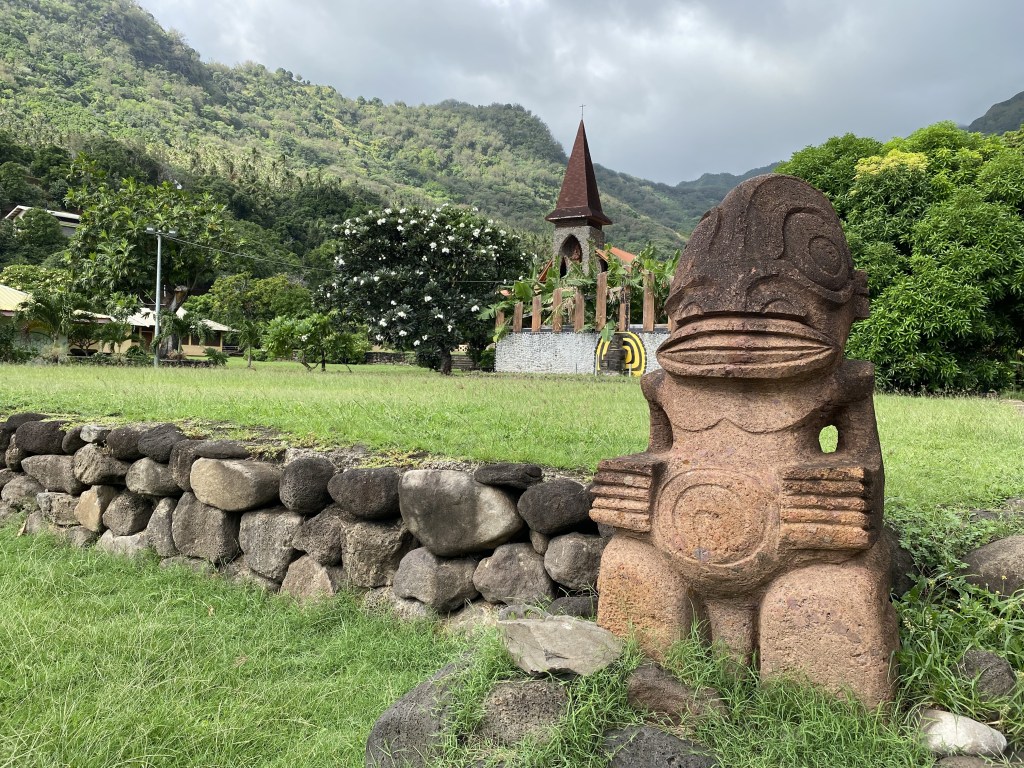
The Catholic church here is a beautiful mix of basalt stone and rich wood with a blend of Catholic and Marquesan imagery. Catholic missionaries arrived on Tahuata in 1838 and Catholicism has become entrenched in the Marquesas. The current Catholic Church here was built in 1998.
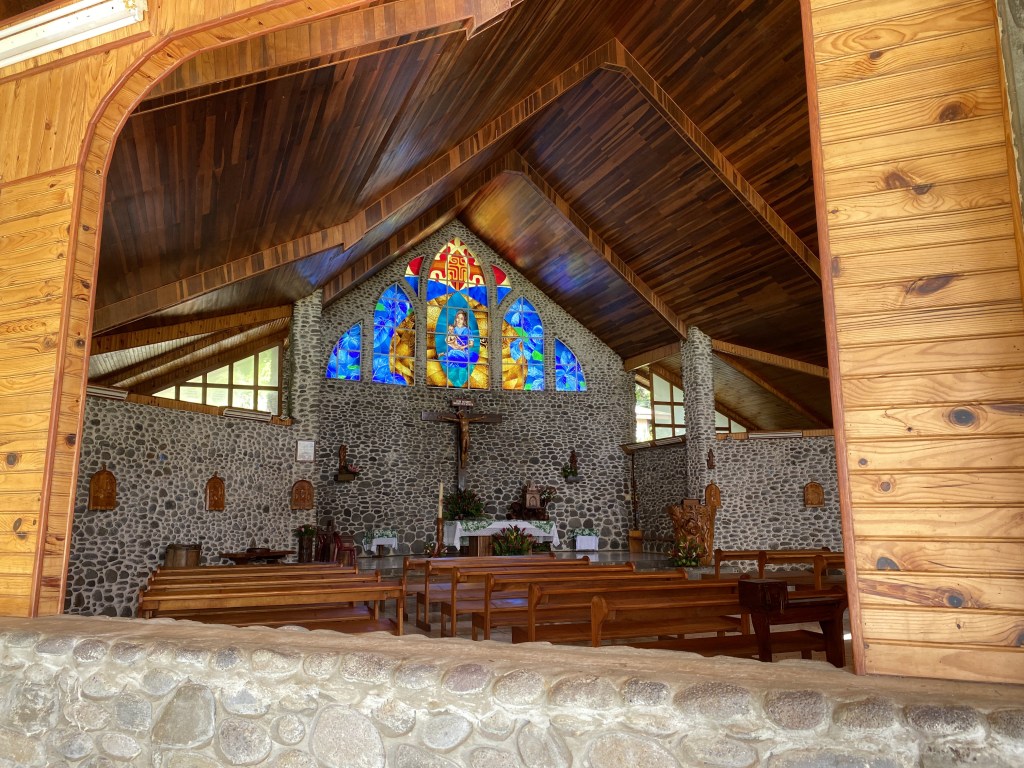
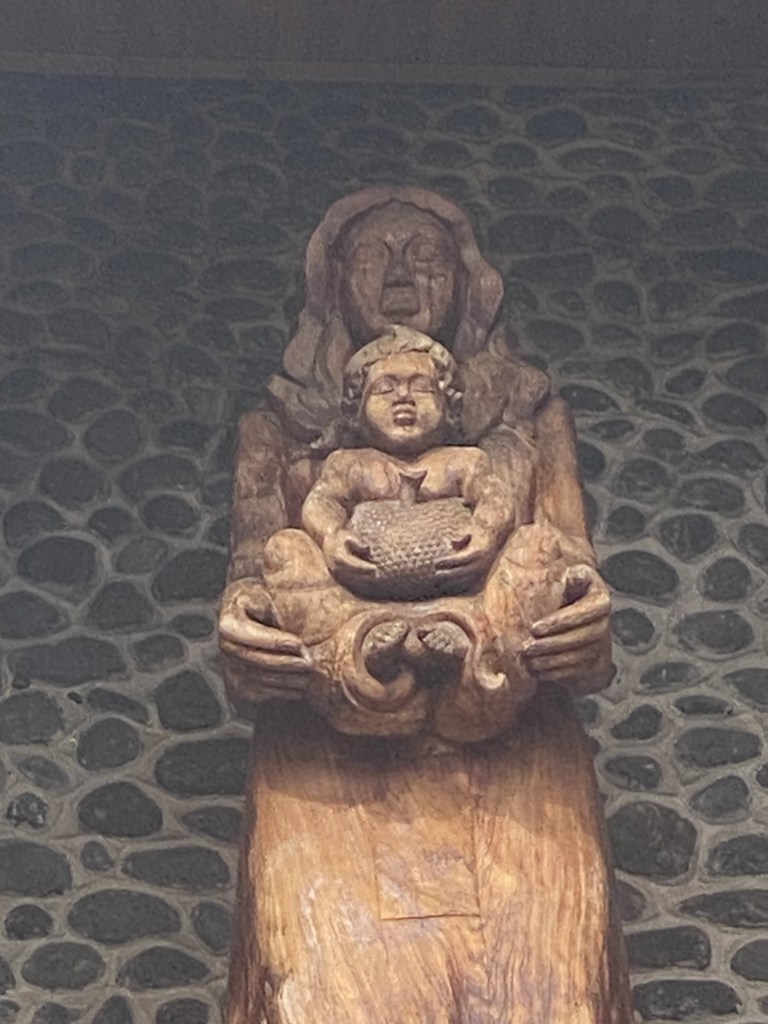
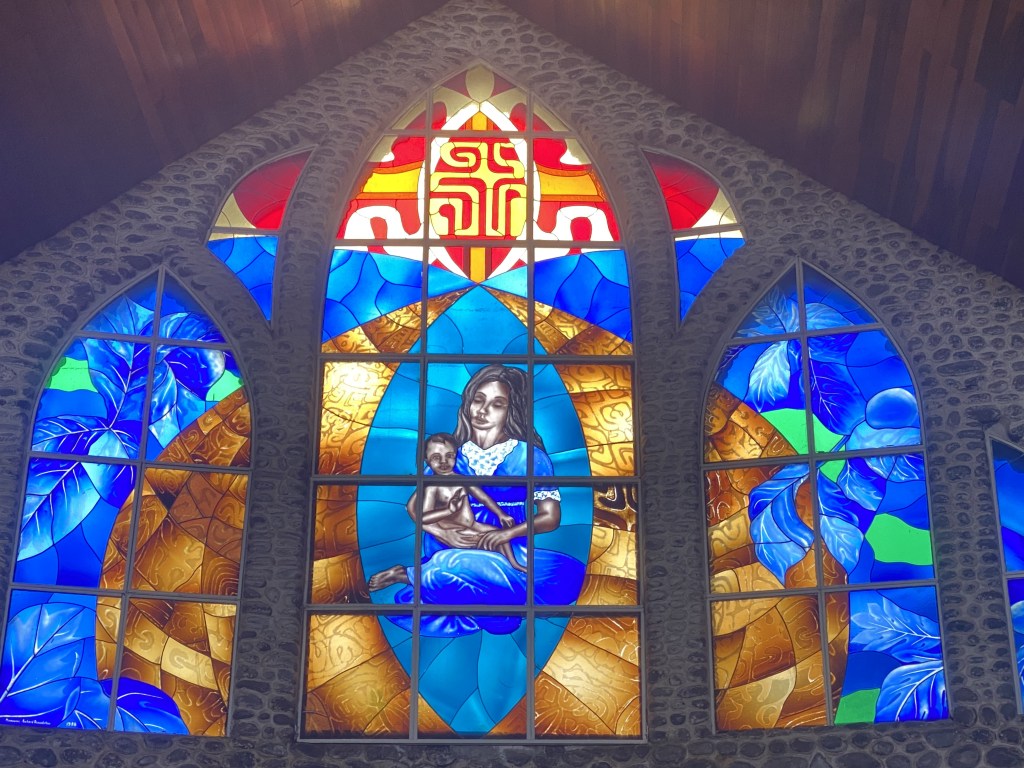
It is fascinating to see the images of Mary holding Jesus with a breadfruit in his hands and the Marquesan cross (not a typical Christian symbol) painted on the wall. The Marquesan cross’ original name peka ‘enana can be translated as “cross of the people,” or also posterity. It’s a symbol for peace, balance, and harmony. The doors with carved people holding hands form the motif called ani ata, which often represent the sky as well as the ancestors guarding their descendants.
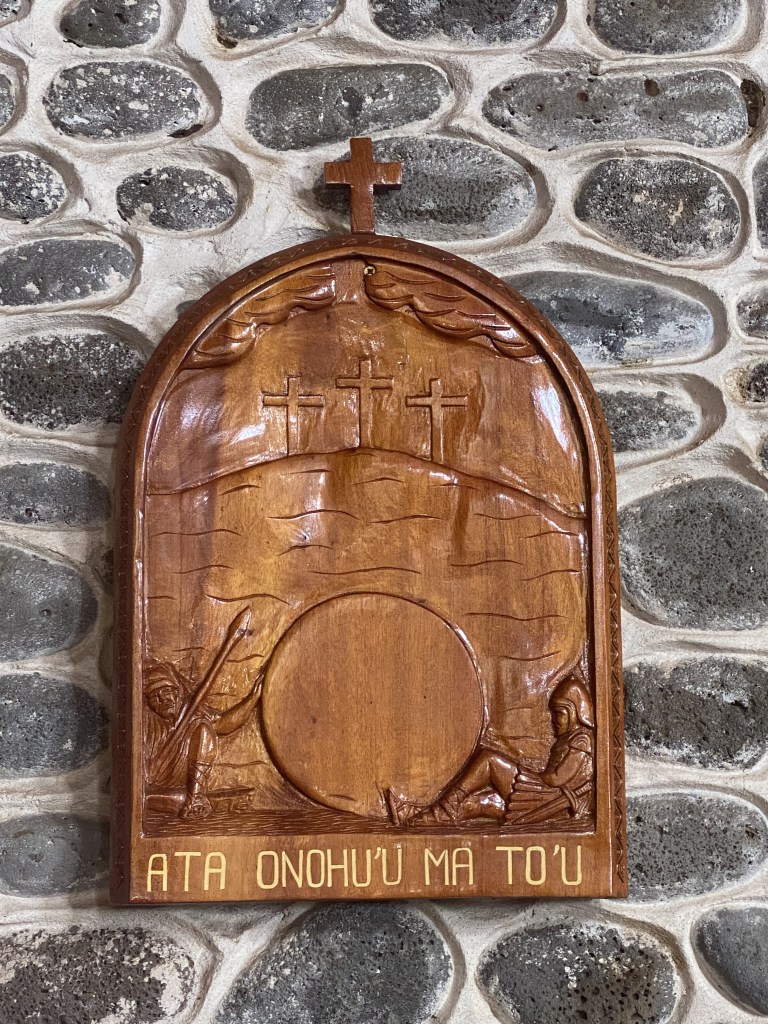
Next to the church is Tohua Iotete (after Chief Iotete) with numerous tiki. Tohua are the large, rectangular ceremonial plazas, constructed by tribes for public ceremonies. The Catholic Church is built near (or on) this sacred site. The juxtaposition and combination of these Catholic and traditional Marquesan images seems to demonstrate that perhaps a comfortable co-existence and melding has taken place.
We stopped in at another Magasin in town looking for vegetables, as the supply barge was recently here, and left with some romaine lettuce (so excited about this!!!), frozen peppers, and some coconut milk. These three items may appear costly at $24 USD, but consider the challenge in getting the items here. Back at anchor, the wind continued to build up to 36 knots, funneling through the valley. Our anchor seems to have held well last night with minimal drag and we are hoping for a peaceful night…
…no such luck. Winds kept funneling through here, building up to a max gust of 39.7 knots. We set an anchor alarm on our phone, but also wanted to keep watch overnight in person to ensure that we weren’t dragging, others weren’t dragging, and our depths looked good. The kids knew that Chris would not sleep at all if we didn’t do this and suggested it; was proud of them for understanding this and offering to stay up. Calder and Cora hung out from 9-midnight, me from 12-3, and Chris from 3-6 until the sun came up. Thankfully our anchor held and we were just tired. After a few cups of robust coffee, getting tired of the howling, we decided to move to a different anchorage just south of here. The anchor came up covered in muddy sand, excellent holding. We hadn’t dove on the anchor to check it due to low visibility as a limiting factor.
 SV Terikah Adventures
2 responses to “Sharks, Fruit, Friends, & Nightwatch”
A question. How deep are you anchoring in? and how much scope do you/ can you put out so you have enough but don’t run the risk of dragging chain across the coral. E Garrett
LikeLike
Hi. In the Marquesas we would anchor in about 30 feet, not much coral there. In the Tuamotus, we will actually float our chain so it doesn’t lay on any coral. We put the anchor down in a sandy spot, then add floats along the length so it is off the coral.
LikeLike