We have started to see some random flotsam in the water, a plastic bottle here or there, not much thankfully. Yesterday, I saw it – the glass fishing ball I’ve been seeking…wait, no, that’s not a glass ball, it’s a ship in a bottle…nope, look closer, it’s a massive…lightbulb?! Must have come off one of the fishing ships out here.
Temporarily out of the squalls, we continue to jerk along loudly – and quickly – on beam seas. The seas are about 2-3 meter swells with wind waves on top. The winds are 15-21 knots and we are making great time sailing with an additional 1.5 knots Equatorial Current with us! Yee-haw!
One cockpit discussion today was expectations vs reality of this passage. First, stating the obvious, this passage is long – and it indeed feels long. Next, there is more constant movement than we anticipated, and it is a jerky movement. Out here there are swells in various directions at the same time, winds, and currents; these are not organized neatly in unidirectional forces, leading to a “hurkey-jerky” motion per Chris. As we luckily had a record-breaking small ITCZ, we never experienced the doldrum calms. We have been moving non-stop since day 1. Sea legs come and go with different sea states, mainly for Chris and Cora, who intermittently still take seasickness meds.
With all this movement comes the notorious “bridgedeck slap” of the catamaran – the water smacking loudly on the bottom of the boat and hitting both hulls. I feel sorry for what we are asking our boat to do, as she groans and creaks and smacks loudly.
With the movement comes less “productivity.” Chris had a list of boat chores to do and I was going to learn French and celestial navigation, as well as having a nicely organized school for the kids every morning. We haven’t even cleaned our bathrooms. Safe passage making, keeping watch, preparing food is busy and takes much time.
We are slower than anticipated, which we think is due to two things. First, we have a full ecosystem on our hull causing drag – Chris thinks that we should be able to harvest the growth and have a nice seafood chowder upon arrival. Second, it seems our starboard keel is full of water; we hear it sloshing around and our waterline is down. As scary as this sounds, Chris reassures me that, although not ideal, it is not a safety issue. The keel is a separate compartment from the rest of the boat, usually hollow, and considered “sacrificial” if it were to hit something underwater. The water in it is likely due to a leaky bilge pump screw. Chris is planning to look into this during a moment of calm or once we are in French Polynesia. Chris jokes that we should turn it into a “live well” for Calder’s fish; a friend suggested we put a kegerator for beer in the port side to keep balanced!
All of the above are not complaints at all, just what we have learned thus far about the reality of this passage.
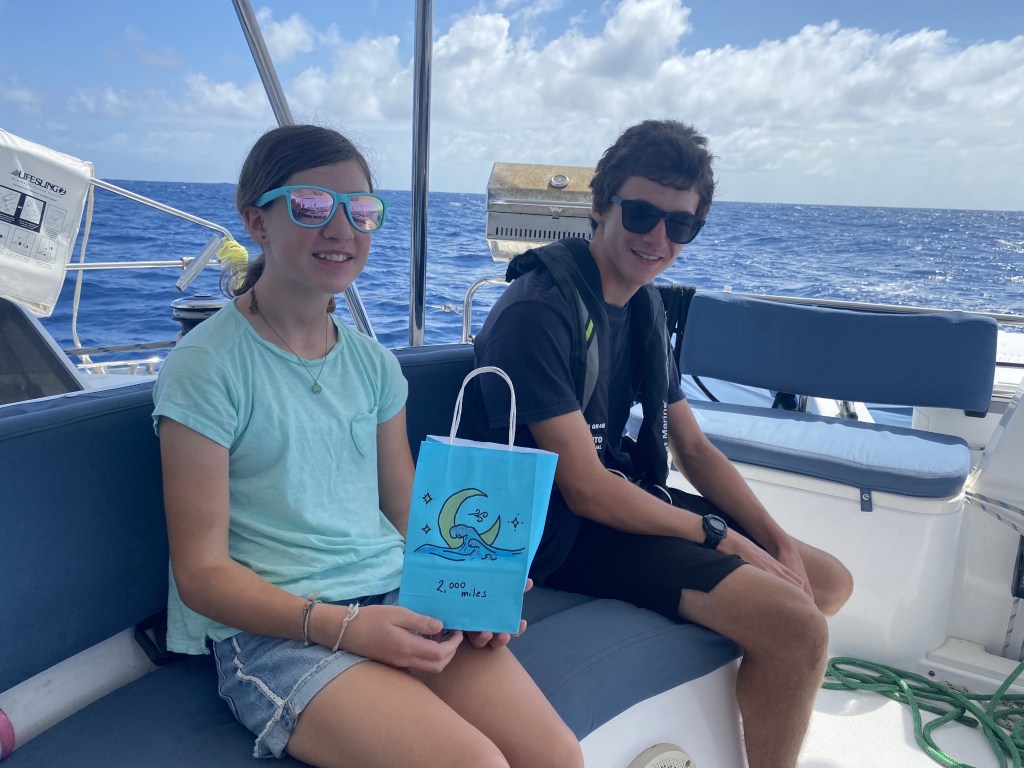
We’ve seen some new birds and new fish jumping; things are changing. There are boats ahead on AIS. We hit the 2,000 nm mark! We are in the final push and should arrive within the week.
Total miles over the last 24 hours: 142.1 nm (a great day!!!)
Average speed in last 24 hours: 5.9 nm
Total miles of trip so far: 2,120 nm
 SV Terikah Adventures
6 responses to “Day 17: Pacific Ocean Crossing to French Polynesia”
I would be interested to know if you ever do find a glass float that far south of Japan
Don Bieber, Petersburg
LikeLike
I would be interested to know if you ever do find a glass flo
LikeLike
I expect kegerator naming rights.
LikeLike
Thanks for talking about expectations vs what you are going through. On our ocean trip, I had full meals planned and ended up eating fruit salad out of a can the whole time. :) I appreciate your observations so much. How exciting to see subtle changes in the water and life. Safe sailing!
LikeLike
2000 nm, wow! What an achievement. Nice to be able to read your posts daily and see that all is well. Thank you for allowing those of us who don’t know you all personally to follow along and learn. We wish you all of the best in your adventure.
James and Camdin.
LikeLike
What a milestone! What a passage! Sending good energy your way. I so appreciate how you are remain very present and are acknowledging all the emotions, thoughts and experiences. I’ll be curious how many days it takes for you to not have the “sea leg feeling” once you are on land.
LikeLike