Me te titiro whanui, kia koa (Look deeply and learn)
Ki nga taonga kei mua i a koe (From your surroundings)
Back out on the water in Terikah, two months to explore before our haul-out, we hope to explore as a family, seeing what Aotearoa can teach us along the way.
Our first stop, only a few miles out, a temporary anchorage off Pahia for Calder to wing-foil. As I watch him soaring over the water with the winds, I think of the similarity of the birds that zip closely along the water’s surface, dipping their feet or beaks in. It seems that nature wants us to play with her.

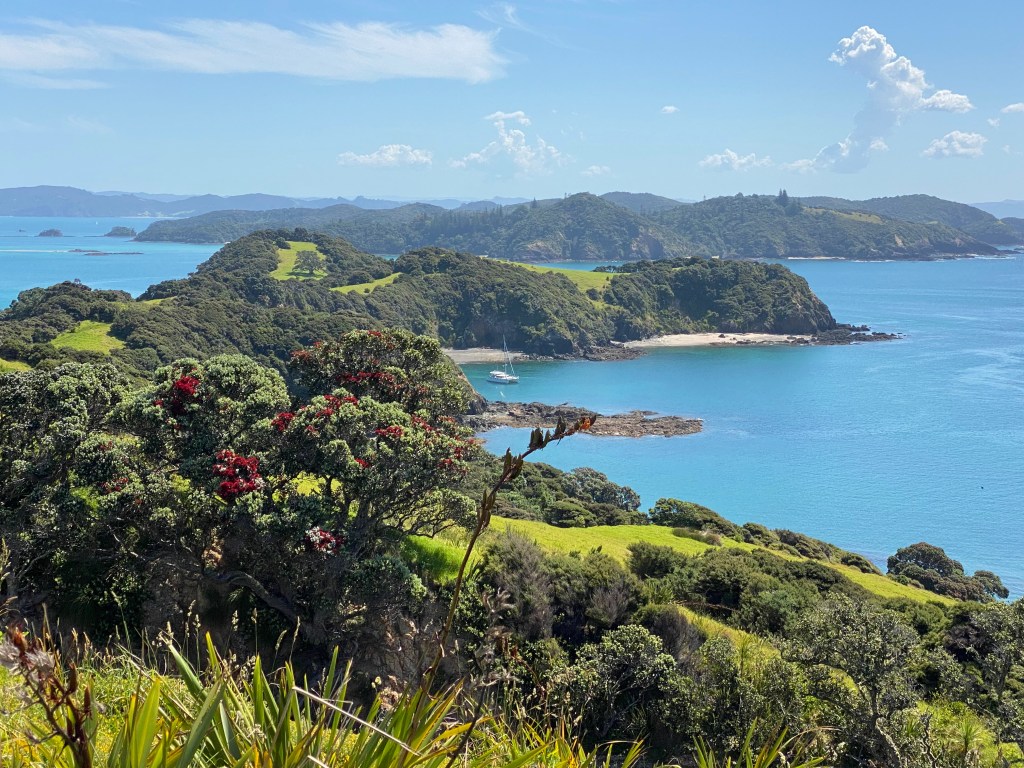
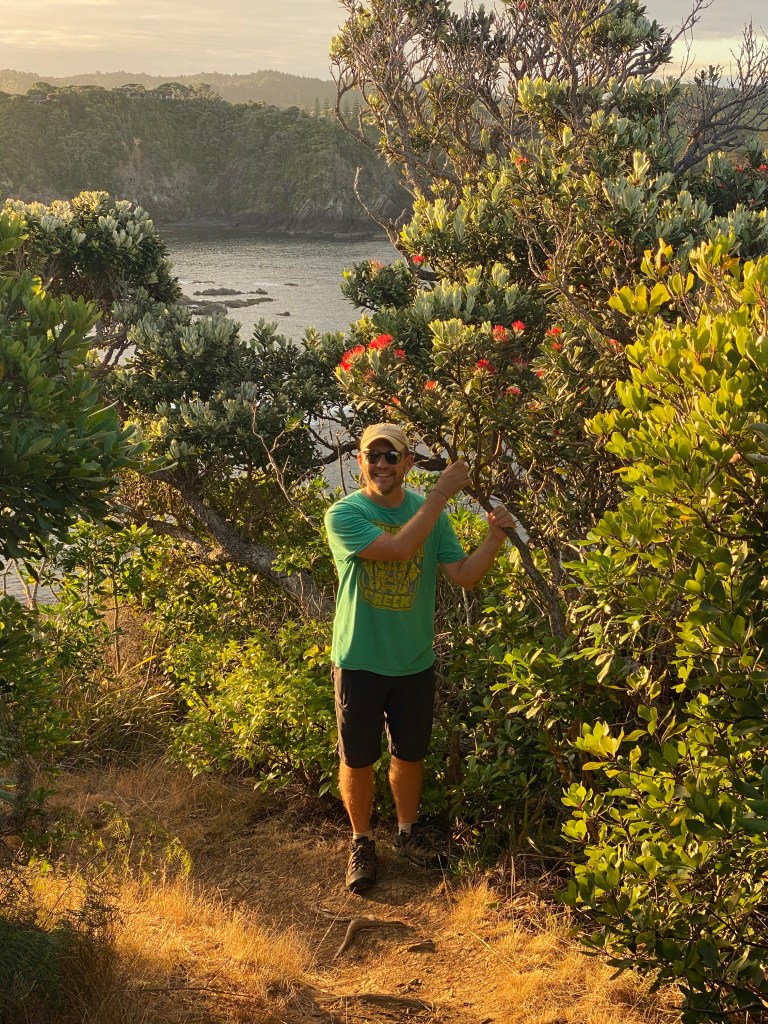
We anchor off the north side of Urupukapuka Island in the Bay of Islands. Cora dives into an acrylic painting of a waterfall as we look out at Aotearoa’s natural palette, so many shades of blues and greens, the bright red Pohutukawa flower in full bloom. It’s so peaceful here before the start of the holiday season when this place will go from a handful of boats to over 100.
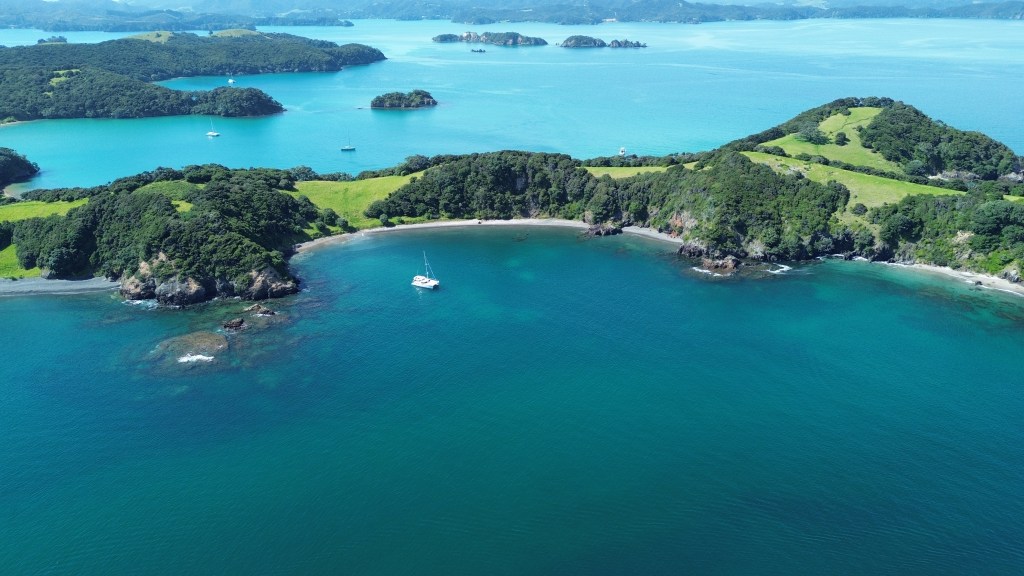
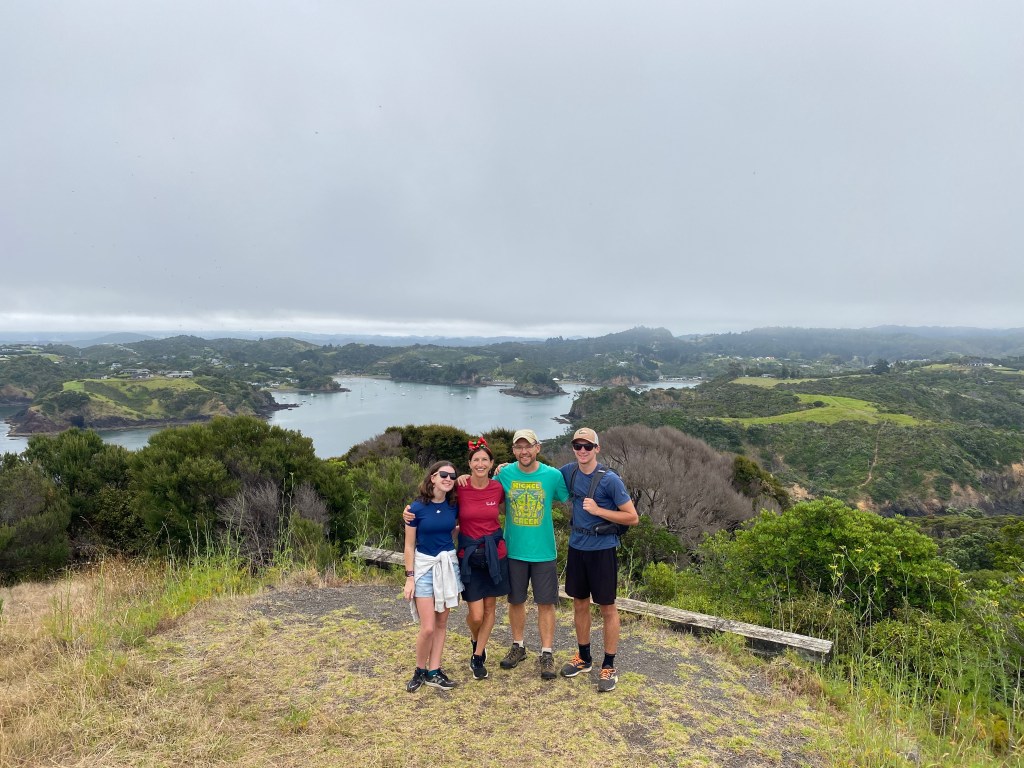
The full moon rising over the island, reflecting a line in the water stretching toward Terikah, is stunning. The next day is about as perfect as one can get – time to meditate in the morning outside (with a flock of birds on the lifelines), a good school morning, gorging ourselves on pit fruits that are in season, a family hike around the perimeter of the island, a family read aloud book, with ruru calls and full moon cuddling at bedtime. There are decisions to be made soon and it’s nice to just revel in the moment.

Cora was, however, dismayed on our walk when we informed her that sheep tails aren’t naturally short, but rather are shortened. She didn’t quite believe us until she found a long lone sheep tail on the trail, rubber band at the top. And Calder never was able to catch a sheep, despite his efforts. Woke in this peaceful, calm anchorage to the sounds of surf and birds. After pancakes, Chris and I went for a short walk among the birdsong, while the kids did school. The air here has a strong distinctive sweet smell, seemingly infused with honey from the manuka trees.
We had planned to head south, but changed our mind and had a 3-hour hop to the Cavelli Islands, where we anchored off Hamaruru Island to meet up with friends and enjoy a calm-weather only anchorage.
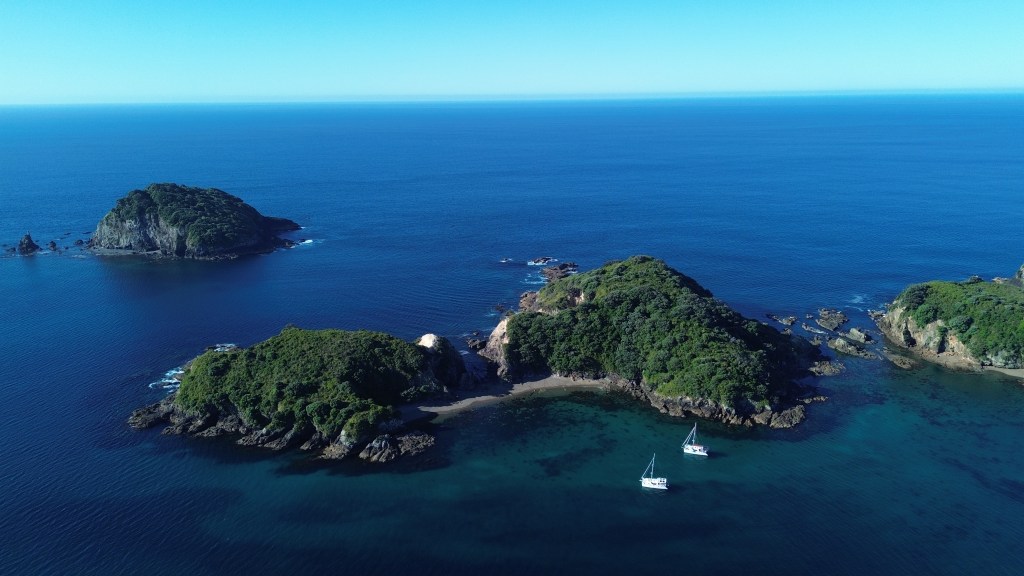
The stillness of the seas made this a feasible anchorage, off a rock that I thought looked like a sleeping elephant.

The Cavalli Islands are volcanic in origin, formed about 4 million years ago from lava flows and ash deposits that erosion has since sculpted into steep cliffs, sea caves, and rugged shorelines. On the beach, we explored these impressive rock structures worn by the exposure to seas. We hiked across Motukawanui Island, climbing through coastal scrub and manuka forests, leading to vistas of the area.

At night, Chris and I woke up due to the calm…yes, the calm woke us…zero movement of the boat. We went outside, entranced by the full moon on the water.
Next a quick sail into striking Whangaroa Harbour Te Rere (Western Arm).
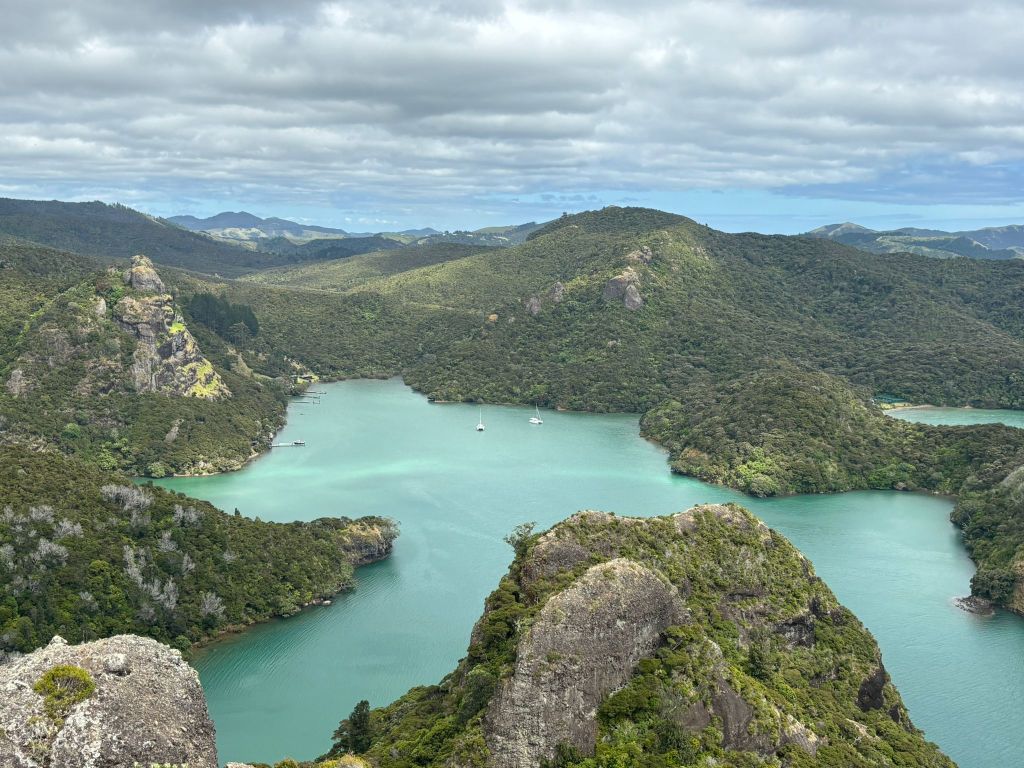
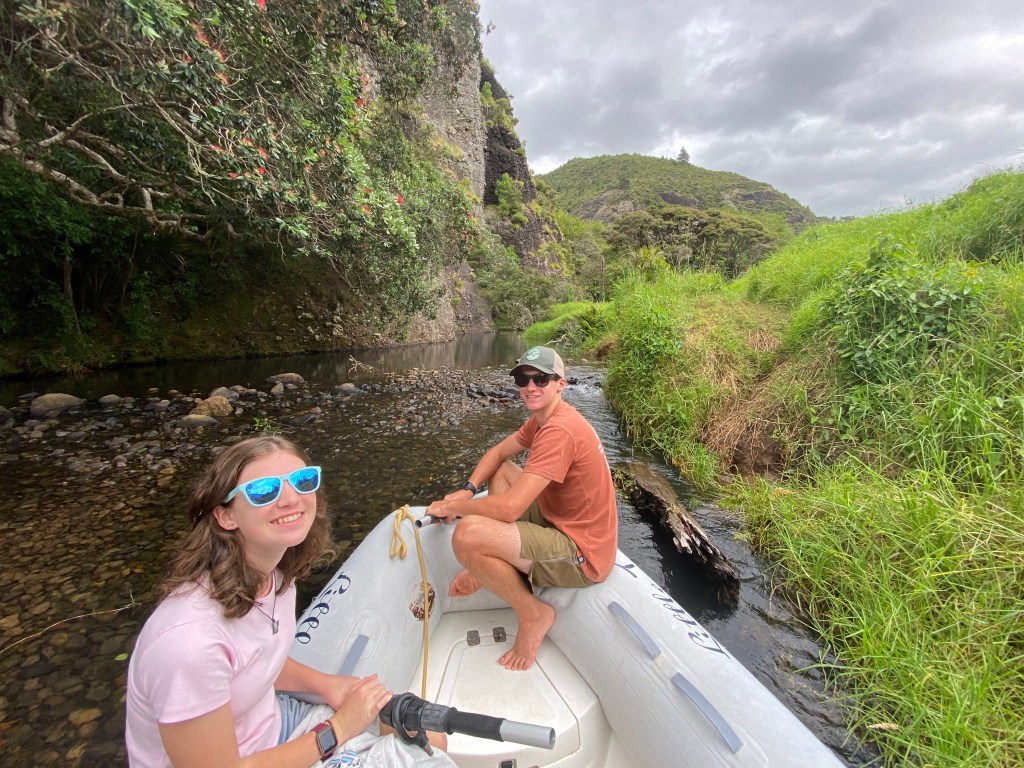
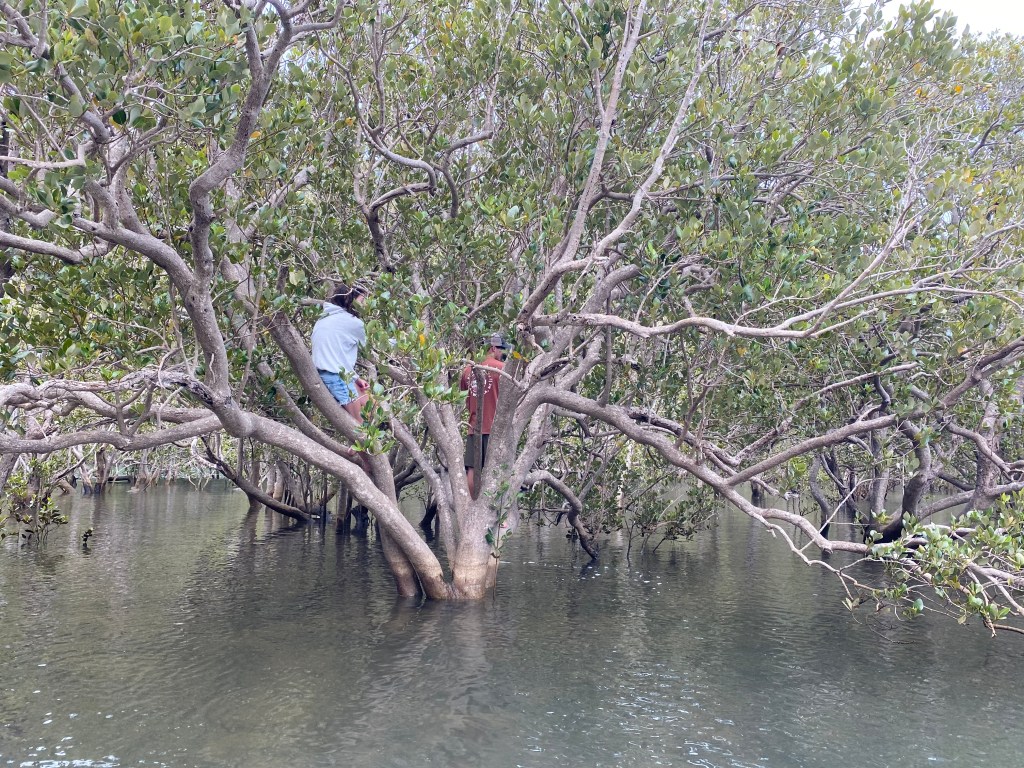
Whangaroa Harbour’s geological story began about 140 million years ago when New Zealand was still part of Gondwana and massive underwater landslides dumped mud, sand, and broken rock into a deep ocean trench, later hardening into greywacke and argillite. Tectonic forces uplifted, folded, and fractured these rocks as the land slowly rose from the sea. Over millions of years, rain, rivers, and waves carved into those weaknesses, shaping the steep harbour walls and leaving dramatic remnants like Duke’s Nose standing where softer rock was worn away. We hiked to the top of Duke’s Nose, tramped along the river trail, and took the tender for a rambunctious explore of the mangroves.
I am obsessed with the birds here and want to introduce you to four of my favorite birdy friends. The fantail flits about, dipping toward us to eat the bugs we stir up on the trails (https://www.youtube.com/watch?v=bsMl3Pjr5pE). The tui, with his white chin feathers, calls out in his R2-D2 type vocalizations, made more colorful when drunk on flax nectar. (https://www.youtube.com/watch?v=b0K1q9JriDE&t=5s). At night, my favorite bird, the ruru (or morepork owl) starts calling, their calls echoing off the cliffs. At night, I enjoy being tucked in bed whilst reading with rurus (https://www.youtube.com/watch?v=ZyLxi3o4tFQ). If we’re very lucky, we’ll hear a kiwi call out at night in the mix (https://www.youtube.com/watch?v=__4rDoA0mPU). Yes, I’m a bird nerd, proudly.
Another reason to add to the list of why we love New Zealand – The Coast Guard has a water buoy (pronounced “boy” in NZ speak) that boaters can use to fill their tanks. The delicious spring water is there for the taking for a recommended $10 NZ donation. This means showers and laundry for all!

It’s a bit of an adventure at times to tie up to the buoy, mainly if windy. Calder was foiling here, while we waited for our tanks to fill with water, and had the unnerving experience of a large shark (bronze whaler shark) coming to check him out.
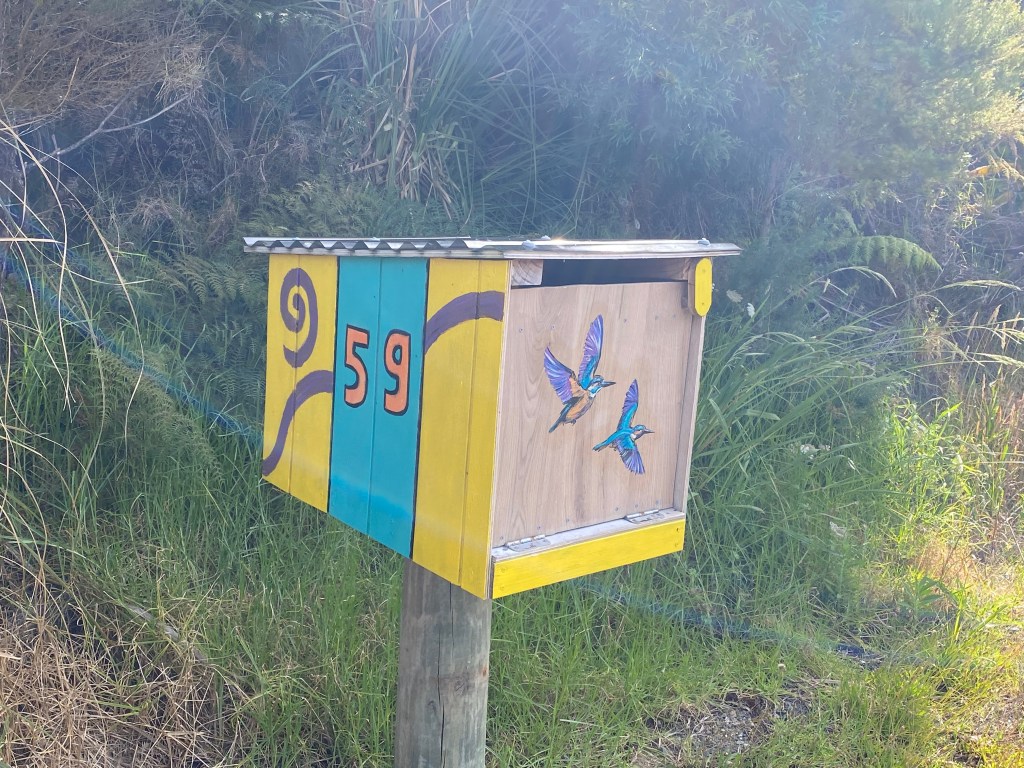
Moved around to different spots in Whangaroa Bay, where we rested and recovered from nasty colds. We went for a few walks, noting another reason we love NZ – creative mailboxes! There is no official type of mailbox that needs to be posted and people get quite creative with their colorful mailboxes of all shapes and sizes.
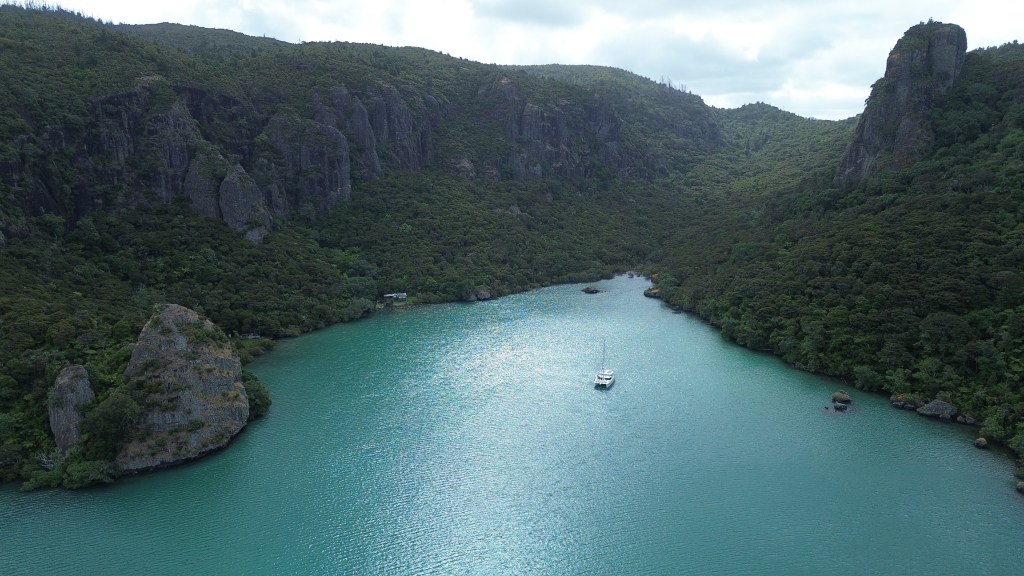
Waihi Bay was a highlight, as we were the only boat tucked into a “mini Marquesas” of striking spires, truly awe inspiring.
We needed to get back south towards the Bay of Islands and we were taught a lesson again – passage expectations aren’t good to have. We had fully envisioned a lovely downwind sail. Instead, seas on the beam with light and flukey winds, combined with our eustachian tubes being plugged up from our colds led to a slow nauseating passage. At least it was only 4 hours and we tucked into lovely Wairoa Bay with Te Pahi Islands, anchoring just before the rain squalls arrived. It was our expectations that made it anything other than a fine run today. It’s good to watch the weather and be prepared, but not to hold on too tightly to a false sense of control.
After a short run the next morning we met Craig from Willis Sails at the Kerikeri dock to discuss our stretched and worn mainsail.

It likely could last a bit longer, but it would be wise to upgrade it before the many miles it will take to get us home to Alaska. We were super impressed with Willis Sails, who actually make their own sails in the loft here, and feel we have picked the best sailmaker for the job. Now if only we could decide on the specifics (fabric type, cut, battens) and place the order!
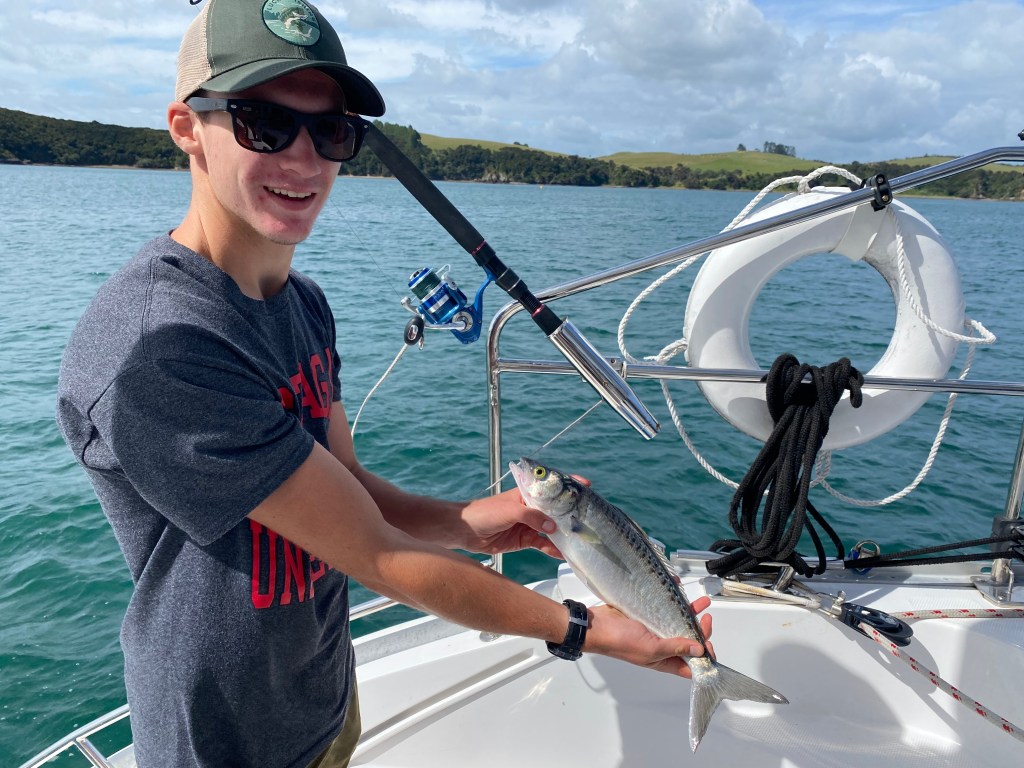
Going though Kent Pass, we caught our first Kahawai, an iconic New Zealand fish. Some use it for bait, but we come from the land of pickled herring and don’t scoff at eating so-called baitfish. The Kahawia are also called Australian salmon and made a delicious dinner. And they were plentiful and fun to catch!
Anchored off Opua, we continued to battle our viral illnesses (this one hit hard!), while also getting boat project supplies, food, and a Christmas tree.

Last year we bought a live kauri tree, which has since been named Kevin and planted at our friends’ house. This year they requested a puriri for their yard, so we found one and decorated him. We think he will be Peter the Puriri. The pūriri is a bird magnet, providing nectar, fruit, and shelter year-round for tūī, kererū, bellbirds, and countless other native species. Back at the boat, the kids have taken over cooking one dinner weekly, which is a nice break.

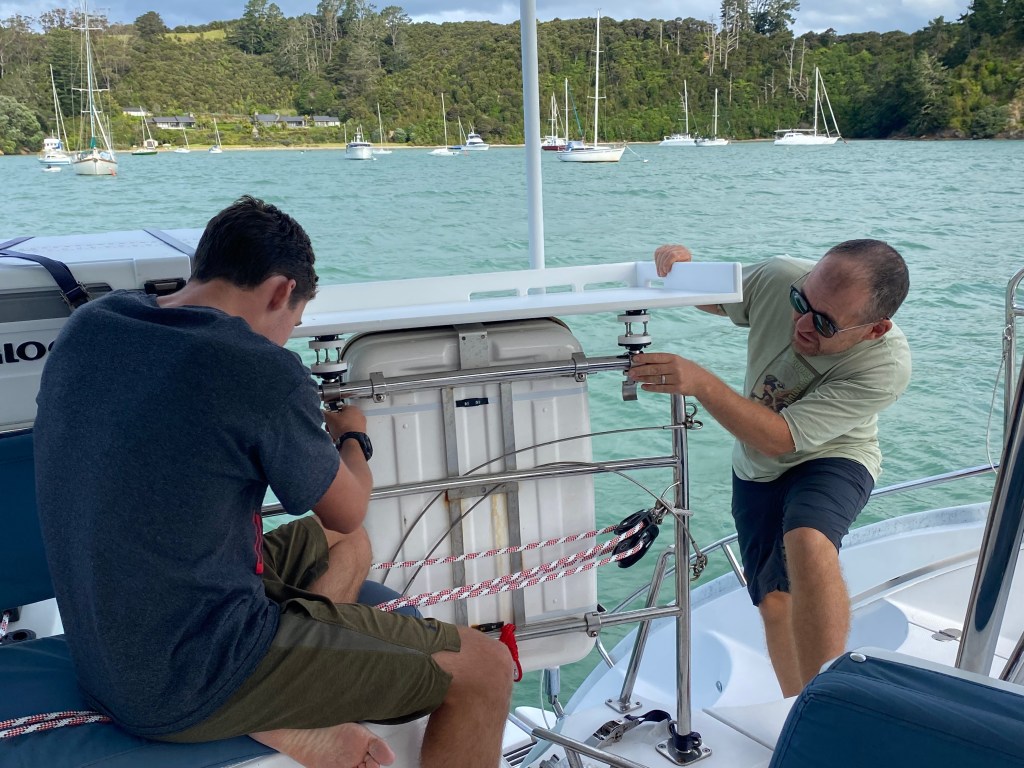
Off the town of Russell for the night, Chris and Calder finished building and installing the new fish cleaning table, while Cora and I decorated the boat to make it feel hygge.
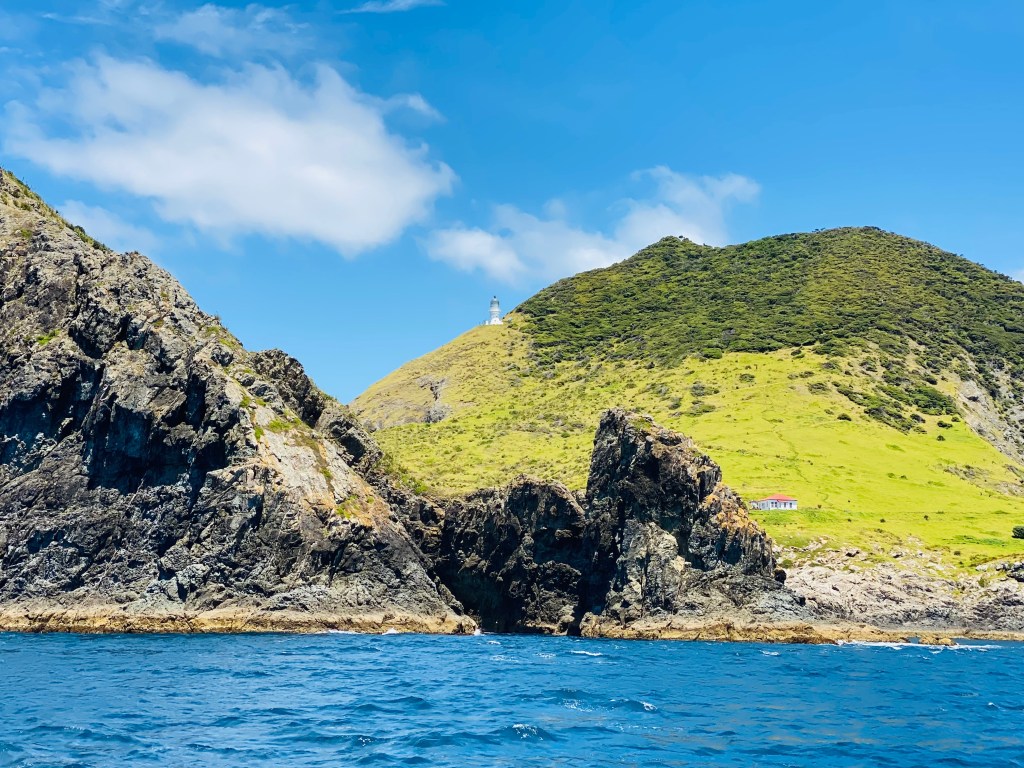
Around Cape Brett for the first time, heading into new waters south.
Spent a few nights at beautiful Whangamumu Habour.
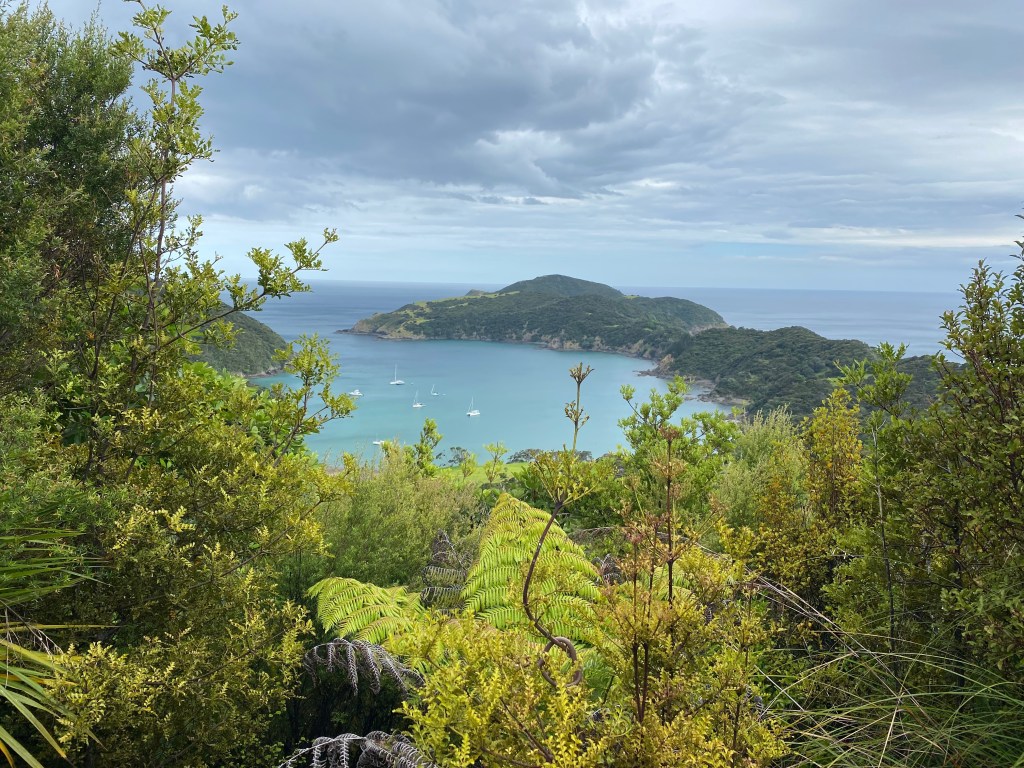
This was once the site of New Zealand’s largest shore-based whaling station, operating from 1890 to 1931, where humpback whales migrating along the coast were hunted and processed. Today, only concrete vats and an old broiler and bits of pier remain, the trees tearing apart the prior structures with tendril-like grasping of bricks, nature reclaiming the site.

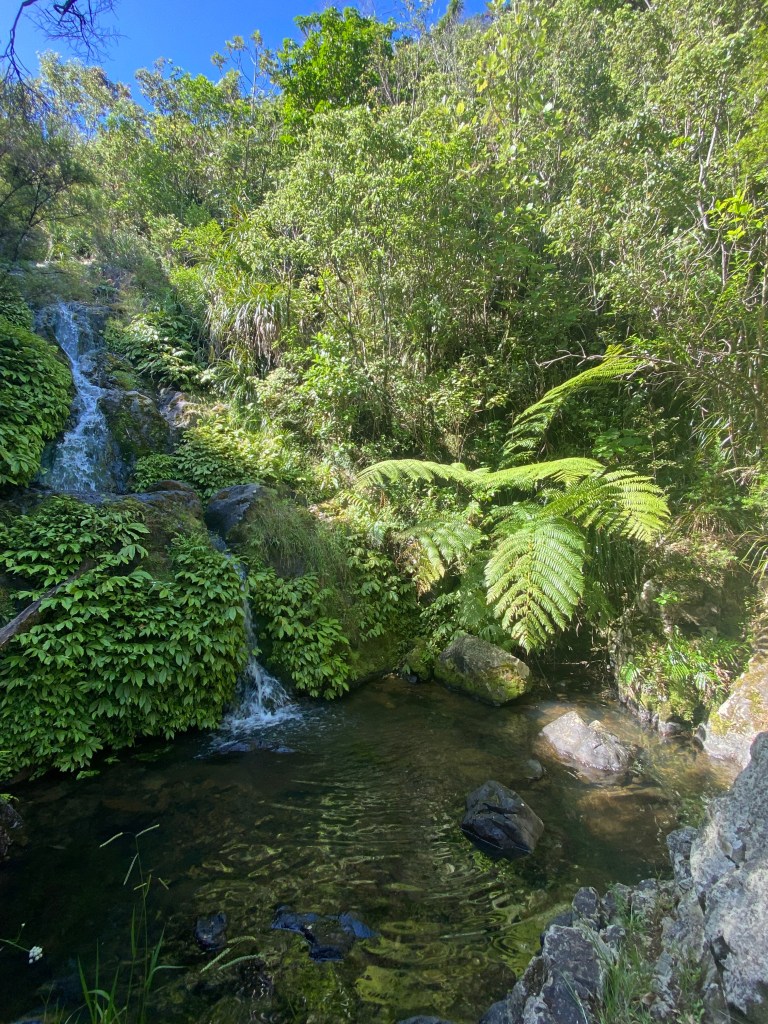
We hiked up to a lush waterfall, a lookout point, and along the pohutukawa lined beach to celebrate the Summer (yes, summer) solstice.
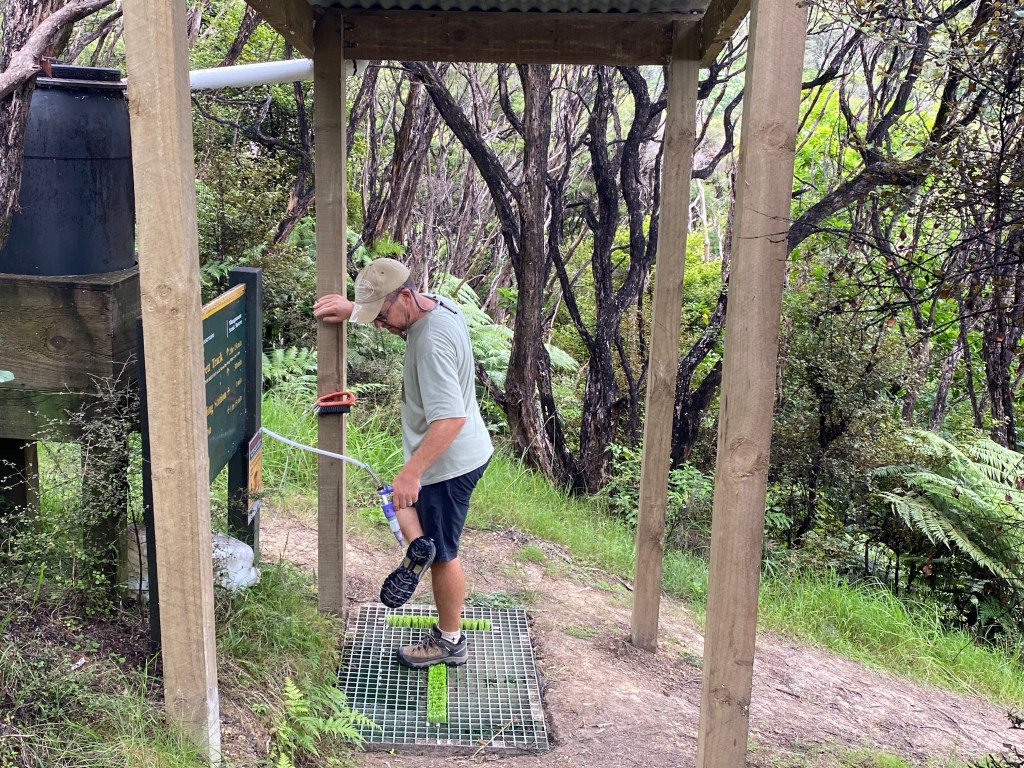
To help protect New Zealand’s iconic kauri trees from the deadly kauri dieback disease, the Department of Conservation (DOC) provides cleaning stations at track entrances so visitors can scrub and disinfect their shoes before entering and leaving forested areas. Some sections of track are closed completely for kauri dieback prevention.
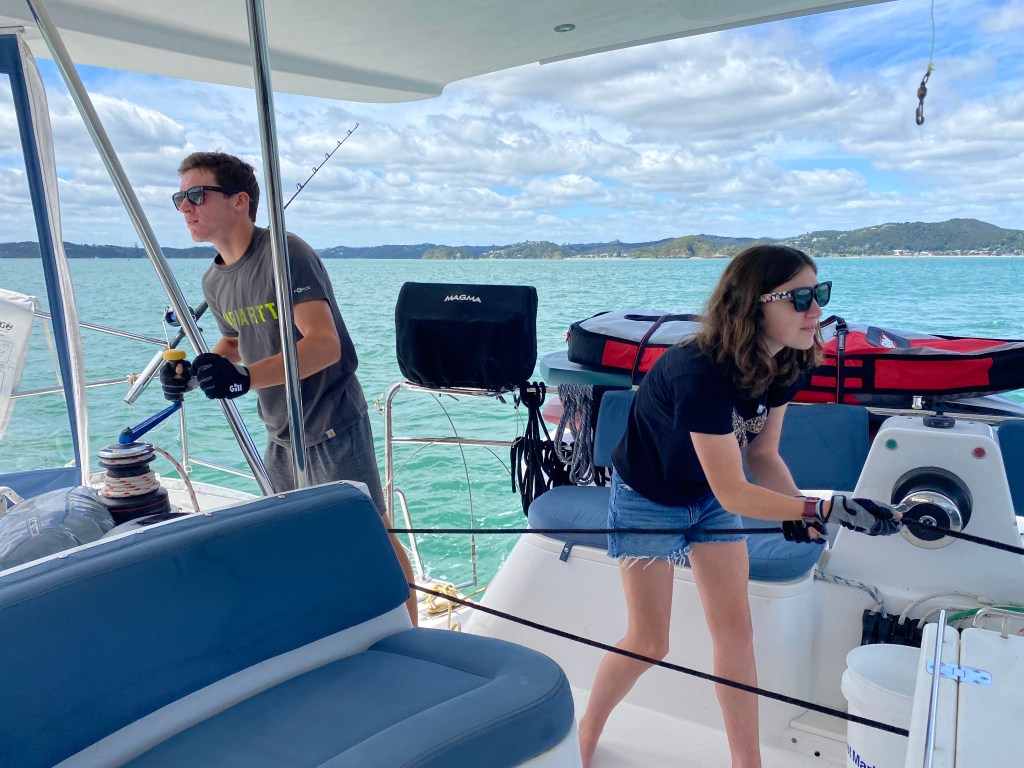
Our planned 9-mile sail turned into a perfect 28-mile downwind sail, too good of sailing with mellow seas to pass up the opportunity to get a bit further south to our goal of Auckland where we’re picking up family for the New Year (yippee!!).
Into Tutukaka Harbour with enough time to head out for woodfired pizza, where I experienced a new favorite pizza called a “green and white” that had slices of lemons, olive oil, feta, chilli flakes, basil, zucchini, red onion, and asparagus.
The holidays can be a bit challenging, as we all tend to experience homesickness…for family, friends, snow, and our cozy Alaskan home. Lately, with our uncertainty we are at a transition. I need to remind myself that wherever we are, there is an ebb and flow to life; best not to jump ship, but just ride it out.
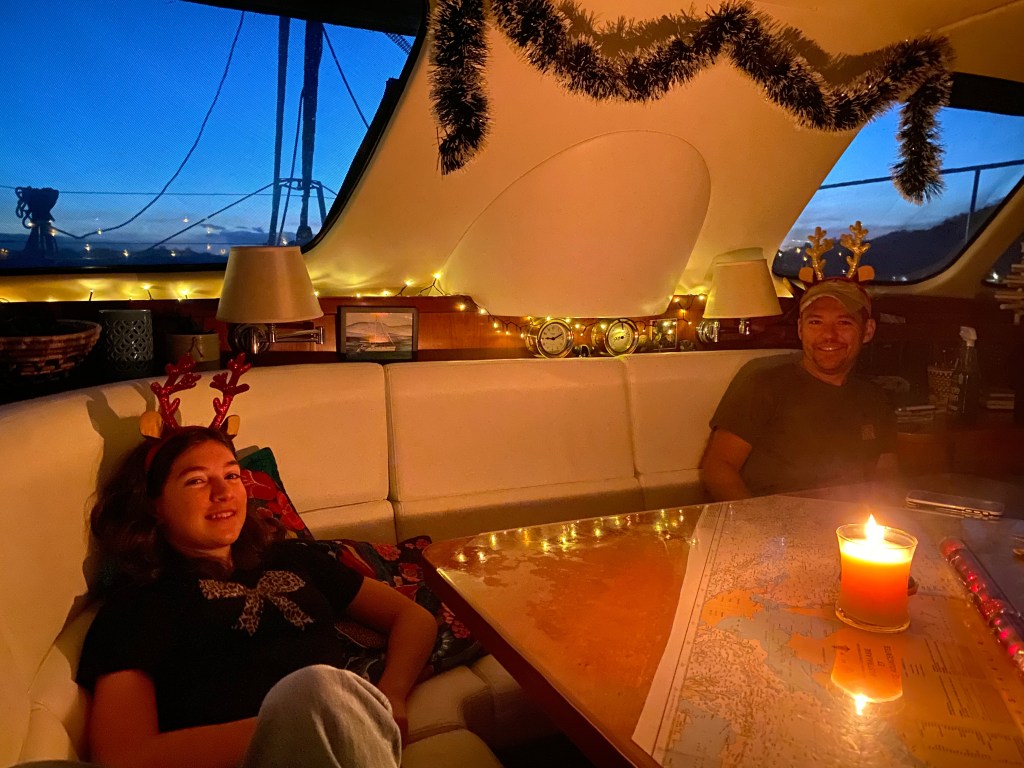
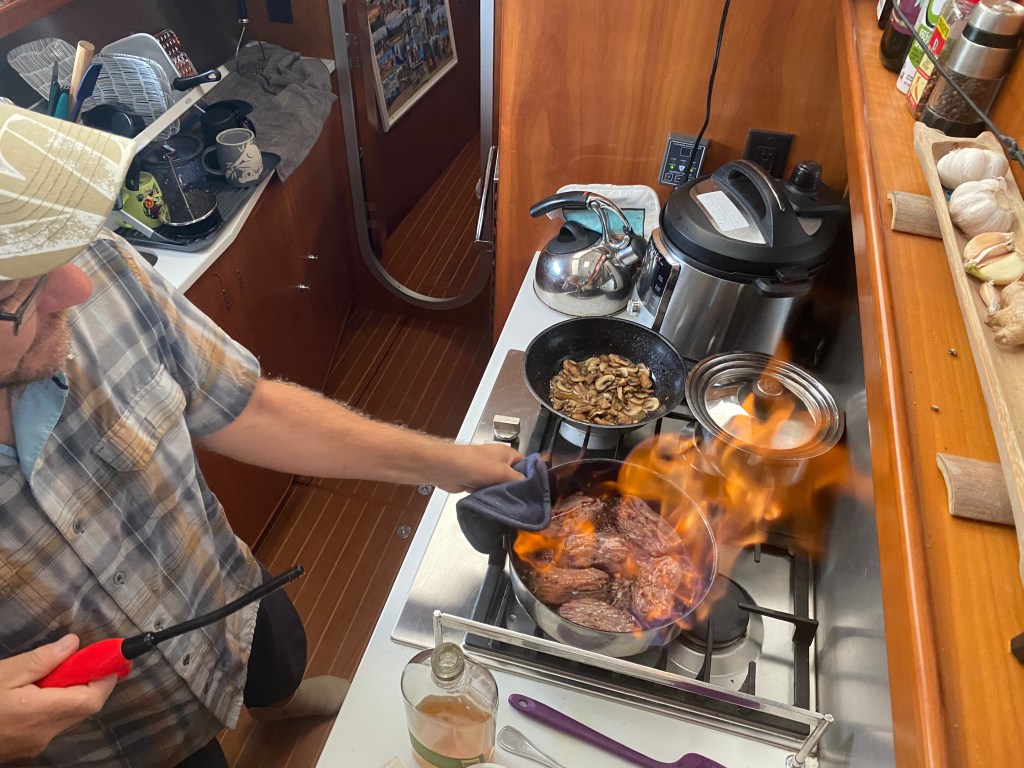
Christmas Eve dinner was peppered lamb steak, the flames rising a bit high for inside our galley (yikes!), followed by Chris and I taking an evening hike with magnificent lighting.
Boat looking so cozy with lights shining, our little puriri tree decorated, stockings hung and gifts wrapped in kiwi paper. Our yearly Christmas ornament tradition this year was a little fantail bird, as well as Cora gifting me a ruru wearing a Santa hat. We made some comical gingerbread men.
Up later on Christmas morning, a highlight for me was the kids helping me prepare a full “Thanksgiving” dinner throughout the day, from sweet potatoes to rolls, stuffing to pumpkin pie. It was quite the spread and made the boat smell good and feel cozy on our drizzly day.

After stuffing ourselves, a break in the rain prompted a wonderful hike out on Tutukaka Head Tracks to the lighthouse.
Up early to get underway south. There are some interesting weather systems about that we’re keeping a close eye on, the biggest predicted up produce 50 knot winds, and we’re looking for a protected nook in which to anchor. Today is a good day to put some miles down sailing (56 miles), as we enter Hauraki Gulf.
 SV Terikah Adventures