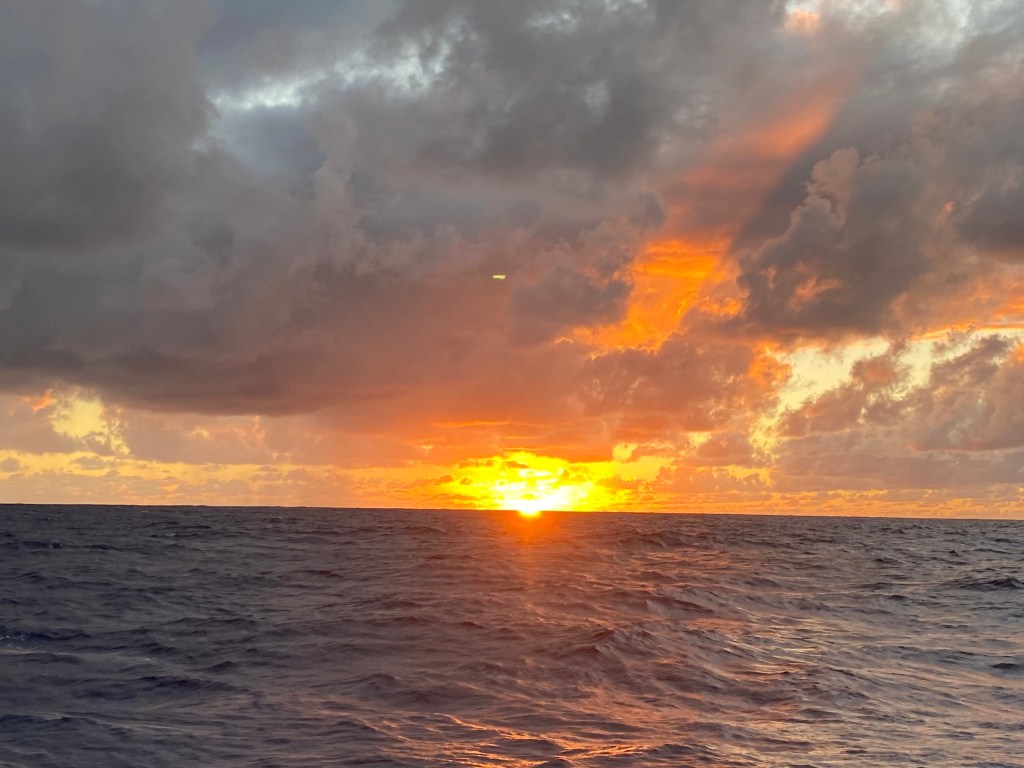
Temperatures rising. 71 degrees F today, long underwear off and barefeet out. Each day increases just a bit.
Needing to top up our batteries, but found that our generator stopped working, as cooling water wasn’t circulating correctly. We ran our boat engine, but this was a very slow and inefficient way to top up batteries. Chris hypothesized that we had barnacles in the intake. He was getting ready to clean it out, but gave it one more try and the water started circulating again; excellent! But it didn’t stay full of water, seemed to be an air lock in the raw water strainer. We “burped” our raw water strainer about every 10 minutes so that it filled with water again and, after an hour, all was working smoothly on its own. Thank goodness it didn’t need more repair out here, as Chris was feeling quite green with his head down in the bilge. We need our batteries charged for autopilot, communications, and refrigeration. We aren’t getting much charge from our solar panels, as they are often blocked by our sails and are covered in salt. It’s unsafe to get up there and clean them off in these conditions.
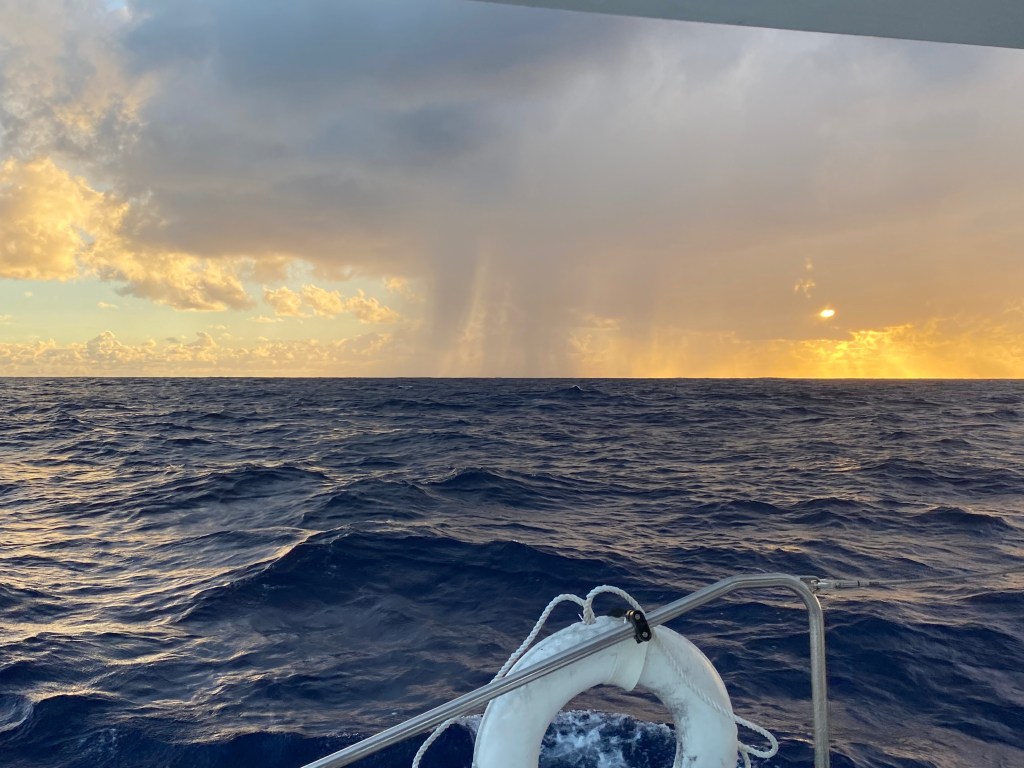
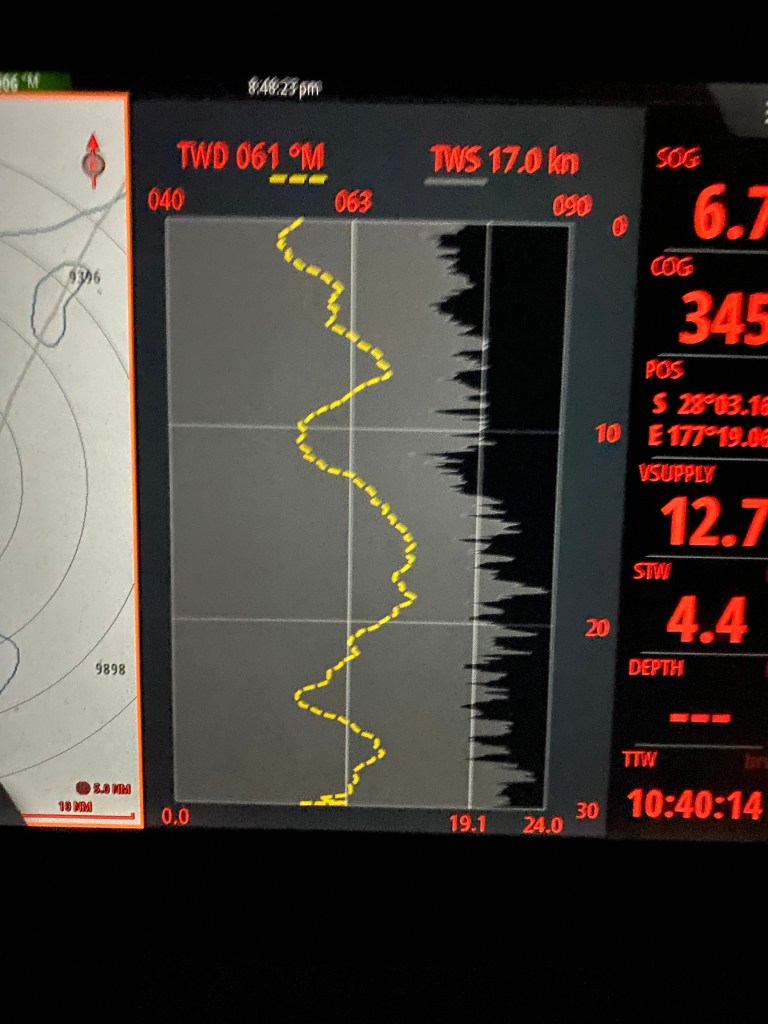
I have to admit that this has not been a “fun passage” thus far. The wind and wave angle makes for constant rolling. And the wind is making quick shifts in direction, keeping us on our toes as the True Wind Direction goes from 45 to 85. Poor Cora has not been able to do any watch shift due to needing to lay down; she’s a trooper and continues to keep us company in the cockpit and is getting plenty of food and fluids in. We find joys in every passage, but this one is challenging; we knew it would be. It feels very safe and the boat is doing wonderfully.
We hit 10,000 nm in SV Terikah as a family! What a milestone!
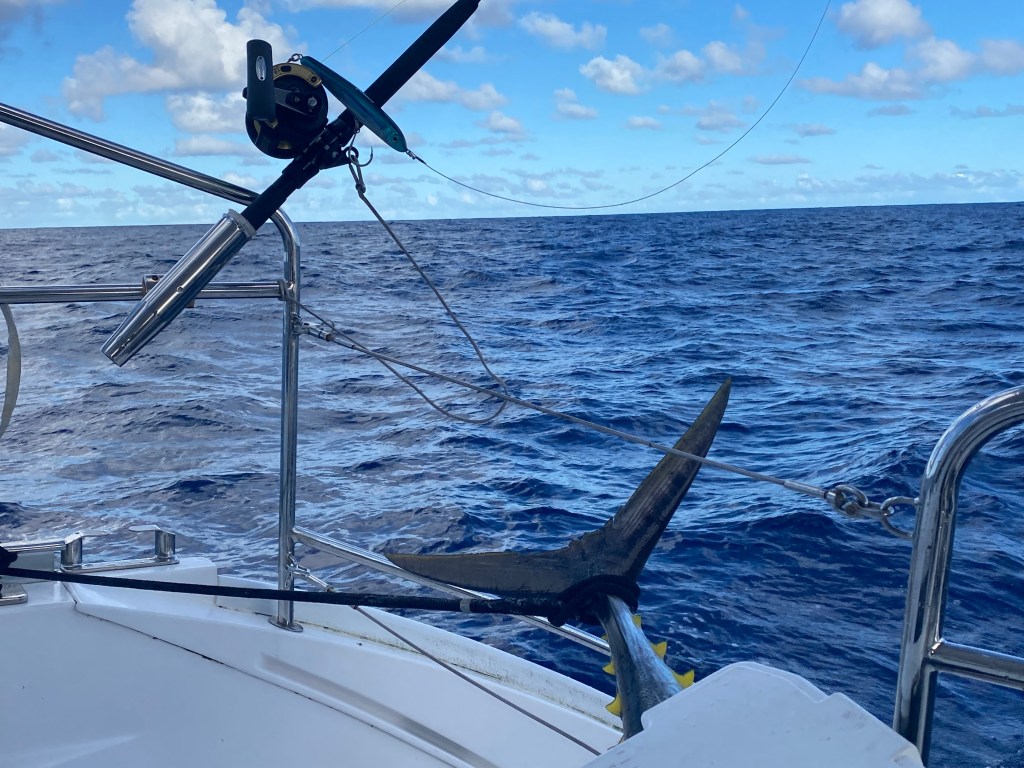
Here’s a story from Calder: Well, the goal was to catch a Wahoo, but hey, I’m not complaining! After catching a nice tuna on day one of the passage, we decided to try to get some white meat fish, such as Wahoo or Mahi Mahi. On Wednesday, a large fish took the lure and spooled out most of the line on the reel before snapping the line, but after getting the big reel rigged up, we were fishing again. On Thursday, trolling two hard aluminum lures designed to withstand violent attacks from big offshore fish and leadered with two meters of 150 kg cable, we were ready. Around 2:00 PM, the reel started its familiar screaming and clicking, and it went on doing that for a good while! Realizing that this was a large fish, the captain took down the mainsail and left just a scrap of Genoa out so we would maintain forward momentum to keep us from wallowing around in the 2 meter seas.
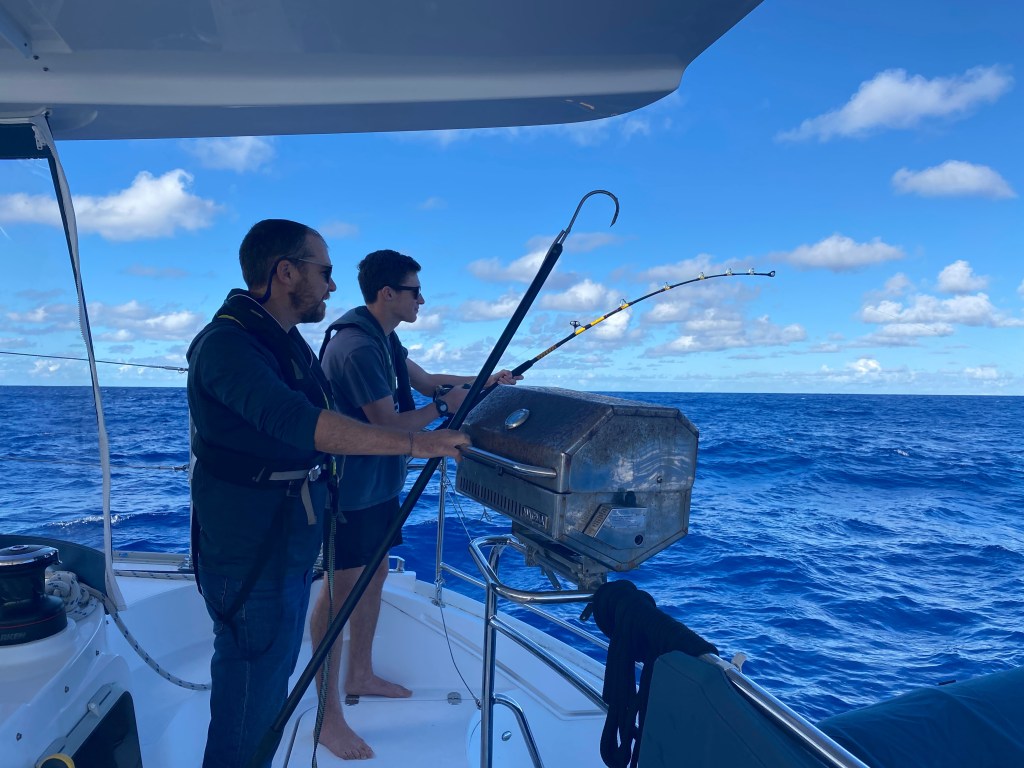
It was a long battle, the fish taking big runs, then me slowly making headway, then another run. It charged the boat once and we thought it was off, but after some fast cranking on the reel, the rod was once again bent towards the ocean off our starboard quarter. 45 minutes to an hour later, we caught our first glimpse of the fish, and decided that we would try to release it, as we already had some tuna onboard, but after a few failed attempts, we came to the conclusion that there was only one choice, and we have our spare freezer empty so the captain took a swing with the gaff. He hooked it on the side of the head, and we soon found out that it was much larger than it had looked next to the boat, with the waves to obscure it. Due to the large seas, wind, weight of the fish, and other effects that the ocean has on a person’s and the boat’s stability, the gaff was too close to the surface of the fish’s body, and after hauling it up the stairs, the gaff ripped out and back into the ocean the huge tuna went. I always set the drag super light after a fish is gaffed for this reason, and the hook did not get ripped out! The tuna, as one would imagine, did not like getting hauled out of the water with a gaff in its head, and dove with everything it had left, which was not enough, and soon the tired fish was back to the swimstep. This time, with the gaff sunk deep and a line tied around its tail, we managed to lift it into the cooler. I put it out of its misery as fast as I could, then thanked the fish and the ocean for the wonderful gift from nature. The fish weighed in at 75 pounds, or 34 kg and was 50 inches, or 127 cm, from nose to fork in the tail. Although this is considered a medium sized Yellowfin Tuna, it was massive by our standards!
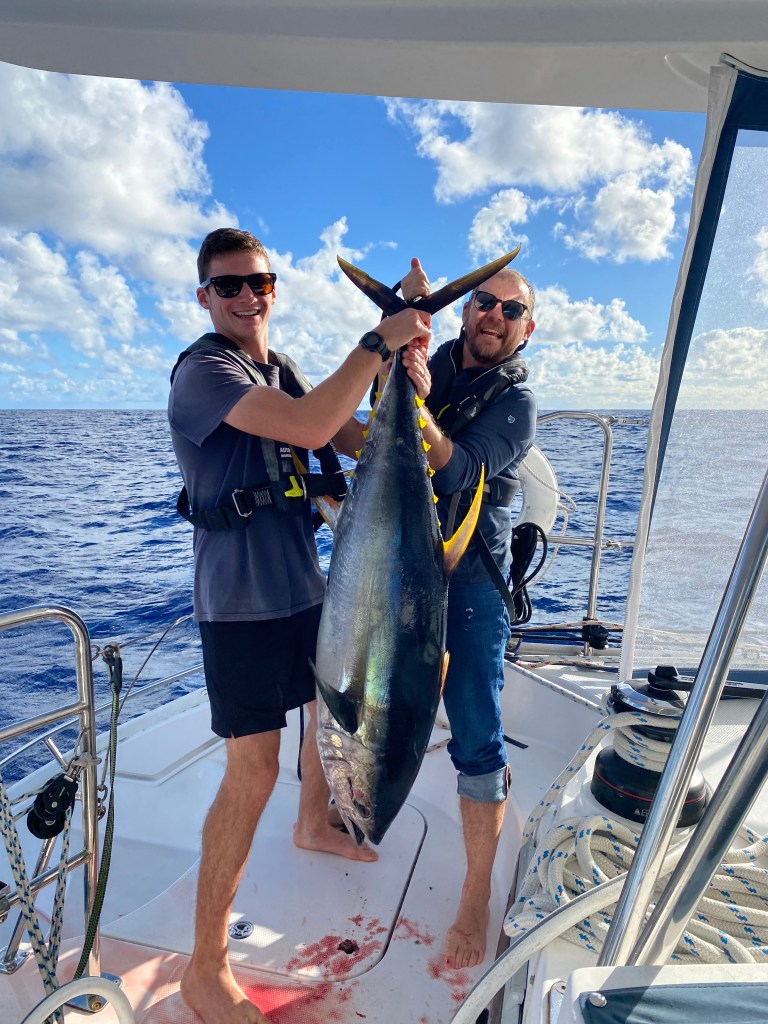
The next two and a half hours were spent filleting, cleaning, and vacuum packing the meat in order for it to get in the spare freezer before it degrades in any way. All of us aboard Terikah are very thankful for this amazing fish and will share it with friends as soon as we arrive in Fiji! This big of a fish also means no more fishing until we have freezer space again, which will likely not be until Fiji, so I may finally have a chance to let my hands stop smelling like tuna, as they have since day one! There are worse problems though, eh? – Calder
 SV Terikah Adventures
4 responses to “Day 4: Passage from NZ to Fiji”
Nice tuna. It must have been fun bringing it in.
LikeLike
What a gorgeous fish! Congratulations! And a lot of work to not only bring it in, but to process it. Sorry it wasn’t a mahi mahi but I’m sure there is one in your near future (as soon as you eat through this delicious monster)!!
Safe travels!
-Patti (former M/V Oz owner)
LikeLike
Wow! Wh
LikeLike
Sentba reply…not sure if you got it…let us know.Love yous
Sent from AOL on Android
LikeLike