Niue – a place I didn’t know existed. Once I learned it existed, a place I desperately wanted to go. Once I learned the weather conditions that needed to be in place to go, a place I thought we’d likely never go. It is a fair weather stop and many cruisers bypass it due to weather. Also, as we have been on a 7-day crossing, when we left Maupihaa we couldn’t be sure of the long-range weather forecast at Niue. However, all factors lined up and, yes, we made it safely to Niue!
The island of Niue is the world’s largest block of coral, covered with underground tunnels and caves, as well as chasms from the force of huge Pacific seas. It is a limestone cap on an extinct volcano, an elevated island on 20-meter-high cliffs, 100 square miles in size. There are no natural harbors and boats tie up to a mooring ball in a small indent on the west side outside the town of Alofi (the capital), with shelter from prevailing winds. Ocean swell is forever present. If there is any west wind or west swell, boaters are advised to leave at once – either to proceed to Tonga or tuck around the other side of the island and wait out the weather (no place to anchor).
The population is around 1,600 Niueans and have a free association with New Zealand, which means they have New Zealand citizenship with internal self-government. As Niueans have the right to work and settle in New Zealand, there has been a steady drain to NZ with more of the islanders living there than on Niue itself. They speak Niuean (a Polynesian language), as well as English.
Niue is a whale sanctuary, currently calving from the cold waters of Antarctica, and the whales are regularly around the moored boats. It is also the world’s first “Dark Sky Nation,” meeting specific criteria for lighting and sky visibility.
Upon arrival in the dark last night, we had set up a time of 10am to check into the country on the wharf. The dinghy dock is an experience in itself. As there is constant swell here, they have set up a crane system where you hoist your dinghy out of the water onto the dock then park it for the day. Getting close to the dock, the swell pulling the boat out and surging in, all except Chris scurried up the ladder. We lowered the giant hook down to him, which he attached on a bridle on our dinghy.
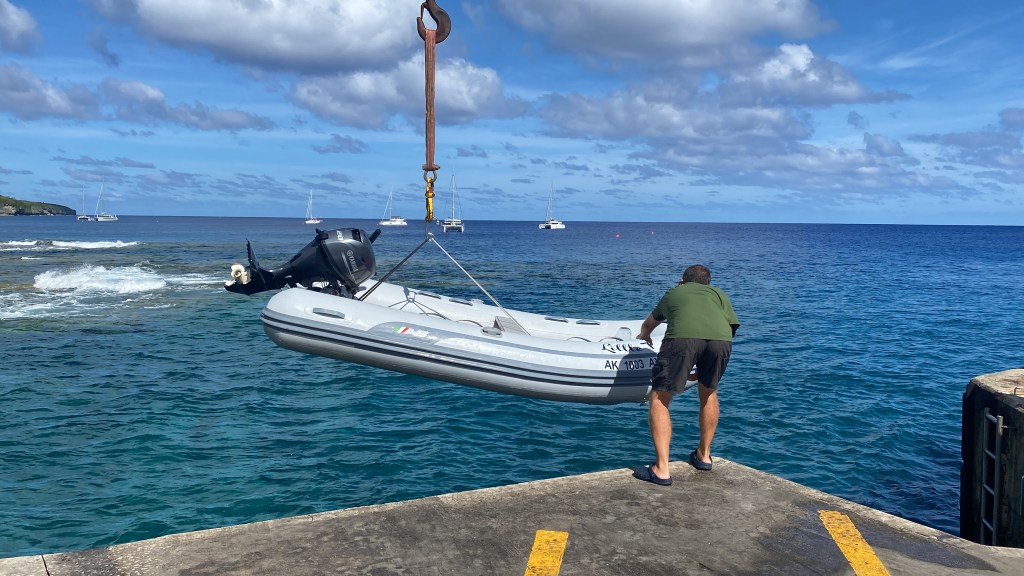
He then climbed out and we used the crane to lift Little T into the air. We parked her in a dinghy parking spot next to our friend’s dinghy and put the crane back into position for the next boat.

I can see how this would be more challenging in bigger surge and completely impossible in large swell.
On the dock, we met with the very friendly people from Customs, Immigration, and Biosecurity. We filled out paperwork, turned in our French Polynesia exit papers, and had our passports stamped right there on the dock out of the back of their vehicles. The stamp specifies “Sea Vessel” and has a picture of the island with a sailboat inside it. So easy!
We had set up a car rental and there it was, parked on the dock, keys inside. This is our first experience with the driver’s wheel on the right, driving on the left side of the road. We kept having to say, “Left!” to Chris with oncoming traffic to remind him to overcome conditioning and go left on the narrow roads.

Niue has striking limestone formations, secluded swimming coves, caves, and chasms to explore. We started with Togo Chasm – a walk through an ancient coral-studded rainforest with massive spiders in webs stretched between trees.

It opened up to an other-worldly landscape of limestone razor-sharp pinnacles, a cemented path winding through to a vertical 28 rung ladder into a surreal oasis below with mature coconut palms.
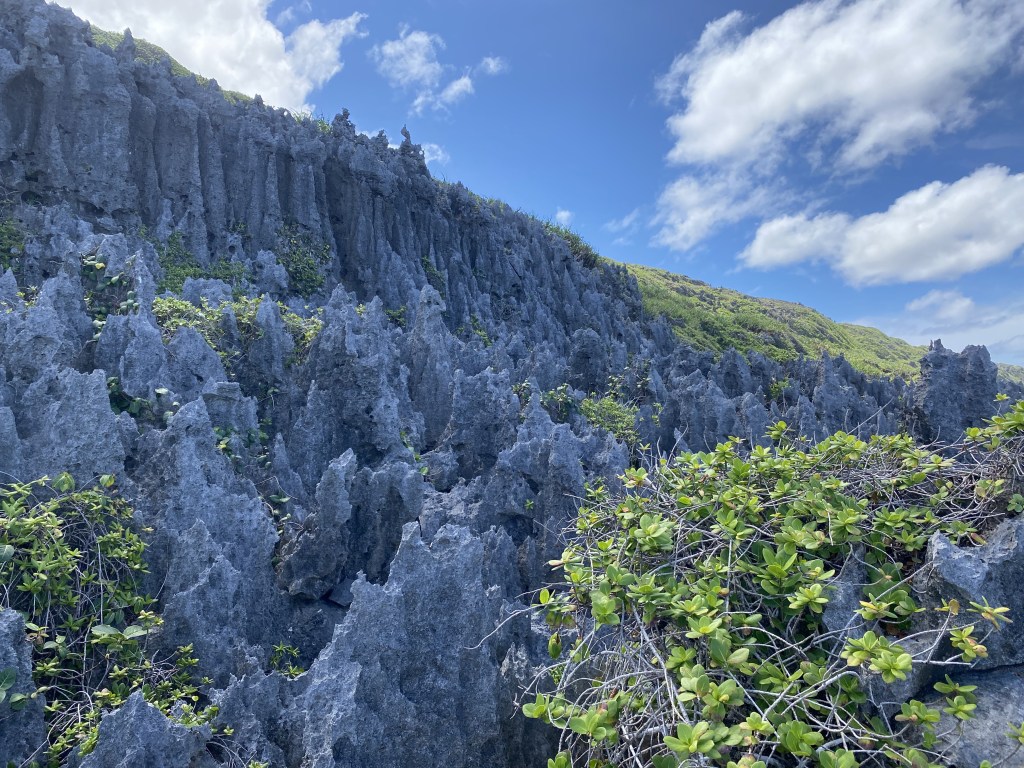

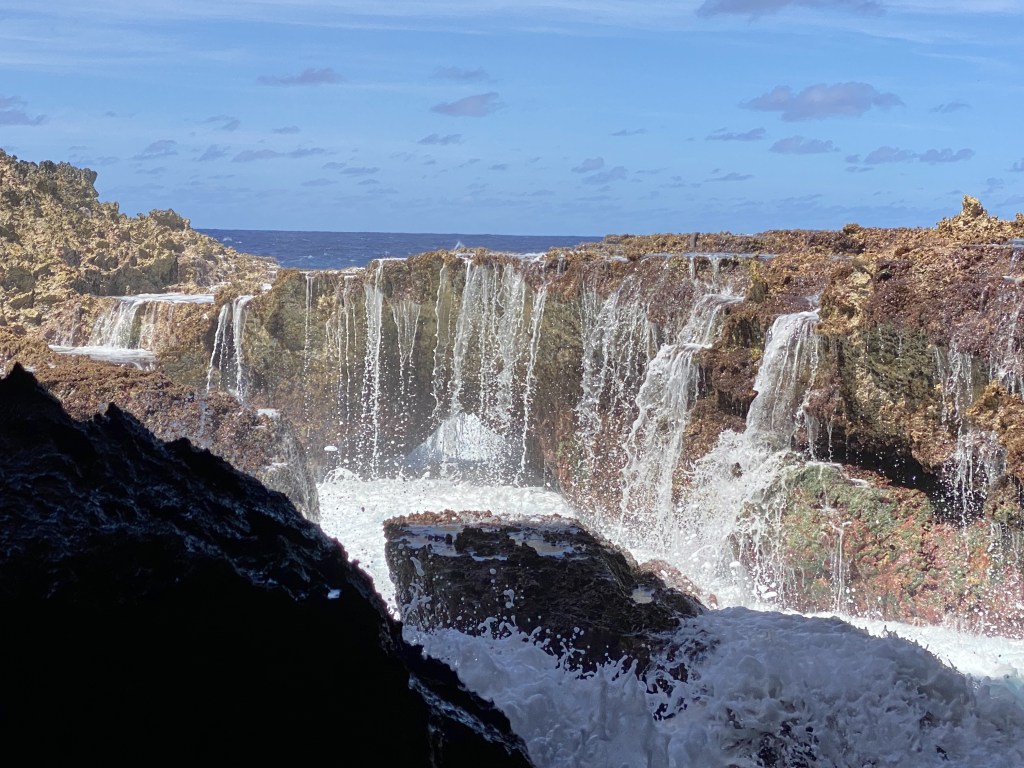
A further scramble led to a primeval swamp, that was actually a swimming pool before it was sealed off by Cyclone Heta in 2004. We clambered through a cave to a natural bridge and pool awash with ocean waves, one moment where a series of 3 large waves splashed in and I found myself clutched to a rock with water afroth all around.
Next, on to Anapala Chasm, where we walked 155 steps down between a cleft of limestone cliffs to reach a narrow freshwater pool in the dark. The water from Anapala was used for anointing past royalty. We couldn’t resist jumping in to swim single file to the other side, a narrow slit where your feet would occasionally touch the sides, but very deep and dark.
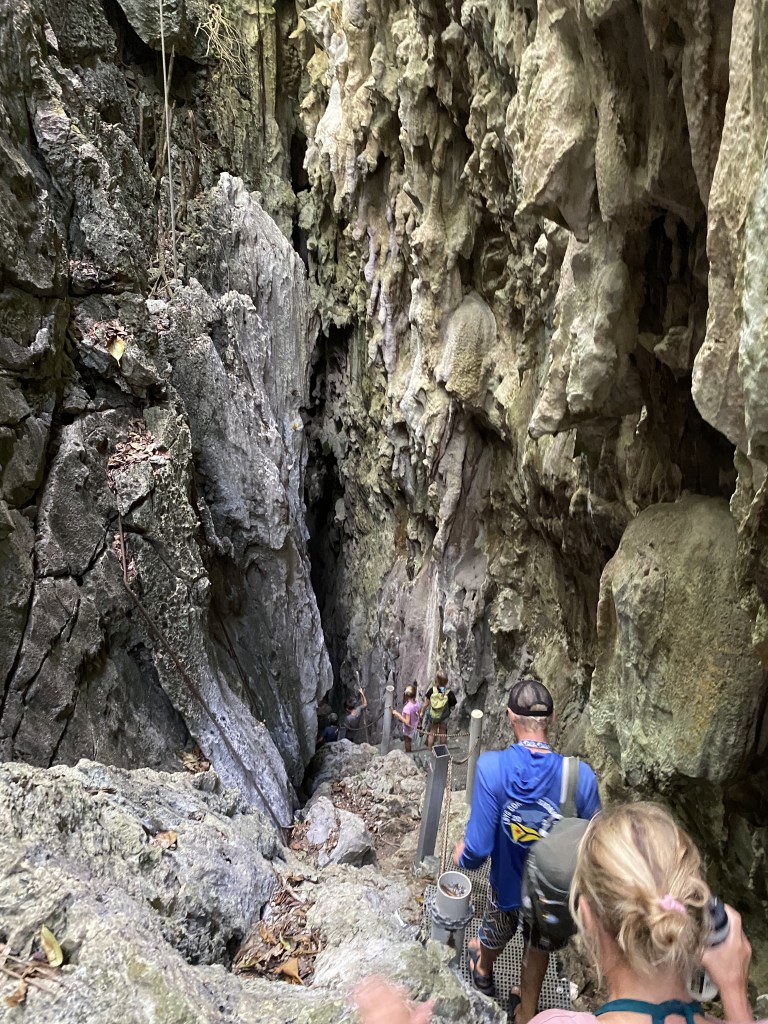
Finally, we stopped at Tuhia along the wild and exposed east coast, where Penny and I took a dip in the small rock pool with reef fish until a larger wave coaxed us out.

The coastline here is vicious row upon row of jagged teeth of coral for miles.
We got our NYC (Niue Yacht Club) flag and had a drink at the headquarters of “The Biggest, Little Yacht Club in the World.”

At night, the smell of sweet air, the sound of whales, a sky of stars.
The next day, we had a convoy of rental cars from boating families head north on the paved road; the roads interestingly updated and maintained by Chinese who are here with expanding diplomatic relations with Niue. At Palaha Cave, we were amazed how the island continues to surprise us, walking through a giant arched roof sea cave with melting stalagmites and stalactites all around. The freedom to simply explore these sites – no entrance fee, no walkways, no rules – is refreshing.

At the Matapa Chasm, we dove in for a royal bath, the top layer cold fresh water, deeper to the warm sea water. I floated on my back, looking up between limestone walls to the sky.

A meander through coral-lined trails and through more caves led to the Talava Arches, a massive sea arch with surrounding crystal-clear turquoise waters alive with healthy coral and fish.
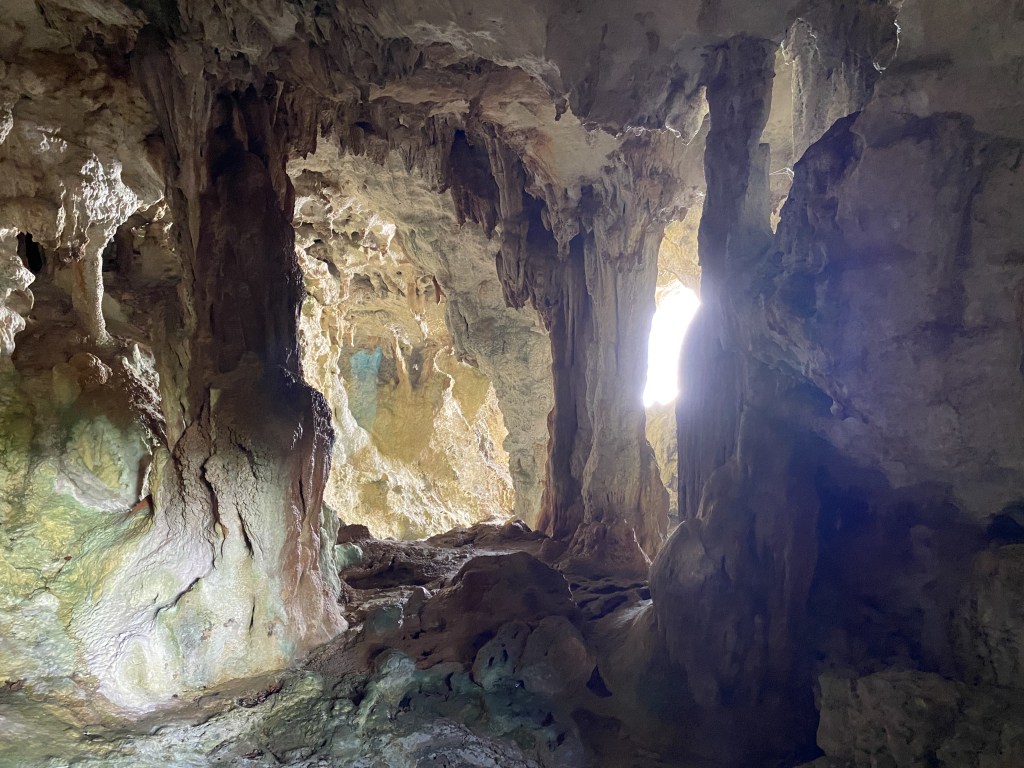

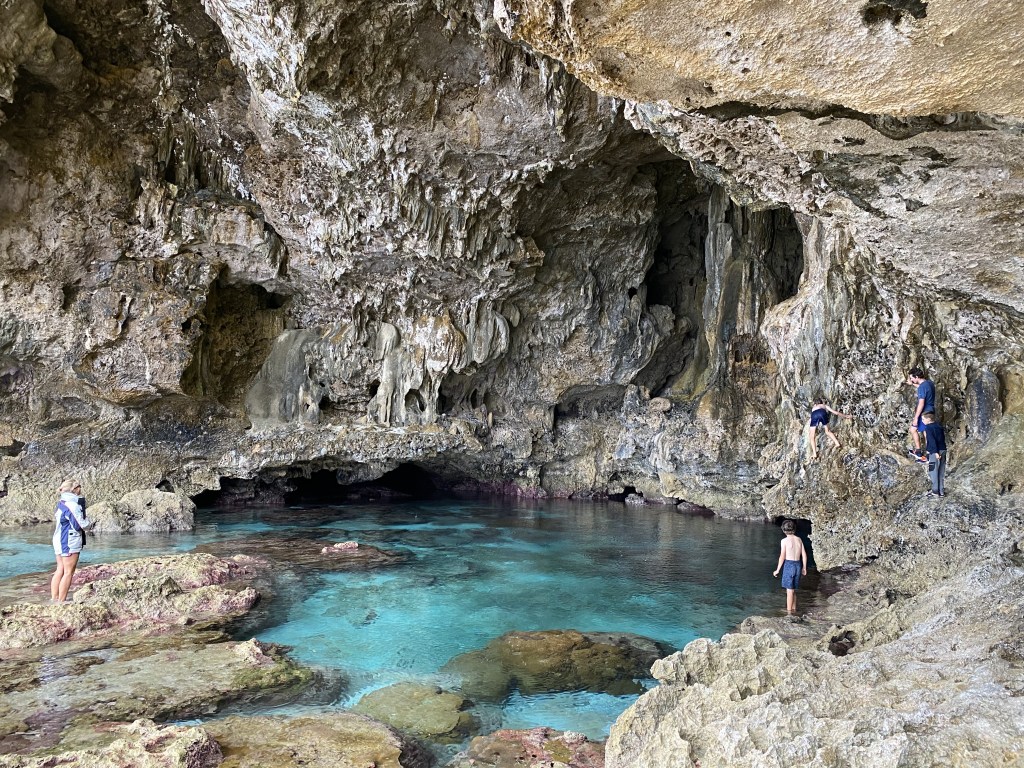
The kids like to wander off, bushwhacking to other small caves in the limestone hills. We swam in iridescent blues in the Limu pools.

Food here has also brought much pleasure, as we’ve been with minimal fresh produce! At the grocery store, I may have squealed when I found a head of lettuce and a 2 kg block of cheddar cheese; I’m a happy girl. One young cruising girl was eating her bouquet of lettuce as she walked around the store.
One of the greatest sites to behold – 7 cruising families who have not had fresh produce or much food variety in over 6 weeks go to a traditional Niuen buffet. Even the little kids loaded their plates with salad, freshly spit-roasted pig, fish, a variety of meats; really, a little bit of everything. A group of local youth from one of the island towns put on a show, which ended up with a handful of us in front dancing. A front is moving in and we were lucky to get back to the boat just as it started to drizzle.
When life gives you tons of rain, it’s time to open our onboard catchment system and take “long” freshwater showers. This is an excellent anchorage for the predominant wind direction. We heard about other cruisers trying to get out of massive 40 knot winds and seas, feeling absurdly blessed in our little anchorage.
Ventured out the next day in the drizzle. After going to a “legit” coffee shop, we proceeded out the road and took the “Bush road” which had many turns and choices, through forests and taro fields; we used our compass to make sure we were heading the correct direction. A funny sign warned us: “Eye am wacthing you.”

Met the other families at Uluvehi and walked to a canoe cave, watching massive waves break on the shore. At Namukulu Boat Ramp we were intrigued by the infrastructure of getting boats into the water here on this unforgiving coastline. A short walk through Avaki Cave’s drip formations led to an ancestral kings private bathing cave at low tide, where Calder worked on his flips into the turquoise waters.
We joined locals at the North vs South Niue rugby game in the rain, the first time our family has witnessed the crazy action of this full contact sport.

On Sunday, when the seas wrapped around the island, we escaped the rolly anchorage and hiked the Vinivini Bush Track rainforest (which we renamed Aragog’s hike due to all the massive spiders). Next, our guidebook said “drive around the edge of the village green,” but the uprooted sign pointed directly across the village green; a friendly local waved us to drive across the field in front of the houses to the road that led to the Tautu look out, where we watched the ocean swell pound against the reef and fill up the cavern below.
That evening, around 10pm, we heard the sound of whale’s breathing. Outside we went and 3 humpback whales came right over to our boat, 2 adults and 1 calf. The large whale moved closer and closer until he was actually touching our boat, spraying us. What a gift, both a tad anxiety-producing, but mostly spectacular.
The waters in Niue are known for their clarify with up to 80 meters visibility and we decided to sign up for a snorkel with Niue Blue. It was overwhelming to first dip into the water, seeing a coral forest and structures laid out all around us.

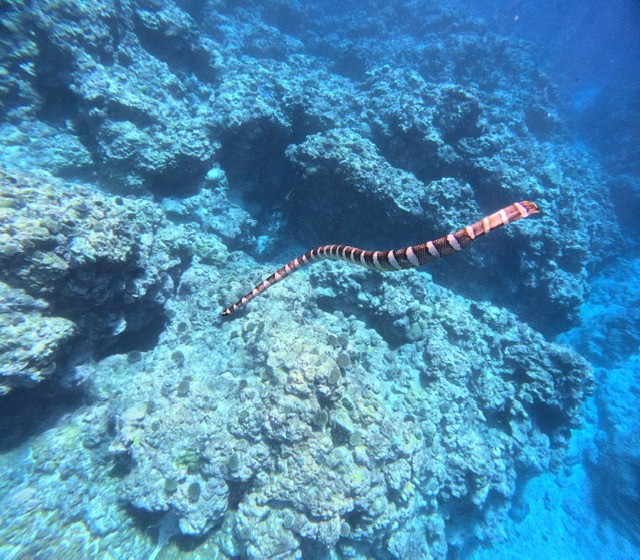
The swell would gently lift us up and down as we floated over the ocean floor. At one point, a pod of about 40 spinner dolphins swam under me. I was a bit nervous about the famous Niue water snakes. The katuali or flat-tail sea snake is a species of venomous sea snake, found only in the waters of Niue. They grow to a total length (including tail) of up to 1 m (3.3 ft), and are highly venomous, making it one of the most potentially dangerous creatures on the planet. These snakes are said to be more poisonous than a cobra. With a small mouth and fangs at the back of their throats, they can dislocate their lower jaw to bite. But they are not interested in us and cannot open their mouths wide enough to bite us. I saw one almost immediately, as it swam up from a crevice on the ocean floor to the air to take a breath, then back down it went. Soon, I was seeing them everywhere, so graceful and not at all scary. One came up behind me and Calder saw him “lick” my flipper. So thankful that we were able to explore the inner lagoon pools, as well as on the outside reef, two very different experiences.
Clearing out of Niue was easy as well, taking about 15 minutes and costing the equivalent of about $240 US dollars for our boat, all of us, and biosecurity fees. Every country we visit has a different fee structure, some paying up front and others at departure. We cast off from our mooring ball, announced our departure to Niue Radio, and off we left for Tonga, about a 2 day passage.
 SV Terikah Adventures
3 responses to “Magnificent Niue”
The Limu pools are beautiful !
Love to you ❤️ Aunt Lyn
LikeLike
Yes, those pools were amazing to swim in. This world is a remarkable place full of wonders. Love you too!
LikeLike
Wow! Just, WOW! What an otherworldly place. Beautiful and amazing. Thanks for sharing.
LikeLiked by 1 person