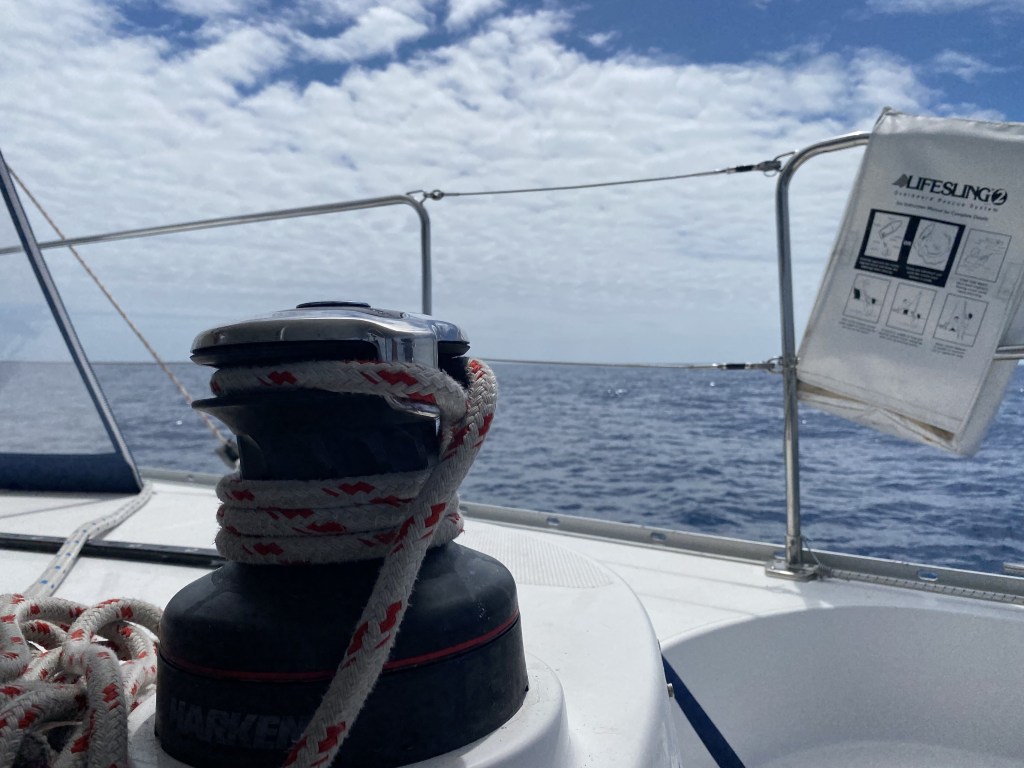
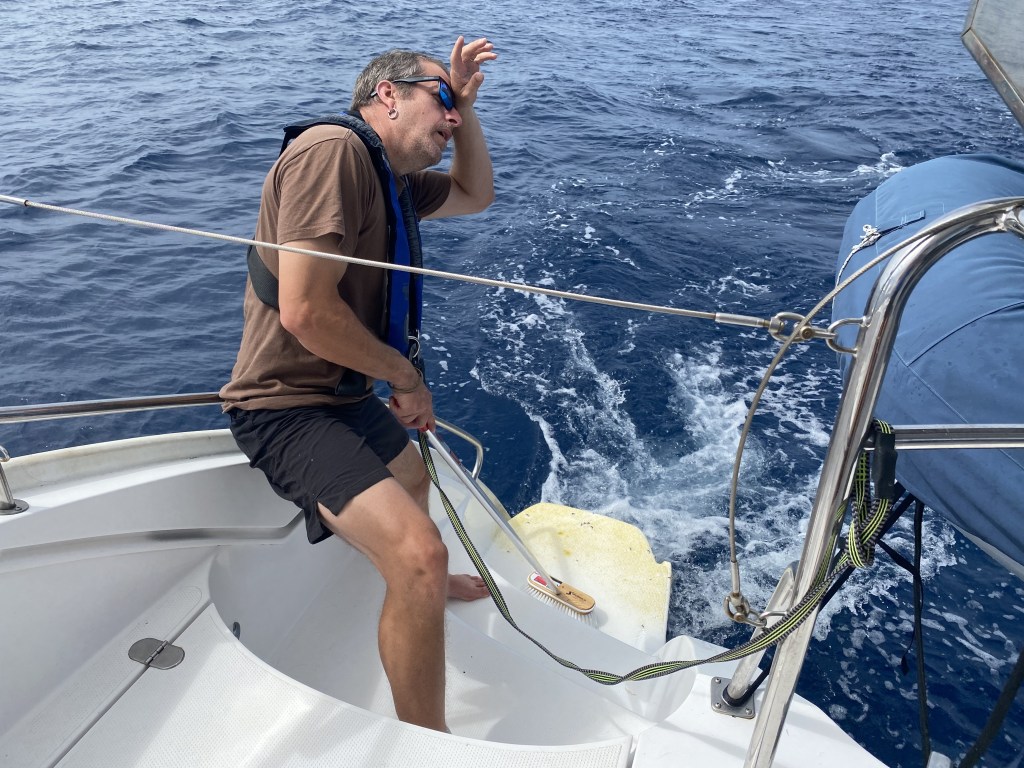
This morning, continued on our same course, making great progress with winds 15 and 1.5 knots current. In the afternoon, winds decreased, sailing with our Code 0 and Main, still able to maintain speed above 5 knots with Equatorial Current our friend. Seas calming, ahhh…feels lovely as we slowly move along. Emil cleaned the barnacles and clams off the swimstep and enjoyed a “sit” in the ocean.
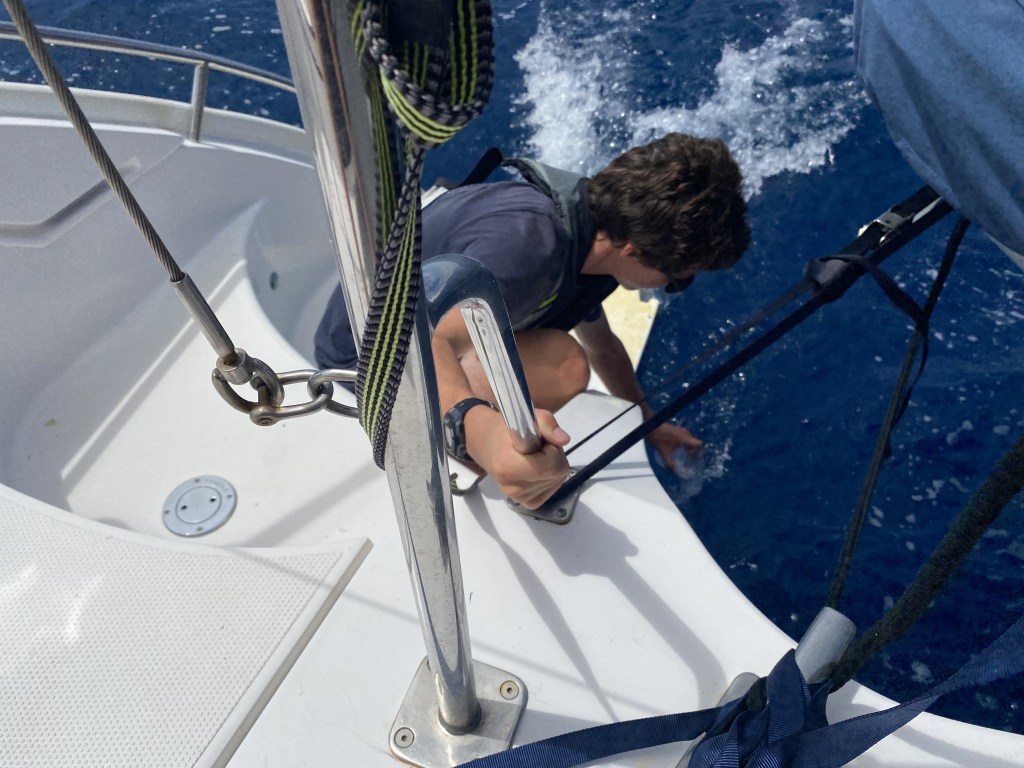
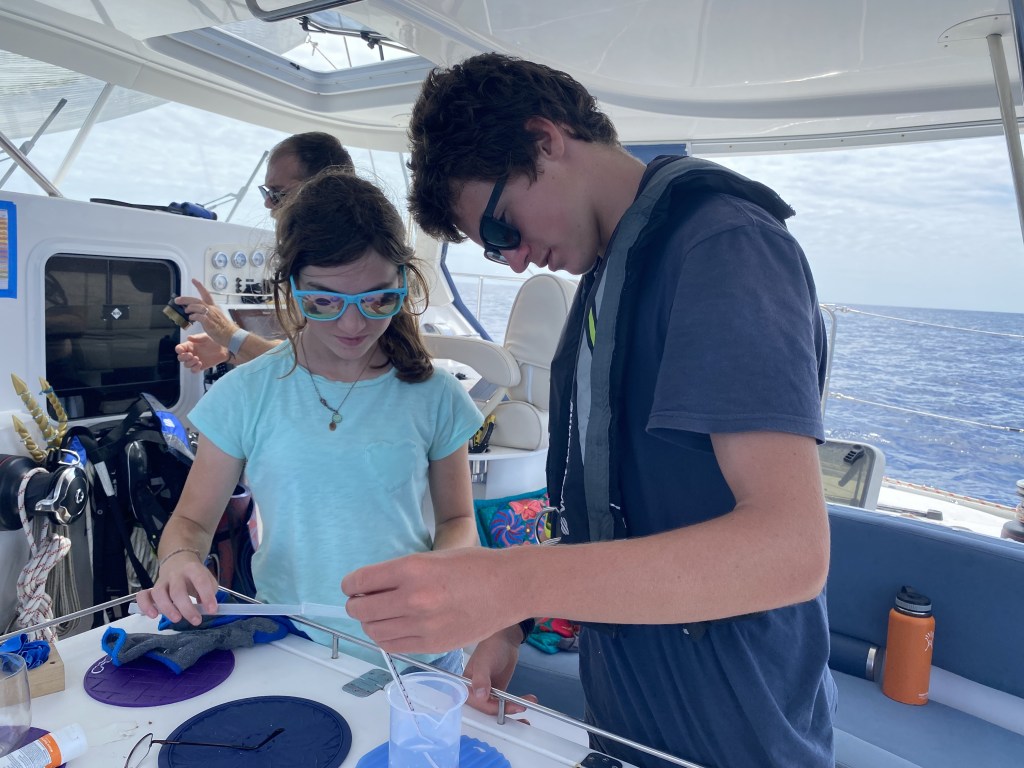
The kids did their “homework” by answering questions from Petersburg John: “Our fathometer is not strong enough to find the bottom because it is so deep. Our chart’s contour lines tells us that it is 14,508 feet deep. It’s crazy to think of how deep the water is out here in the middle of the ocean. The ocean currents around us at the moment are 1 plus knot and are flowing southwest. We are riding in the Equatorial Current. The air is 27-29 degrees Celsius and the water is also 27-29 degrees Celsius. We learned that the Coriolis Effect is a real thing, but a myth about the toilet bowl water changing direction in the Southern Hemisphere.”
I changed our waypoint, usually just a few hundred miles away and a small portion of our trip, to our destination of Hiva Oa… and the countdown begins.
Every night of this trip we’ve had a cooked dinner. I’m surprised and proud of this accomplishment. We have never been too seasick to eat and, between all of us, we’ve prepped and cooked a delicious dinner.
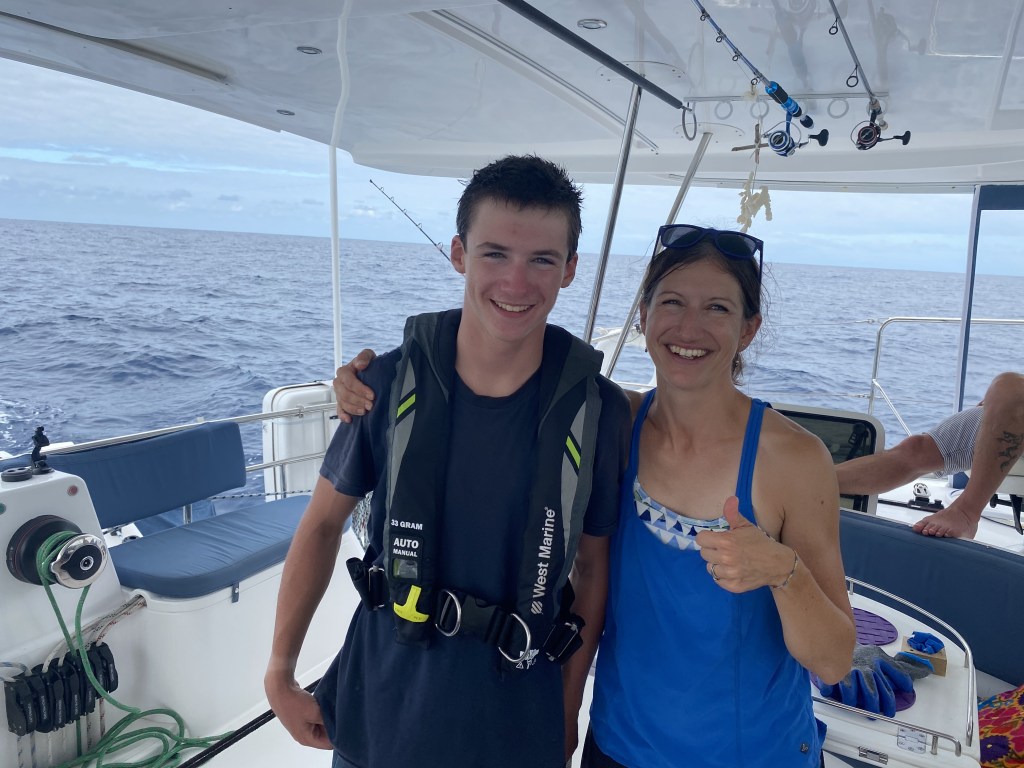
The calm of the night was interrupted in the wee hours of morning…
Crew Emil’s account of the night’s events:
I love a rainy night.
Part and parcel of navigating the tropics is squall avoidance, so whenever clouds appear we glare at them, and whenever they appear as blotches of various colors on the radar we dodge, as much as one can dodge at four knots anyway. Last night we dodged like our Petersburg high school basketball team in the finals and in the end piled right into a slow-moving line of squalls that kept us hopping for nearly four hours.
It started on the night watch just after 4am, with a few spots on the radar ahead. We had the main up and one motor going, so we woke the captain, dropped the sail and steered to port. For a while it worked, and we split two fierce looking squalls, but by 5 we were in the thick of it. We closed all the hatches and just stared at the radar in the dark. Lightning flashed to starboard, the wind rose, a squall seemingly materialized right above us and began spitting sideways rain. We kept turning more to port, away from the lighting but never seemed to make any progress as the radar signal just kept blossoming ahead of us. Twice we turned completely in a circle lured by gaps in the radar image before realizing that we were right in the middle of it and there was no way out. We picked a reasonable bearing away from lighting and dove in, emerging hours later unscathed (and perhaps cleaner) into a few gaps and eventually into the clear.
The fear of course isn’t really the rain, but the lightning, as we’re moving along waving a giant metal pole and there’s not a tree in sight to hide under. Lighting strikes, while rare, can have devastating consequences to sailboats, specifically their onboard electronics – our computer and other portable devices get stuck in the microwave for the duration, but the main navigation station and autopilot are fixed on and so very vulnerable and necessary. The mantra is straightforward – avoid – easy to say, straightforward to understand, awful in practice when you once again realize how small we are in a large ocean and how slow and ineffective our maneuverings seem.
In the end we passed through the rain, the winds dropped, the barometer climbed back up millibar by millibar, the seas sorted themselves out and the sky grew grey and then light. The fierce dark clouds of night gave way to a mixed and patchy sky. We made some coffee, toweled off the seats, found our bearing again and continued on with the day, with breakfast, with naps for the tired crew, and improved weather – we’re not there yet, but we’re still moving along.
Total miles over the last 24 hours: 128 nm
Average speed in last 24 hours: 5.3 nm
Total miles of trip so far: 2,248 nm
 SV Terikah Adventures
One response to “Day 18: Pacific Crossing to French Polynesia”
My admiration for you all just continues to grow! and so delighted to follow your journey, day by day! thank you for sharing!!
LikeLike